 World
World
Foreign Minister calls for enhancing Việt Nam – RoK cooperation effectiveness
1.
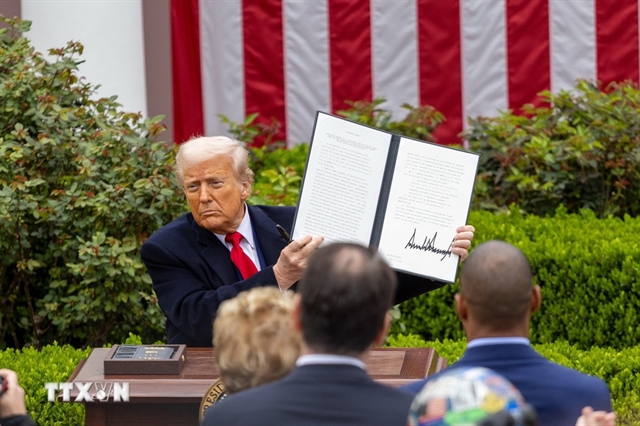 |
| US President Donald Trump signs an executive order imposing new reciprocal tariffs at the White House on April 2, 2025.— XINHUA/VNA Photo |
1. US reciprocal tariffs heighten global trade tensions
On April 2, US President Donald Trump announced the imposition of reciprocal tariffs ranging from 10 to 49 per cent on most imported goods in a move to protect domestic production. The decision upended the global trading order, disrupted supply chains and pushed gold prices to record highs. Economies worldwide were forced to adjust policies and accelerate negotiations to secure trade agreements. Amid the escalating tariff war, US-China trade tensions reached their most serious level since 2018.
 |
| People evacuated to avoid border conflict between Cambodia and Thailand spend the night at the Chang International Trade Centre in Buriram Province, Thailand, on July 24, 2025.— Anadolu Agency/VNA Photo |
2. Escalation of the Thailand-Cambodia border conflict
Tensions along the Thailand-Cambodia border “flared” following clashes between the two countries’ armed forces on the morning of May 28, severely affecting bilateral relations and regional stability. ASEAN and the international community pressed for a diplomatic solution, leading to the signing of a peace agreement that established joint patrol mechanisms, border security coordination and commitments to enhanced bilateral dialogue. However, the agreement was breached on multiple occasions. Experts warn of the agreement’s fragility given the long history of conflict between the two neighbours.
 |
| The US Capitol building in Washington, D.C. — XINHUA/VNA Photo |
3. Global economic growth estimated at 3.2 per cent
The International Monetary Fund (IMF) and the Organisation for Economic Co-operation and Development (OECD) projected global economic growth of around 3.2 per cent in 2025, underscoring the resilience of many economies despite the global tariff war, conflicts in multiple regions and a prolonged shutdown of the US Government.
Throughout the year, gold, crude oil and stock markets experienced sharp volatility, with gold hitting a historic high of US$4,503.30 per ounce in the December 23 trading session.
 |
| Delegates pose for a group photo at the AI Summit in Paris, France, on February 11, 2025. — XINHUA/VNA Photo |
4. Artificial intelligence emerges as a new front in global competition
The race in artificial intelligence (AI) intensified as technology companies rolled out low-cost and generative AI models, profoundly reshaping the structure, scale and distribution of labour worldwide. AI has evolved beyond a technological tool into a new geopolitical battleground, where technological prowess translates into strategic advantage.
At the AI Summit held in Paris, France, in February 2025, 61 countries adopted a joint declaration calling for AI that is “open, inclusive and ethical”.
 |
| Buildings in Bat Yam, Israel, were damaged after an Iranian missile attack.— XINHUA/VNA Photo |
5. Comprehensive escalation of conflict in the Middle East
The Middle East saw a sweeping escalation of conflicts, culminating in 12 days of mutual air strikes between Israel and Iran from June 13 to 24, followed by Israeli air raids on Qatar and the spread of tensions to Lebanon and Yemen. Despite diplomatic efforts that resulted in a ceasefire agreement and hostage exchanges between Israel and Hamas, the peace process remains fragile and prone to collapse amid strategic calculations and deep mistrust among the parties involved.
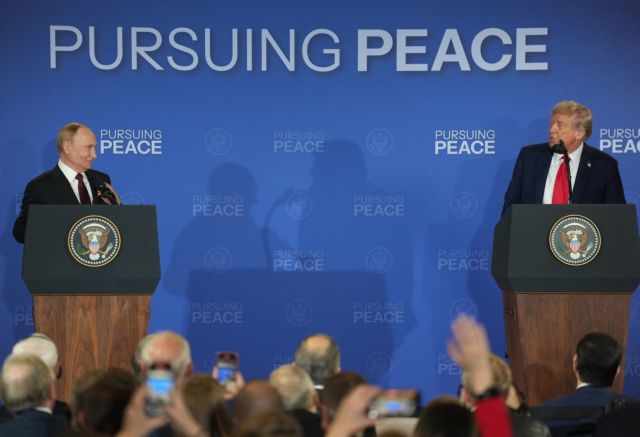 |
| US President Donald Trump (right) and Russian President Vladimir Putin at a joint press conference after talks in Alaska, US, on August 15, 2025. — XINHUA/VNA Photo |
6. Diplomatic efforts stepped up to end the Russia-Ukraine conflict
Diplomatic initiatives to bring an end to the Russia-Ukraine conflict gathered pace, with the United States and Europe putting forward peace proposals. US President Donald Trump held separate meetings with Russian President Vladimir Putin and Ukrainian President Volodymyr Zelensky, but failed to broker direct talks between the leaders of Russia and Ukraine. Meanwhile, the conflict continued in new forms, inflicting heavy losses on both sides.
 |
| Scenes of devastation after the earthquake in Mandalay, Myanmar, on April 1, 2025. — XINHUA/VNA Photo |
7. A record year of natural disasters worldwide
Climate change reached unprecedented extremes, triggering severe natural disasters across the globe, including earthquakes in Myanmar; super typhoons and floods in many Asian countries and the Caribbean; and wildfires in Greece, Canada, the United States and Australia. These disasters claimed thousands of lives, disrupted the livelihoods of millions and caused economic losses estimated at US$220 billion. Against this backdrop, the 30th Conference of the Parties to the UN Framework Convention on Climate Change (COP30), held in Brazil, failed to reach an agreement on fossil fuel cuts, highlighting the need for stronger global action to curb global warming.
 |
| On May 9, 2025, a magnificent parade commemorating the 80th anniversary of Victory Day (May 9, 1945 - May 9, 2025) in the Great Patriotic War takes place on Red Square in Moscow and many other locations across Russia. — XINHUA/VNA Photo |
8. 80th anniversary of the victory over fascism commemorated
Russia, China and numerous countries around the world marked the 80th anniversary of the Victory over Fascism with major commemorative events, including military parades in Moscow’s Red Square and Beijing’s Tiananmen Square. The anniversary recalled a historic victory achieved at immense human cost, underscoring the decisive role of the Soviet army and people, and conveyed a powerful message of shared global responsibility to prevent extremism and neo-fascism, and to strive for a peaceful, stable and sustainable world.
 |
| Prime Minister of Timor-Leste, Kay Rala Xanana Gusmao (fifth, left), after signing the Declaration on the Admission of Timor-Leste to ASEAN at the opening ceremony of the 47th ASEAN Summit. — Bernama/VNA Photo |
9. ASEAN admits Timor-Leste as its 11th member
Timor-Leste’s official accession to ASEAN on October 26 marked a significant milestone, reaffirming the bloc’s determination to strengthen internal unity and expand regional cooperation. The move reflected ASEAN’s commitment to building an inclusive Community in which no Southeast Asian nation is left behind, while providing fresh momentum for enhanced coordination in addressing regional and global challenges.
 |
| Three-year-old Oliver Chu was born with a rare, genetic condition called Hunter syndrome. Photo courtesy of Chu Family |
10. Breakthroughs in gene therapy offer hope for patients with incurable diseases
Doctors in the United Kingdom successfully treated Hunter syndrome, a rare genetic disorder, in a three-year-old child using advanced gene therapy. The UK’s National Health Service also began the widespread adoption of Casgevy, a CRISPR-based gene-editing therapy, to treat patients with sickle cell disease and inherited anaemias caused by genetic mutations.
CRISPR represents a major medical breakthrough, enabling precise identification and correction of faulty DNA segments and opening up new possibilities for treating genetic diseases, cancer, HIV and other disorders by repairing genes either directly within the body or by editing cells externally before reinfusion. — VNS
World
 World
World
 World
World
 World
World
 World
World
 World
World
 World
World
 World
World
 World
World
 World
World
 World
World
 World
World
 World
World
 World
World
 World
World