 Sports

Charity programme brings specialised medical services to residents in Tuyên Quang
1.
|
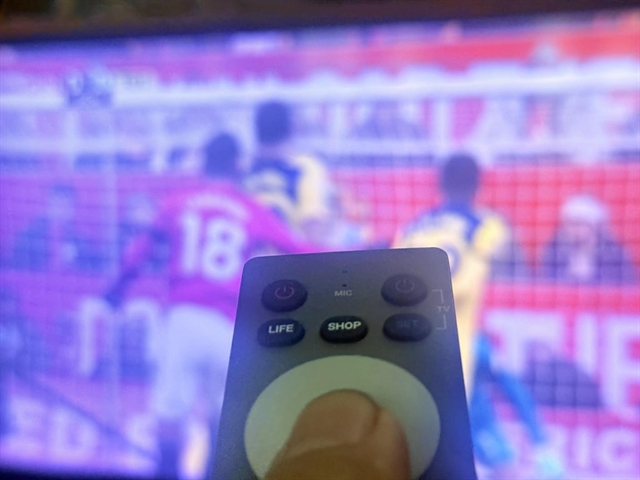
| A viewer watching a Premier League game on TV. VNS Photo Anh Đức |
Anh Đức
This past week, football discussions in Việt Nam have revolved not around the country's domestic league, but around the downfall of a major piracy website for sports streaming, or 'bootleg streams' as dubbed by the fans.
The website has been around for 10 years and has provided streaming for a vast variety of sporting events, from football to the NBA, the NFL, Formula One and even darts, with in-house Vietnamese commentary.
It rose to prominence during the 2018 Asian Games, at which Việt Nam advanced to the top four. But back then no Vietnamese stations had broadcasting rights for the games up until the knockout rounds, thus leading viewers to resort to bootleg sites. Việt Nam's stunning 1-0 victory against Japan garnered thousands of viewers on the bootleg platform, and the in-house 'bootleg' commentators were praised by fans for their style of commentating.
Bootleg commentators, anonymous and outside the boundaries of regulations and norms for broadcasting, were able to make jokes and connect with viewers interactively. Broadcasts were even sometimes divided into multiple streams, with different styles of commentary or different biases in terms of teams available for viewers to select.
Say if you are a Manchester United hater, one stream even has a commentator who always roots for the opponent and laughs like a hyena every time United concedes or misses an opportunity; if you are a United fan, there's another stream for fans where the commentators pull out gongs and pray for the Red Devils to make it to full time.
The disappearance of the website has stirred up a debate about bootleg streams and commentators, with some fans mourning the loss of the piracy service. The debate has shifted into criticism of current broadcasting rights holders and the quality of their services, and how the bootleg streams, despite being illegal, were able to pull off a better customer experience for free.
Let's be real here: there should be no debate – bootleg streams and piracy in general are illegal acts and violate copyright laws. Furthermore, the price viewers pay for bootleg streams is not entirely 'free'. Bootleg streams are sponsored by illegal betting sites, with dozens of banners placed in the website's interface, and commentators naming them multiple times during the match. Some commentators even participated in instigating illegal betting by providing viewers with live odds and tips.
Illegal betting, or any kind of gambling in general, needs no introduction as to its dire consequences. In a recent report by VTV on problem gambling, a victim admitted to starting her gambling addiction by clicking on a banner on a piracy streaming platform. If gambling is an enormous problem even for adults, how could children – a prominent age group of sports viewers – control it should they watch the bootleg streams with thirty different sportsbook advertisements?
Some fans compare bootleg services to the character Robin Hood, a comparison that I agree with. Robin Hood was beloved by the people since he stole from the rich and gave to the poor. But if the rich were good and kind and provided to the people equally and in good measure, there would be no need for Robin Hood to exist.
The same goes for the competition between legitimate official broadcasters and bootleg streams. Bootleg streams pay more attention to their viewers to improve themselves, and provide an abundance of content in an era where, as the saying goes, 'content is king'. If official broadcasters were able to up their game and give the viewers what they want, providing a service worthy of the subscription fees, no one would watch bootleg streams.
All in all, the downfall of bootleg streams is a win for official broadcasters and a mark of Việt Nam's respect for international copyright laws. Broadcasters, however, should not relish this victory. Instead, they should focus on improving their services for the betterment of fans' experiences and their own revenues. VNS
Sports
 Sports
 Sports
 Sports
 Sports
 Sports
 Sports
 Sports
 Sports
.jpg) Sports
Sports
 Sports
 Sports
 Sports
 Sports
 Sports