 Society
Việt Nam prioritises rental housing as social housing targets lag
1.
|
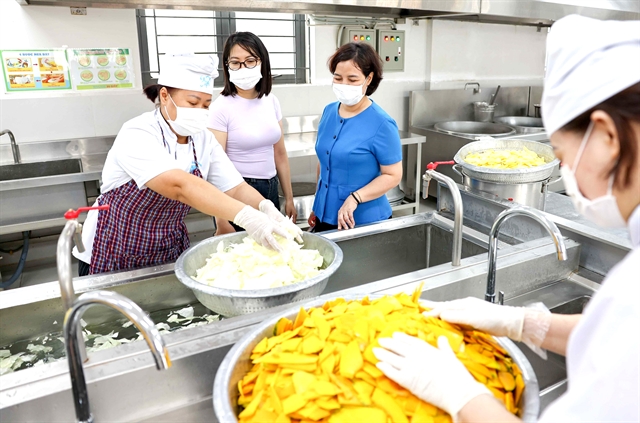
| Parents take turns visiting the food preparation facility at Quang Trung Primary School in Cửa Nam Ward, Hà Nội. VNA/VNS Photo Thanh Tùng |
HÀ NỘI — Experts have called for the urgent development and completion of policies and mandatory standards for school nutrition in Việt Nam to ensure students receive balanced, nutritious meals that meet food safety requirements.
Without standardised requirements, schools face risks ranging from shortages of trained staff and errors in meal planning to inadequate food safety controls, they warned.
Dr Bùi Thị Mai Hương, deputy director of the Centre for Nutrition and Food Science and Technology Services under the National Institute of Nutrition, said Việt Nam faces a double burden of malnutrition, with undernutrition coexisting alongside overweight and obesity.
The stunting rate among children under five in the northern mountainous region reaches 37.4 per cent, while the prevalence of overweight and obesity among children aged five to 19 in urban areas is 26.8 per cent. Micronutrient deficiencies remain another concern.
School meals in some places still focus primarily on ensuring that children eat enough, rather than meeting their nutritional needs, she said.
Research by the National Institute of Nutrition has also highlighted shortcomings in school food environments and food safety. Students can readily access sugary drinks, fast food, confectionery and other unhealthy products in school canteens. Meanwhile, the supply and preparation of meals, particularly for schools providing day-boarding and boarding services, may pose food safety risks where storage, transportation and kitchen procedures are inadequate.
Some school kitchens do not fully comply with food safety principles, including the requirement for a one-way workflow to prevent cross-contamination. Compliance with regulations governing food production, processing and trading must also be monitored more closely, Hương said.
|
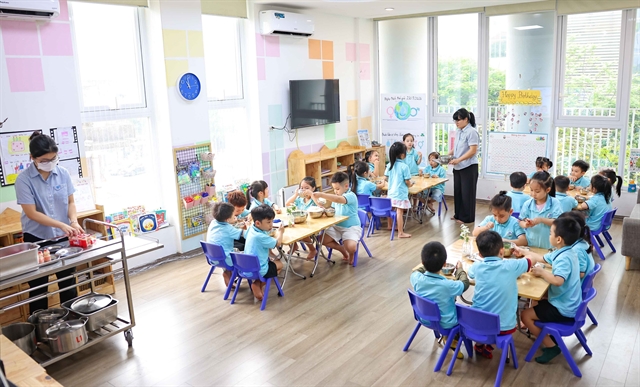
| Children at Bà Triệu Kindergarten in Cửa Nam Ward, Hà Nội, prepare to have lunch at school. VNA/VNS Photo Thanh Tùng |
Although Việt Nam has established a relatively comprehensive policy and legal framework for school nutrition, gaps remain in implementation.
One major shortcoming is the lack of mandatory national technical regulations on school nutrition. Many schools still rely on kitchen staff or catering providers to prepare menus, without consistent nutritional requirements. As a result, meals may fail to provide sufficient amounts of essential micronutrients.
A second challenge is the lack of dedicated nutrition personnel in schools. The education system has yet to establish dedicated positions for nutrition officers or specialists. Menu planning, food safety management and student health monitoring are often assigned to school healthcare staff as additional duties, even though they may lack the specialised training needed to perform these tasks effectively.
Infrastructure and funding disparities also affect meal quality. Schools in remote and mountainous areas may lack the space and equipment needed for one-way kitchen layout, as well as clean water and adequate food storage facilities. Meanwhile, the cost of school meals depends largely on parents’ ability to pay, making it difficult to ensure consistent nutritional standards across localities.
Hương said institutional reform and standardisation were essential to improving school nutrition nationwide.
She called for mandatory national technical regulations covering meal composition, nutritional requirements and ingredients that should be prohibited or restricted. The standards should be based on international benchmarks and Việt Nam’s recommended dietary allowances.
Technology and workforce development should also be prioritised. Model menus could be developed using locally available foods and regional specialities, while digital tools could help calculate portion sizes and an appropriate balance of micronutrients. Nutrition education should also be integrated into the formal curriculum.
Evidence-based monitoring would help assess the effectiveness of nutritional interventions and identify ways to reduce underweight and anaemia among students, she said.
Hương also highlighted the need for financial support and stronger intersectoral coordination. Authorities should consider subsidies to address specific nutritional needs and maintain or increase financial support for school meals. Existing meal assistance policies for eligible student groups could provide a basis for expanding access to nutritionally adequate meals.
Effective implementation would require coordinated action by management agencies, schools and other service providers, alongside community oversight to ensure meals meet both nutritional and food safety requirements.
Hà Thị Phương of the TH Nutrition Institute also called for more comprehensive policies and standardised requirements, outlining four priorities.
These include establishing a coherent legal framework for organising, managing and monitoring school meals; introducing mandatory national technical regulations covering meal quality, monitoring procedures, staffing and infrastructure; and developing transparent funding mechanisms that clearly define the respective contributions of the State, parents and businesses.
She also called for stronger independent oversight and public disclosure of information on menus, meal quality, the types of milk provided and compliance with nutritional standards. This would enable parents and communities to monitor school meals more effectively.
Experts said that a coordinated approach combining clear regulations, adequate funding, trained personnel and transparent supervision would be crucial to ensuring that all students have access to safe and nutritious meals. — VNS
Society
 Society
 Society
 Society
 Society
 Society
 Society
 Society
 Society
 Society
 Society
 Society
 Society
 Society
 Society