 Society

Deputy PM urges business ties for half of all research projects by 2030
1.
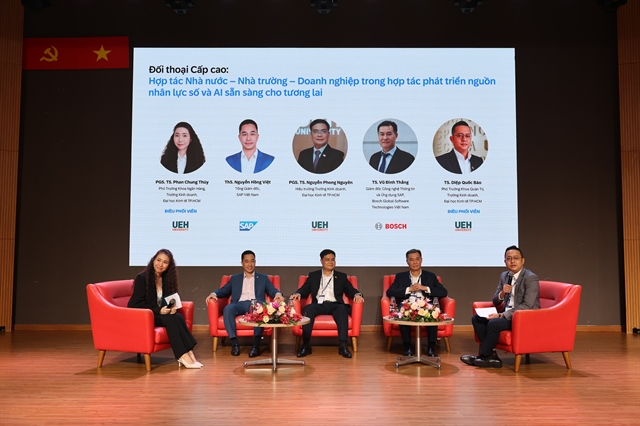 |
| Panelists participate in the 2026 SAP Academic Community Conference Việt Nam being held in HCM City from October 12-14. Photo courtesy of UEH |
HCM CITY — More than 200 delegates from regulatory authorities, higher education institutions, and the business community gathered at the 2026 SAP Academic Community Conference Việt Nam, which opened in HCM City on Monday.
The three-day event, themed “Learning and Teaching for the Age of Autonomous Enterprise”, serves as a forum for updates on technology trends and connecting the Government – University – Business community.
Through a series of activities ranging from policy dialogue, business cooperation, faculty development, classroom innovation to connecting students with the labour market, the event aims to contribute to building a collaborative ecosystem capable of translating technological changes into substantive changes in education and workforce development.
Speaking at the opening ceremony, Trần Trọng Tuyên, deputy director of HCM City Department of Science and Technology, said: "In the context of the city's new development stage, science and technology are identified as a key driving force."
Digital transformation integrated with artificial intelligence (AI) and the development of a high-quality digital workforce are strategic pillars, Tuyên said.
The city needs not only a pool of experts in AI, data, and digital technology but also human resources across all sectors capable of applying technology, leveraging data, innovating processes, and adapting to the rapidly changing work environment, he said.
He urged businesses to engage more deeply in the training process, ranging from identifying workforce needs and contributing to curriculum development to providing real-world contexts, guiding practical training, and evaluating outcomes.
Assoc. Prof. Dr Bùi Quang Hùng, president of University of Economics HCM City (UEH), said, “In the age of AI, the question for universities is no longer simply what we can teach, but rather what capabilities the economy and society will need over the next five to ten years. This requires the Government, universities, and businesses to move beyond working on three separate paths.”
Universities need to connect policy, knowledge, technology, and practice to co-create the workforce of the future, Hùng said.
AI, data, and digital platforms are fundamentally transforming how businesses operate and make decisions, he said.
Nguyễn Hồng Việt, managing director of SAP Vietnam, said that as AI and AI agents become increasingly integrated into workflows, many tasks can be further automated and standardised.
Consequently, people will take on more strategic roles that require analytical, evaluative, and decision-making capabilities, Việt said.
Students should not merely learn how to use specific software or technologies. Instead, they need to understand business processes and operations while continuously updating their AI-related knowledge and skills, he said.
Experts said that AI, data, and digital platforms are fundamentally transforming how businesses operate and make decisions.
They said that moving beyond traditional enterprise resource planning (ERP), businesses are gradually advancing toward the autonomous enterprise model, where AI, data, and automation are becoming increasingly deeply integrated into management processes.
This creates a new requirement for higher education: universities must not only teach what they currently have, but also identify and prepare the capabilities that the economy and labour market will require in the future.
Within the framework of the conference, UEH signed cooperation agreements with SAP and three other enterprises with the aim of expanding business participation in learner development through practical training activities, industry experts, internships, scholarships, projects, and career opportunities. — VNS
Society
 Society
 Society
 Society
 Society
 Society
 Society
 Society
 Society
 Society
 Society
 Society
 Society
 Society
 Society