 Society

Preserving heritage and harnessing cultural strength in a new era
1.
|
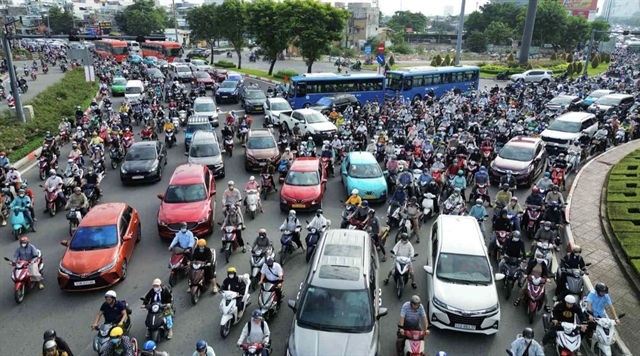
| HCM City plans to tackle 28 traffic congestion hotspots across the city by 2030. — Photo: laodong.vn |
HCM CITY — HCM City is prioritising major infrastructure projects to tackle 28 traffic congestion hotspots across the city by 2030, as part of a broader plan to improve transport connectivity and support economic development.
Speaking at the “People Ask – Government Answers” programme, Trần Quang Lâm, director of the municipal Department of Construction, said addressing these bottlenecks was a key objective for the next five years.
Projects under way or in preparation will be prioritised for completion, helping ease congestion at locations including Mỹ Thủy and An Phú intersections, National Highway 13, and the Nguyễn Khoái Bridge and Road and Bình Tiên projects.
Lâm said the projects would not only resolve congestion at specific locations but also improve the overall transport network, strengthen connectivity between areas and support the development of new economic and urban corridors.
Long-standing congestion hotspots in HCM City area include the An Phú and Mỹ Thủy intersections, Hàng Xanh and Nguyễn Tất Thành Street. Similar problems have also occurred at intersections and around major industrial parks in the former Bình Dương and Bà Rịa - Vũng Tàu areas. The city is also studying steel flyovers at several locations to ease traffic congestion.
HCM City accounts for around 37 per cent of the country’s air passenger traffic and 65 per cent of its container throughput. However, infrastructure bottlenecks and inadequate connections continue to affect residents’ daily lives, economic development and the investment environment.
Following the merger, the city identified three transport priorities: addressing existing bottlenecks, completing backbone infrastructure and regional connections, including ring roads, expressways and radial national highways, and expanding the metro network in conjunction with transit-oriented development (TOD).
The city expects its backbone transport infrastructure to be largely completed by 2030. However, with a population of more than 14 million projected to rise to 25 million, expanding the urban railway network is considered a fundamental long-term solution.
The metro network is expected to reach 255km by 2030 and around 500km over the following decade. Under the overall master plan, the network could eventually extend to 1,500km, compared with just over 1,000km under the existing plan.
Lâm said special mechanisms for metro projects would help shorten procedures and give the city greater autonomy, while new urban development policies would facilitate resource mobilisation and accelerate implementation.
Trương Tấn Vũ, deputy director of the municipal Department of Finance, said the city had allocated around VNĐ500 trillion for investment during 2026-2030.
Of this amount, approximately VNĐ200 trillion is earmarked for 98 transport projects, including 28 projects targeting congestion hotspots. Another VNĐ120 trillion is allocated to 37 regional connectivity projects, while VNĐ50 trillion is set aside for 59 projects addressing severe flooding.
The city will also continue relocating homes along canals and waterways, alongside urban upgrading and improvements to transport infrastructure and living conditions. — VNS
Society
 Society
 Society
 Society
 Society
 Society
 Society
 Society
 Society
 Society
 Society
 Society
 Society
 Society
 Society