 Society

Cultural industry product 'The Moment' debuts to bring new staging experience to theatregoers
1.

|
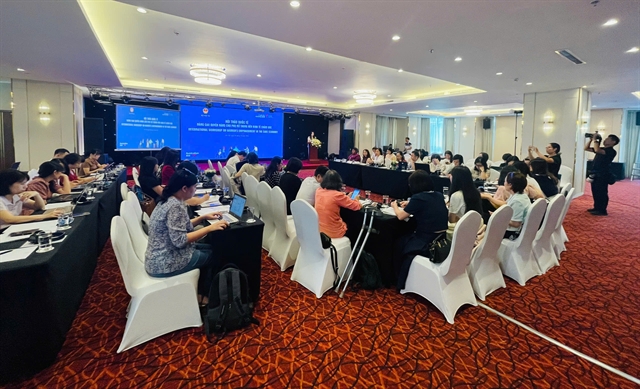
| Delegates at the international conference on Education Cooperation in the Digital Era, held alongside the Education and Educational Technology Exhibition in Hà Nội on October 8-9. Photos courtesy of the Ministry of Education and Training |
Khánh Linh
HÀ NỘI — Việt Nam is sharpening its AI educational toolkit.
This was the key message at international conference on Education Cooperation in the Digital Era, held alongside the Education and Educational Technology Exhibition in Hà Nội on October 8-9.
Top talks revolved around investing in teachers, ensuring equitable access to technology, safeguarding children's rights and strengthening links between education and industry.
The event brought together policymakers, international organisations, educational institutions and technology companies to discuss digital transformation and international cooperation in education.
Discussions come as Việt Nam advances education reform and digital transformation under Party resolutions, including Resolution No. 57-NQ/TW on science and technology, innovation and national digital transformation; Resolution No. 71-NQ/TW on education and training; and Resolution No. 59-NQ/TW on international integration.
While AI offers opportunities to personalise learning, improve teaching and expand access to educational resources, experts remarked that technology alone cannot guarantee better learning outcomes. The priority is to ensure innovation benefits learners, empowers teachers and narrows educational inequalities.
Putting people and equity at the centre
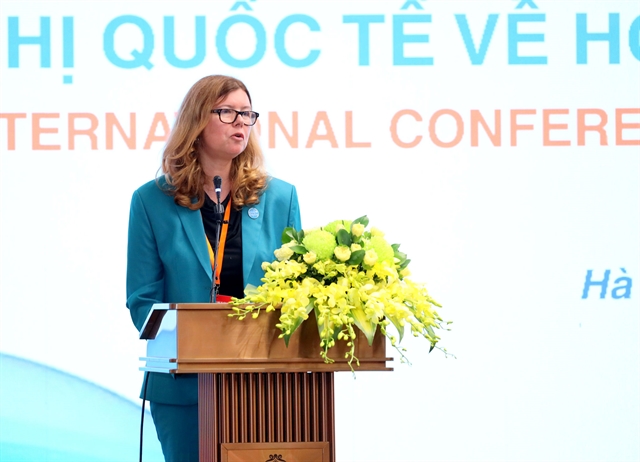
Silvia Danailov, UNICEF Representative in Việt Nam, said education would be central to the country's ambition to become a high-income economy by 2045, with future growth increasingly dependent on innovation, technology and a skilled workforce.
The key challenge is to harness technology to improve learning while ensuring every child develops the knowledge and skills needed to thrive in a rapidly changing digital world.
|
| Silvia Danailov, UNICEF Representative in Việt Nam speaks at the event. |
“How do we harness technology to improve learning and ensure that every child has the opportunity to learn, thrive and develop the skills they need for the future?” she asked.
Danailov outlined three priorities: investing in people and education systems alongside technology, making equity fundamental to digital transformation, and embedding children's rights, safety and protection into digital systems from the outset.
Teachers, school leaders and education systems determine whether technology translates into better learning experiences and outcomes, she said. Việt Nam has established frameworks for the digital and AI competencies of teachers and education managers, but the next step is to translate these foundations into classroom practice.
This requires sustained investment in teacher training, inclusive digital learning resources, accessible platforms, connectivity and institutional support.
“The question is not simply how much we invest in technology, but whether we invest in the people and systems that enable technology to deliver better and more equitable learning,” the UNICEF official said.
She warned that digital transformation could widen existing learning gaps if disadvantaged learners' needs were overlooked. Children in remote areas, ethnic communities and disadvantaged households, as well as children with disabilities, may face barriers involving internet access, devices, accessible content and digital skills.
She called for an ‘equity by design’ approach, prioritising investment in communities with the greatest needs and ensuring digital resources are accessible, safe, culturally relevant and responsive to different languages and learning needs.
Data analytics could help education authorities identify learners being left behind and target support more effectively. Technology providers should also be subject to clear requirements on safety, privacy and accessibility.
As AI becomes more integrated into education, safeguards are needed for collecting, storing and using children's data, alongside age-appropriate AI applications, stronger digital literacy and meaningful human oversight of decisions affecting children.
“Online safety cannot be added later. Data protection cannot be an afterthought. Human oversight cannot be optional,” Danailov said, adding that children should have a voice in shaping the digital environments in which they learn.
Keeping people in control of AI
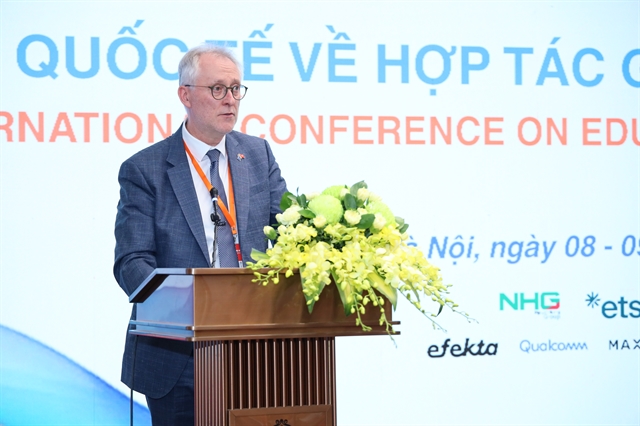
Stefaan Hermans, Director of the European Commission's Directorate-General for Education, Youth, Sport and Culture, said digital transformation should be understood as more than introducing platforms, devices or AI tools.
|
| Stefaan Hermans, Director of the European Commission's Directorate-General for Education, Youth, Sport and Culture speaks at the event. |
“Digital transformation is not only about platforms, devices or AI. Our experience in Europe shows that it is ultimately about people, institutions and the way we create, share and apply knowledge,” he said.
Effective transformation requires strong leadership, appropriate policies, digitally competent educators, innovative teaching methods and meaningful partnerships with industry and society.
As AI reshapes education, the European Union wants technology to support teaching and learning while keeping people in control and ensuring inclusion, he said. These priorities are reflected in the EU's Union of Skills strategy, which aims to strengthen education and lifelong learning and support the green and digital transitions.
The European Commission is also preparing a new Education Package, expected in November 2026, covering basic skills, teachers and trainers, and digital education infrastructure.
International cooperation can help turn these priorities into practical programmes. Through Erasmus+, the EU has supported more than 6,800 student and staff mobility opportunities between Europe and Việt Nam since 2021. Vietnamese institutions have participated in nearly 100 capacity-building projects, some addressing the digital transition, alongside 10 Jean Monnet activities promoting EU studies in Việt Nam.
The EU's Horizon Europe research and innovation programme, with a budget of more than €90 billion, provides another avenue for cooperation. Vietnamese organisations and researchers are already involved in 29 grants covering areas including digital technologies, health and green innovation.
Hermans also highlighted the EU-Việt Nam TVET Programme, implemented with Germany and France under the Team Europe approach, with a budget of more than €50 million. It aims to develop the green and digital skills needed by Việt Nam's economy in close cooperation with businesses.
He said cooperation should go beyond transferring existing programmes.
“This is therefore not simply about bringing European programmes to Việt Nam. It is about connecting European opportunities with Việt Nam's own priorities and ambitions, and turning shared priorities into concrete cooperation and tangible results,” he said.
Connecting education with the labour market
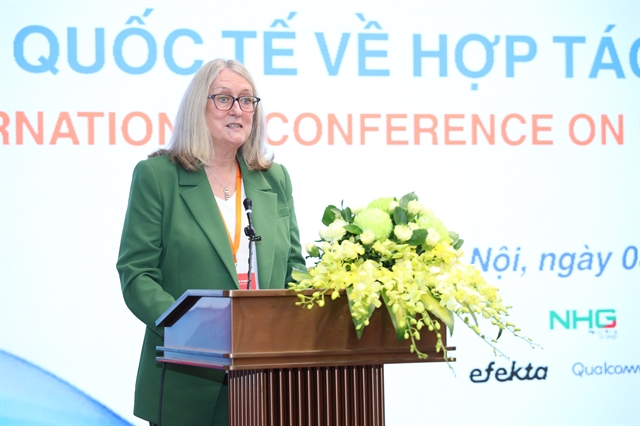
Baroness Jacqueline Smith, the United Kingdom's Minister of State for Skills at the Department for Education, said education and skills cooperation was an important part of the UK-Việt Nam Comprehensive Strategic Partnership.
|
| Baroness Jacqueline Smith, the United Kingdom's Minister of State for Skills at the Department for Education speaks at the event. |
The two countries will continue to strengthen cooperation through an updated government-level memorandum of understanding on education and skills, she said.
She outlined three priorities: placing employers at the centre of skills development, investing in teachers and trainers, and expanding international learning opportunities.
“Businesses know what they're looking for, so they need a strong say in the design of training and qualifications,” she said.
Closer cooperation between UK and Vietnamese educators and employers would help ensure learners develop skills relevant to industry needs, particularly in strategic sectors such as AI, advanced engineering and financial services.
Smith also stressed the importance of helping teachers and trainers keep pace with changing technologies and workforce requirements. Partnerships among colleges, universities and training institutions could support professional development and the exchange of expertise.
International study, work placements and internships would allow learners to apply their skills in new environments while building confidence, technical expertise and an understanding of global workplaces.
She said partnerships should ultimately be judged by their practical results, including stronger education-business links, training aligned with economic priorities, more career opportunities for young people, and support for workers to upgrade or change their skills throughout their lives.
Turning cooperation into results
The experts' recommendations converge on a central challenge for Việt Nam: ensuring that AI and digital technologies deliver measurable improvements in education.
This requires more than providing schools with equipment or introducing AI-powered platforms. It means strengthening teachers' capacity, developing safe and inclusive digital infrastructure, protecting learners' rights, and ensuring education responds to the needs of society and the economy.
International partnerships can support this process through joint research, teacher training, institutional exchanges, digital skills programmes and cooperation between universities and businesses. Such initiatives, however, must be aligned with Việt Nam's priorities and adapted to the needs of its schools, teachers and learners. — VNS
Society
 Society
 Society
 Society
 Society
 Society
 Society
 Society
 Society
 Society
 Society
 Society
 Society
 Society
 Society




