 Sci-Tech
PMs pay tribute to late Vietnamese, Lao leaders in Vientiane
1.
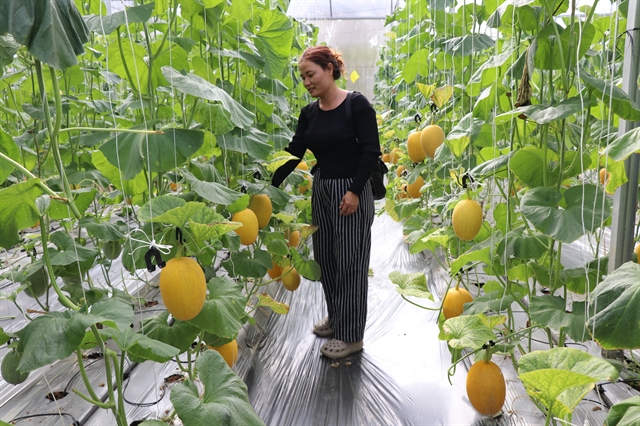 |
| Huỳnh Việt Trung's family in Sóc Trăng Province invested VNĐ2 billion (US$80,000) from Agribank's preferential credit programme to build a 5,000sq.m melon greenhouse, yielding high economic efficiency. — VNA/VNS Photo Thanh Hòa |
MEKONG DELTA — The Ministry of Science and Technology is urgently finalising a draft proposal titled 'Special Project on Developing Science, Technology, Innovation, and Digital Transformation for the Mekong Delta' for official submission before November 15.
The highly anticipated project is expected to unlock long-standing institutional bottlenecks, creating a strategic launching pad to transform the region's economic model and achieve sustainable, double-digit growth.
Shift to spatial reorganisation
According to a keynote report by the Vietnam Institute of Science and Technology Strategy (VISTS), there is a distinct paradigm shift in the region's development mindset, pivoting from mere passive climate adaptation to integrated development and spatial reorganisation, with science, technology, innovation and digital transformation serving as the central axis.
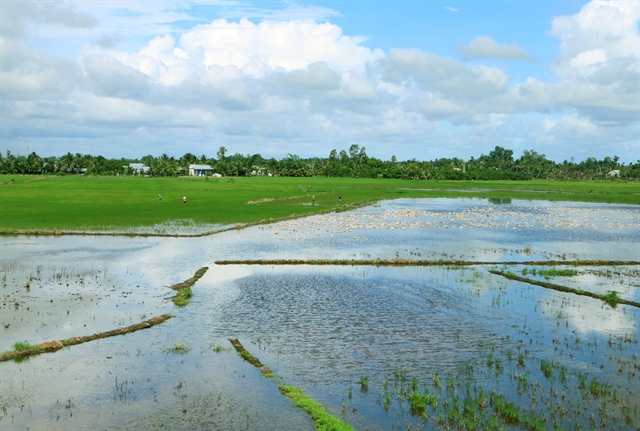
The Mekong Delta continues to assert its position as the country's largest agricultural powerhouse, contributing over half of the national rice production, 65 per cent of aquaculture output, 70 per cent of fruit yields, and more than 90 per cent of Việt Nam's total rice export turnover.
However, experts emphasise that the region's room for growth no longer lies in traditional expansion or simple volume increases, but relies entirely on the application of science, technology, and digital solutions to enhance productivity and value-chain efficiency.
Climate and structural constraints
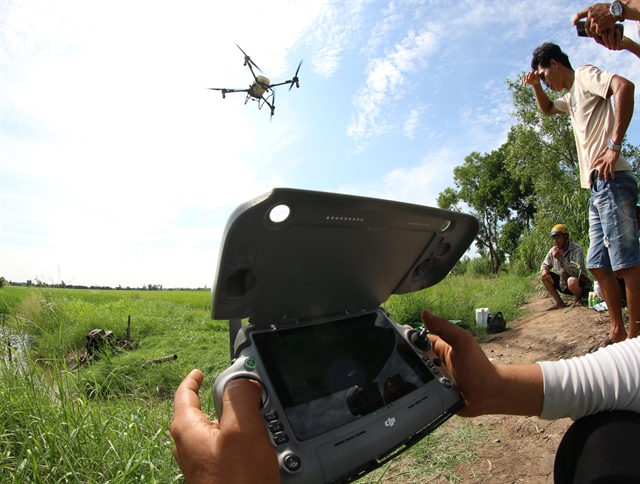 |
| A farmer operates a drone over a Mekong Delta paddy field, backed by Agribank’s VNĐ200-trillion ($8-billion) credit package with interest rates 1–2.5 per cent lower than standard. — VNA/VNS Photo Duy Khương |
Emphasising the urgency for a breakthrough in the new era, Nguyễn Văn Khởi, Vice Chairman of the Cần Thơ City People's Committee, noted that while the region's GRDP growth reached 7.24 per cent in 2023, modernising remains a massive hurdle when small-scale farming still accounts for 68 per cent of total households.
Accelerating high-tech applications, green economy practices, circular economy models, and comprehensive digital transformation across the agricultural value chain is an absolute necessity to sharpen the competitive edge of regional produce.
Beyond structural production constraints, the Mekong Delta faces severe survival threats. Professor Hà Thanh Toàn, former Rector of Cần Thơ University, pointed out that climate change, saltwater intrusion, riverbank and coastal erosion, as well as declining transboundary water resources have directly impacted the region's production foundation.
This, combined with limited technical infrastructure and a lack of high-income jobs, has driven a massive migration wave, with over one million people leaving the Mekong Delta in recent years.
Analysing production methods, Professor Nguyễn Thanh Phương from Cần Thơ University affirmed that traditional farming based purely on experience is no longer viable against climate pressures and strict market demands.
The key solution is 'ntellectualising farmers' by boosting biotechnology, automation and digital transformation, while incentivising them to join large-scale cooperatives to establish sustainable linkages with major corporate buyers.
Professor Hà Thanh Toàn also reflected that critical regional programmes, such as the Mekong Delta Agricultural Processing and Preservation Centre Project, have stalled due to legal overlaps and a lack of cross-ministerial coordination. Most notably, current State Budget Laws do not allow localities to jointly pool financial resources, presenting a major barrier to executing regional linkage tasks.
Policy alignment and regulatory sandboxes
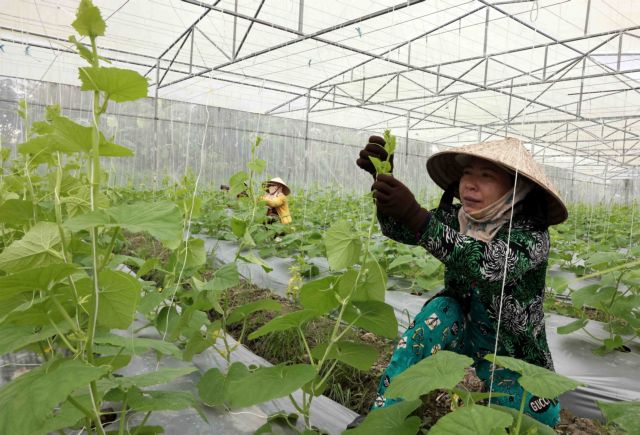 |
| Farmers tend to greenhouse crops in Sóc Trăng Province under Decrees 55 and 116, which incentivise high-tech agriculture through Agribank’s low-interest loans. — VNA/VNS Photo Trần Việt |
To overcome these barriers, the Mekong Delta must synchronously apply Central resolutions on science, technology, and innovation, most notably Politburo’s Resolution No. 57-NQ/TW on strategic breakthroughs in science, technology, innovation and national digital transformation.
This overarching national policy serves as the direct legal and ideological foundation to restructure the delta's production network. Sustainable regional growth demands a clear tripartite synergy where state management acts as the enabler to clear institutional barriers, enterprises drive investment and commercialise technology, and citizens proactively upgrade their skills to adopt new production methods.
Nguyễn Phương Lâm, Director of the Vietnam Chamber of Commerce and Industry (VCCI) Mekong Delta Branch, suggested making science and technology the focal point of regional linkages instead of traditional administrative boundaries, with Cần Thơ University acting as the scientific core.
Financially, funding should be synchronised from joint central-local budgets, corporate investments and a tailored credit mechanism from commercial banks dedicated specifically to regional agriculture and tech development.
Emphasising operational agility, Trần Kim Chung, Chairman of CT Group, recommended evolving the traditional three-party alliance into a five-party model by adding specialised tech providers and banks. He proposed immediate 12-to-24-month high-yield solutions, including carbon credit projects, precision agriculture, digital twin infrastructure, and generative AI training for regional managers and enterprises.
From an agricultural management perspective, Nguyễn Văn Long, Director General of the Department of Science, Technology and Environment under the Ministry of Agriculture and Environment (MAE), pointed out that execution remains a major bottleneck, as only one out of 55 strategic tech proposals successfully passed evaluation.
He urged the Ministry of Science and Technology to soon issue a framework for controlled regulatory testing mechanisms (sandboxes) to resolve legal tangles for emerging technologies, such as gene-edited crops and unmanned digital fields.
According to Trần Trung Tính, Deputy Minister of Science and Technology, the special project focuses on immediate priorities, breakthrough solutions, and long-term strategies. Coordinated by 12 ministerial departments alongside provincial authorities, academic institutions, and major corporations, the proposal will establish a concrete legal corridor, turning the Mekong Delta into a premier testing ground for advanced tech commercialisation to drive rapid and sustainable regional growth. — VNS
Sci-Tech
 Sci-Tech
 Sci-Tech
 Sci-Tech
 Sci-Tech
 Sci-Tech
 Sci-Tech
 Sci-Tech
 Sci-Tech
 Sci-Tech
 Sci-Tech
 Sci-Tech
 Sci-Tech
 Sci-Tech
 Sci-Tech