.jpg) Society
Society


DFI Retail Group Announces New Group Chief Digital & yuu Rewards Officer
1.

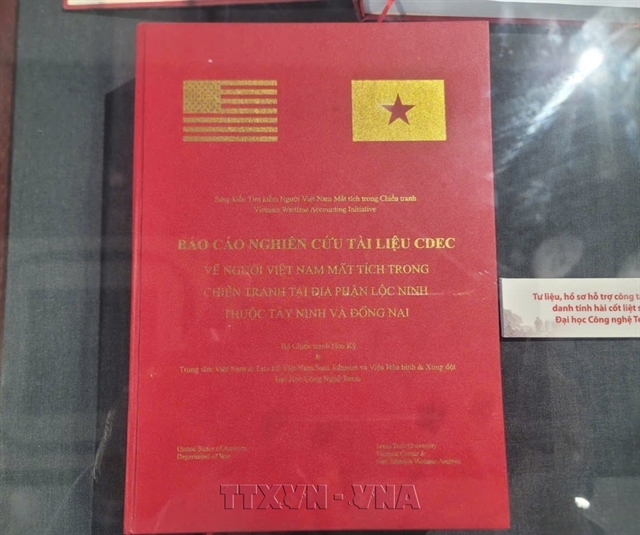 |
| Materials and records supporting the search, recovery and identification of martyrs’ remains, compiled by the research team from the Vietnam Centre and Sam Johnson Vietnam Archive at Texas Tech University. — VNA/VNS Photo Chu Thanh Vân |
HÀ NỘI — More than 50 wartime files and personal memorabilia have been transferred to the Vietnamese side to support the country’s 500-day campaign to search for, recover and identify the remains of fallen soldiers, according to the Vietnam Wartime Accounting Initiative (VWAI).
Speaking on the sidelines of an exhibition of archival documents and memorabilia of officials who served in southern battlefields during the war, held on Fridayby the State Records and Archives Department under the Ministry of Home Affairs, Dr. Võ Đình Thái, co-leader of the VWAI and Research Assistant Professor at the Vietnam Centre and Sam Johnson Vietnam Archive at Texas Tech University, said that among the materials transferred is a research dossier decoding the designation of Unit 962. It provides additional leads in the search for fallen soldiers believed to have been buried at Lê Thị Riêng Park in HCM City, including martyr Huỳnh Văn Quên. The dossier had previously been shared with the city’s Steering Committee for the search for, recovery and identification of martyrs’ remains for verification.
VWAI also presented a burial map documenting the general burial locations of 21 fallen soldiers at Hospital K76A T7 under Military Region 7. In addition, eight personal artefacts, including diaries, letters and notebooks, were handed over to Vietnamese authorities, enabling them to trace and return them to the families of their original owners. Another collection includes 15 death notices, six burial maps, and lists identifying burial locations of fallen soldiers.
Particularly significant are 32 files and memorabilia relating to the southeastern battlefield during the 1966–72 period. Compiled from original microfilm records, the reports range from five to 110 pages and combine archival research with historical and geographical analysis. They allow authorities to compare wartime terrain with present-day conditions, helping identify areas that may still contain unmarked graves.
The VWAI also transferred 18 personnel lists of military units. According to Dr Thái, these records are especially valuable for identifying recovered remains. While DNA testing remains essential, the lists help narrow the search for surviving relatives who can provide reference samples, greatly increasing the likelihood of successful identification.
The VWAI representative said more than 60 thoroughly researched dossiers have now been delivered to Vietnamese authorities, following discussions with Deputy Prime Minister Phạm Thị Thanh Trà on June 13. — VNA/VNS
Society
 Society
 Society
 Society
 Society
 Society
 Society
 Society
 Society
 Society
 Society
 Society
 Society
 Society
 Society