 Society

LANDMARK Launches ‘Destination CENTRAL’: A District-Wide Invitation to Explore the Dynamism, Luxury, and Soul of Central
1.
|
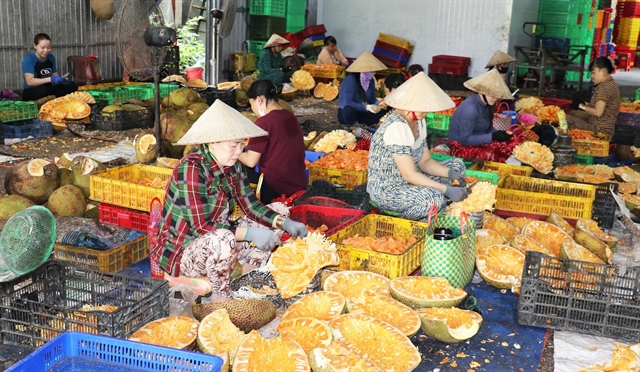
| Women process jackfruit at a co-operative project linking farmers to boost economic development and sustainable poverty reduction in Đồng Tháp Province’s Mỹ Lợi Commune. — VNA/VNS Photo |
ĐỒNG THÁP — Đồng Tháp Province is expanding livelihood and job support programmes, aiming to eliminate poor households by 2029.
The province People’s Committee has issued a plan for sustainable poverty reduction for the 2026–30 period, targeting a reduction in the poor household rate to 0.56 per cent this year, down 0.14 percentage points from last year.
The Cửu Long (Mekong) Delta province aims to cut the poverty rate by an average of about 0.18 percentage points each year, achieve the goal of having no poor households by 2029 and maintain the result through 2030.
To achieve the target, the province is focusing on five key solutions: reviewing and organising livelihood models for different household groups, developing market-linked livelihood models, promoting the role of co-operatives and value chain linkages, mobilising resources effectively, and strengthening monitoring and evaluation of poverty reduction models.
The plan follows the principle of “giving people a fishing rod instead of a fish” by encouraging residents to create stable incomes and actively improve their living conditions.
Alongside livelihood support, the province is helping poor households access essential social services such as jobs, education, healthcare, housing, clean water, sanitation and information.
Poverty reduction models are also linked with production, business, services, tourism, start-ups and climate change adaptation.
Under the plan, at least 80 per cent of people from poor and near-poor households who are able to work and need support will receive assistance to improve their capacity in agriculture, forestry, fisheries and other suitable occupations.
The support is expected to help them adopt new production methods, apply advanced technologies and techniques in production, and increase their incomes.
|
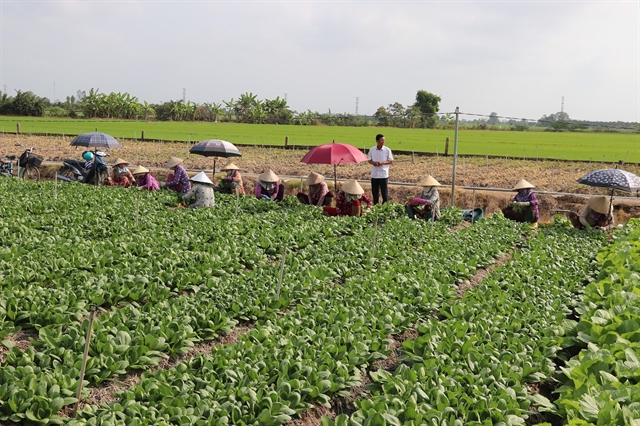
| Women harvest vegetables at Hòa Thạnh General Agricultural Co-operative in Đồng Tháp Province’s Long Bình Commune, earning VNĐ200,000–300,000 (US$7.6–11.4) per day. — VNA/VNS Photo |
The province now has 6,698 poor households, accounting for 0.7 per cent of the population.
In Mỹ Tịnh An Commune, there are 89 poor households, making up 1.04 per cent of local residents. The commune has set a target of eliminating poverty completely by 2030.
Hồ Trung Hiếu, Deputy Chairman of the Mỹ Tịnh An Commune People’s Committee, said that to achieve this target, the commune will continue implementing the national target programme on sustainable poverty reduction effectively while integrating it with other programmes to expand resources.
He said diversifying livelihood models and combining different support resources had helped local residents become more proactive in developing their economy and gradually escape poverty sustainably.
Trần Phú Hải in Mỹ Tịnh An, who was born deaf and mute, faced many financial difficulties. Then, in early 2024, he received more than VNĐ29 million (US$1,100) from the national target programme on sustainable poverty reduction to invest in breeding cattle. The funding became an important source of support for his family.
The sedge hat weaving model in the commune has created stable jobs for many rural women.
The family of Châu Thị Nga has joined a sedge hat weaving group organised by the commune Women’s Union for more than 10 years.
“Thanks to the weaving group, I can earn a daily income while still having time to take care of my family,” she said.
The commune currently has two sedge hat weaving groups in Trung Hòa and Hòa Ninh hamlets. The Hòa Ninh group alone has 20 members with average monthly incomes of VNĐ5–7 million ($190–270).
|
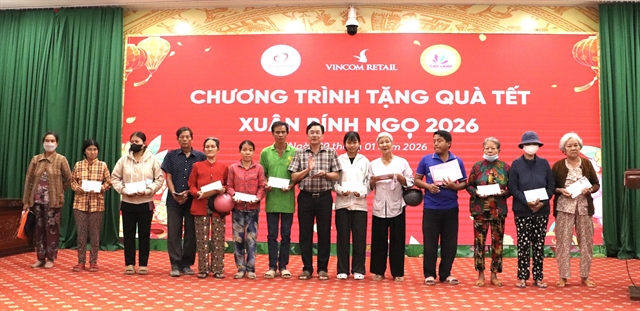
| Đồng Tháp Province’s Cao Lãnh Ward presents gifts to poor households on the occasion of Tết Bính Ngọ 2026 (the Lunar New Year of the Horse). — VNA/VNS Photo |
The province’s preferential loan programme has played an important role in helping residents expand production, escape poverty, stabilise their lives and support local socio-economic development.
With the preferential loan programme, many effective livelihood and business models have been developed, including mat weaving in Long Định Commune, fruit orchard development in Vĩnh Kim Commune, and raising chickens, quails and fish in Lương Hòa Lạc Commune.
The family of Phan Thị Mai in Trung An Ward was previously classified as poor and faced financial difficulties. After receiving a VNĐ100 million ($3,800) loan to grow pineapples and rent farmland for lotus cultivation, the family now has a stable income and has escaped poverty.
Huỳnh Minh Tuấn, Deputy Chairman of the province People’s Committee, said the province would strengthen co-ordination among agencies and local authorities to ensure effective poverty reduction efforts at all levels.
The province is also encouraging poor households to join group production models to improve scale and economic efficiency, he said. — VNS
Society
 Society
 Society
 Society
 Society
 Society
 Society
 Society
 Society
 Society
.JPG) Society
Society
 Society
 Society
 Society
 Society