 Society

LANDMARK Launches ‘Destination CENTRAL’: A District-Wide Invitation to Explore the Dynamism, Luxury, and Soul of Central
1.
|
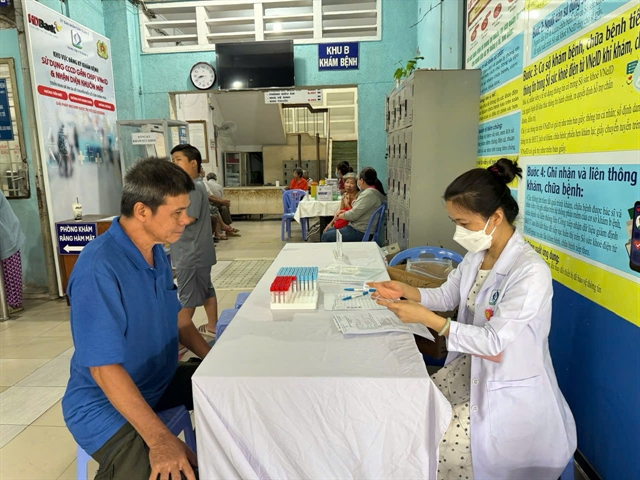
| Senior citizens receives a health check-up at the Chợ Lớn Ward Health Station in HCM City on April 17. — VNS Photo Thu Hằng |
HCM CITY — HCM City plans to provide free health checks to all residents this year at a cost of more than VNĐ2.5 trillion (US$96 million), according to its Department of Health.
The department has developed three health check packages for various age groups based on guidelines issued by the Ministry of Health.
The package for children under six focuses on monitoring growth, assessing nutrition, mental and motor development, and screening for autism risks.
The one for children aged between six and 18 focuses on the early detection of school-related diseases, refractive errors, scoliosis, mental health issues, and adolescent reproductive health counselling.
For those aged above 18, there will be multi-specialty examinations, basic clinical tests, and chest X-rays.
Female workers will also be screened for breast and cervical cancer.
Speaking at a meeting on May 25 with the city Party Committee on the universal health check-up programme, Associate Professor Dr Nguyễn Anh Dũng, deputy director of the Department of Health, said the city is implementing a plan for periodic health checks for all citizens starting in 2026.
Everyone would get at least one check-up a year, with all results updated in an electronic health record for lifelong management, he said.
The programme is considered a major shift in the community healthcare strategy, moving from a model of “disease treatment” to one focused on “prevention, early detection, and proactive health management”.
The target group for the check-ups is everyone living in the city, both permanent and temporary, identified through the VNeID application.
In 2026, health authorities expect to check around 15 million people.
The city is prioritising vulnerable groups such as the elderly, people with disabilities, poor and near-poor households, war veterans, people with chronic diseases, and those living in disadvantaged areas.
To facilitate access, it would deploy various methods, including check-ups at medical facilities, mobile examination points at schools, companies, and residential areas, and even home visits for elderly residents, Dũng said.
All health data will be updated in electronic health records to support seamless health management.
Deputy Secretary of the city Party Committee, Nguyễn Phước Lộc, said healthcare should embrace technology, innovation, and digital transformation to improve the effectiveness of services and develop the medical economy.
The sector needs to focus on disease prevention, preventive medicine, and primary healthcare, and develop traditional medicine, he said.
Disease risk factors, including living conditions, food safety, and other environmental risks, also need to be controlled and addressed to reduce the disease burden on the community, he said.
Hospitals have coordinated with the Department of Health to implement the initial phase of the universal health check programme, he said.
Health checks are aimed not only at early disease detection, but also at building a nationwide health database to support long-term management and policy planning, he added.
The city has a population of around 15 million, and has 170 public hospitals and medical centres, 168 health stations, and more than 12,000 private clinics. — VNS
Society
 Society
 Society
 Society
 Society
 Society
 Society
 Society
 Society
.JPG) Society
Society
 Society
 Society
 Society
 Society
 Society