 Society

VPS leads brokerage market share on HNX in Q3
1.
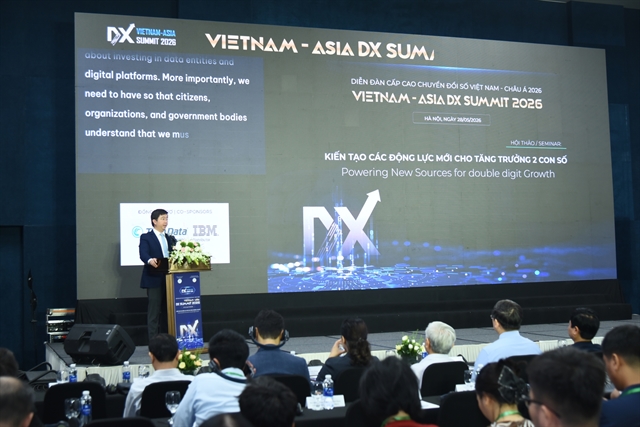 |
| Deputy Minister of Science and Technology Bùi Hoàng Phương speaks at the summit. — VGP/VNA Photo |
HÀ NỘI — Việt Nam is entering a new development phase targeting double-digit economic growth in 2026–2030, a goal seen not only as an acceleration of output but also as a structural shift in the country’s growth model.
Deputy Minister of Science and Technology Bùi Hoàng Phương said at a summit in Hà Nội that science, technology, innovation and digital transformation are becoming the most important new growth drivers in this context.
The Việt Nam–Asia Digital Transformation Summit 2026 (Việt Nam–Asia DX Summit) held its plenary session on Thursday morning under the theme Creating new drivers for double-digit growth.
The annual event is organised by the Việt Nam Software and IT Services Association (VINASA) under the sponsorship of the Ministry of Science and Technology (MoST).
The summit brought together more than 2,000 delegates from 12 economies and 18 provinces and cities, as well as international organisations, technology corporations and Vietnamese and foreign business communities.
Mastering deep technologies
Speaking at the event, Deputy Minister Phương said the MST appreciated VINASA’s initiative in maintaining the annual Việt Nam–Asia DX Summit.
He said the forum is not only a regional platform for exchange, cooperation and investment but also a venue to honour outstanding digital products and solutions that reflect Vietnamese ingenuity.
Phương said digital transformation, digital technologies, databases and artificial intelligence (AI) bring significant benefits but also require stronger interoperable connections not only within countries but across the region and globally.
They also present distinct governance challenges.
He urged the forum not to focus solely on the advantages of digital transformation but to address solutions for interoperability, AI governance, databases and emerging digital technologies.
The MST will take these inputs into account and work with other ministries, agencies and localities to continue improving policy and implementation.
Representing the organiser, Ngô Diên Hy, deputy chairman of VINASA and deputy general director of VNPT Group, said the forum’s theme was a call to action.
He said the digital economy must take on a central role and the digital technology industry must accept two strategic tasks: to drive science and innovation as engines for productivity growth in the real economy and to pioneer new spaces for development.
According to Hy, Việt Nam’s digital technology community must have the confidence to develop and lead future technologies such as AI and quantum technology. These emerging fields generate technology surpluses and will help determine Việt Nam’s position in the global supply chain.
In that spirit, the plenary session discussed closer cooperation among technology companies to harmonise data, models and infrastructure, set out a roadmap for AI to move from application breakthroughs to core proactive creative technologies and framed recommendations on sandbox mechanisms while consolidating proposals to address local growth challenges.
Building new capabilities
Delegates assessed that as the global economy undergoes restructuring driven by AI, big data, automation and digital transformation, countries and businesses are under pressure to reshape growth models to remain competitive.
Việt Nam is entering a new era with an annual macroeconomic growth target above 10 per cent. This is not only a technological issue but also one of labour productivity, governance capacity, digital infrastructure, workforce quality and the ability to connect government, business and the technology ecosystem.
Hoàng Hữu Hạnh, Deputy Director of the National Digital Transformation Department under the MST, said economic productivity is not determined by applications at the top layer but by the quality of foundational systems and the speed at which the economy absorbs technology.
He said the foundational layer includes shared infrastructure and data, enabling institutions to open space for innovation and reduce legal risk, as well as the executive machinery that translates policy into results.
The Digital Transformation Law 2025, which took effect on July 1 this year, has established a solid load-bearing foundational layer.
From a global perspective, Trần Thị Lan Hương, an expert from the World Bank, warned of the shallow technology trap in which AI is widely present but has not taken root in the real economy.
To bridge this gap and achieve a breakthrough, she said Việt Nam needs to build five pillars in a coordinated way: connectivity and energy, computing capacity, context and data, skills and responsible AI.
Hồ Quang Bửu, deputy chairman of the Đà Nẵng People’s Committee, shared local experience in unlocking momentum through a model of proactive public administration.
Đà Nẵng has used data to identify needs and serve residents. Notably, the city pioneered a Data Exchange, demonstrating that data can transparently generate value and create new revenue streams from AI services.
Representatives at the event agreed that Việt Nam’s new growth drivers will not come solely from capital or labour as in the past but from productivity generated by technology, data, AI and innovation capacity.
They said what Việt Nam needs now is more effective digital transformation to raise productivity, establish a new growth model and strengthen national competitiveness in the AI era. — VNS
Society
 Society
 Society
 Society
 Society
 Society
 Society
 Society
 Society
 Society
 Society
 Society
 Society
 Society
 Society