 Society
VN-Index ends lower despite liquidity hit over $1 billion
1.
|
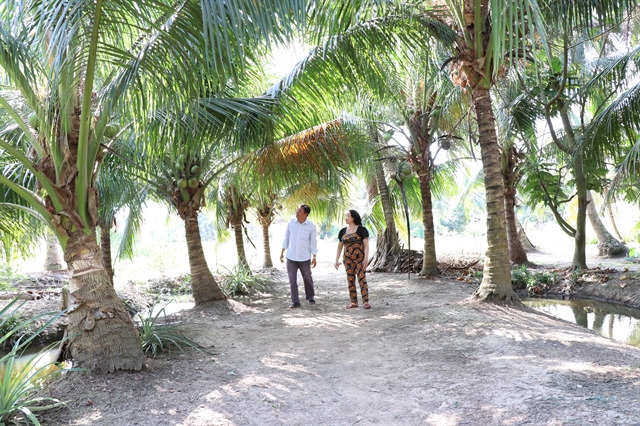
| An organic coconut grove owned by Nguyễn Thị Nhành in Vĩnh Long Province’s Tiểu Cần Commune. — VNA/VNS Photo Thanh Hòa |
VĨNH LONG — Vĩnh Long Province is accelerating its shift to organic coconut farming while strengthening production linkages, as it seeks to raise product value and expand sustainable exports.
The Cửu Long (Mekong) Delta province, the country’s largest coconut producer, has more than 122,800ha under cultivation, accounting for about 61 per cent of the country’s total area.
Of this, more than 114,000ha are currently being harvested.
The province’s coconut-growing area has grown at an average of 2 per cent a year in recent times, with more than 80,000 households engaged in coconut farming.
Authorities have identified organic production as a key strategy to improve competitiveness in demanding international markets.
The province has more than 30,700ha of coconut meeting organic standards, certified under major international schemes, including those of the US, the EU and Japan, according to its Department of Agriculture and Environment.
“Developing organic coconuts to international standards is a strategic direction to raise added value and meet export requirements,” Lê Văn Đông, deputy director of the department, said.
Organic farming models in the province not only increase profits but also reduce costs and emissions, contributing to environmental protection.
Certified organic coconuts with traceable origins fetch more stable prices and are often sold under long-term contracts with companies, helping farmers reduce market risks.
Nguyễn Thị Nhành, a farmer in Tiểu Cần Commune’s Phú Thọ 2 Hamlet, is among those who have successfully transitioned to growing organic coconuts.
Six years ago, she converted her 0.4ha rice field into a coconut grove, and it now produces around 300 nuts a month, which fetch around 10 per cent higher prices than regular coconuts.
“Organic farming reduces costs by using compost made on-site while protecting people’s health and the environment,” she said.
The hamlet has 263ha of agricultural land, previously used mainly for growing rice, but more and more farmers have switched to coconut in recent years.
Huỳnh Bảo Kỳ, head of the hamlet People’s Board, said organic farming linked to co-operatives improves efficiency, raising incomes by three to five times from rice.
By joining co-operatives and signing contracts with companies, farmers get technical support and secure stable outlets, he said.
The province has 222 planting areas producing fresh coconuts and 29 packing facilities that have been granted export codes to ship to China.
|
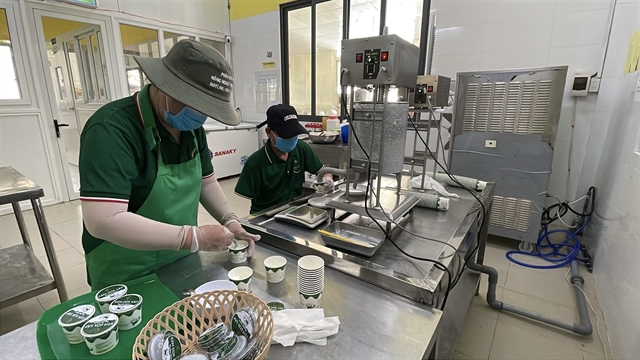
| Workers at Phat Dang One Member Co., Ltd in Vĩnh Long Province’s Song Lộc Commune produce ice cream from sáp (wax) coconut, the province’s speciality variety. — VNA/VNS Photo Thanh Hòa |
The province has 151 processing firms producing a wide range of coconut products, from traditional items to higher-value products such as activated carbon, cosmetics and functional foods.
The coconut processing industry generated an estimated VNĐ8.15 trillion (US$310 million) last year, up 5.84 per cent year-on-year and accounting for nearly 6 per cent of the province’s total industrial production.
Coconut exports are growing strongly, rising to around $500 million last year from $451 million in 2024.
Key export markets such as the US, Canada, the EU, the Middle East, and Africa remain steady. Most products have registered trademarks, while packaging and labelling have improved, helping enhance competitiveness.
But challenges do persist.
Production remains fragmented, and linkages between growers and buyers are not yet fully stable, limiting the potential.
Local authorities say further restructuring is under way to address these issues, including expanding concentrated farming areas, strengthening co-operatives and encouraging businesses to participate more deeply across the value chain.
“To ensure sustainable development, the province is building concentrated farming areas that meet organic standards and ensure traceability,” Châu Văn Hòa, deputy chairman of the province People’s Committee, said.
The province is also stepping up trade promotion and market diversification, alongside investment in processing and logistics infrastructure to improve competitiveness. — VNS
Society
 Society
 Society
 Society
 Society
 Society
 Society
 Society
 Society
 Society
 Society
 Society
 Society
 Society
 Society