 Society
VN-Index ends lower despite liquidity hit over $1 billion
1.
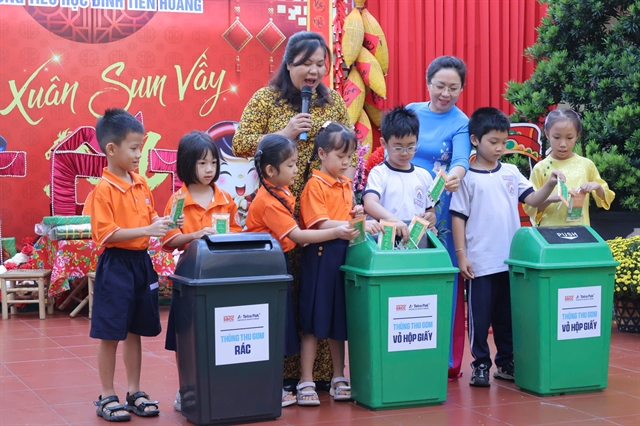 |
| Primary students are being guided to sort empty milk cartons at Đinh Tiên Hoàng School in HCM City. — Photos courtesy of Tetra Pak |
HCM CITY — Billions of beverage cartons are consumed each year, representing a vast yet underused source of recyclable material. As Việt Nam moves into a new phase of mandatory household waste separation, a new education and environmental initiative being piloted in 16 primary schools in HCM City is showing how meaningful change can begin with something as simple as a milk carton.
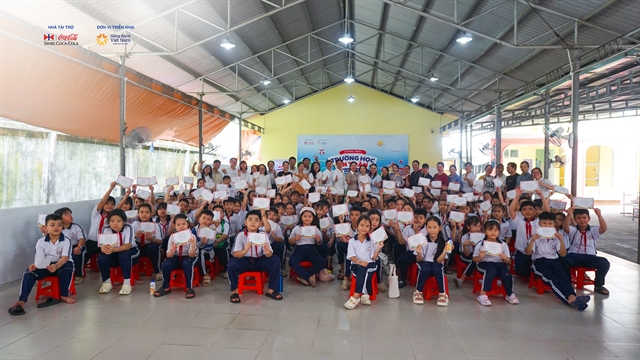
Initiated by Tetra Pak, the Carton for Communities programme is being piloted at 16 schools across HCM City. Alongside wider community awareness campaigns, the initiative places a strong focus on students, a group seen as well positioned to develop recycling and waste-sorting habits from an early age.
Educational psychologists describe children as reverse change agents, individuals capable of influencing parents and the wider community to adopt positive behaviours. Field studies conducted across Asia and Latin America have repeatedly documented this effect, showing that when children change their habits, families often follow.
Under the programme, students are taught four simple steps: drink it clean, tuck in the straw, close the lid and flatten it. While each step takes only seconds, organisers say they can make a significant difference by reducing storage space and ensuring used cartons can enter the recycling chain more effectively.
A key feature of the programme is its closed-loop design, linking schools, collection teams and recycling partners in a continuous chain that takes used cartons from classrooms to processing facilities before returning them to the community as new products.
Nguyễn Đỗ Thu Minh, Sustainability Manager at Tetra Pak Vietnam, said one of the main challenges remained waste separation at the source.
“Tetra Pak paper cartons can be recycled where appropriate collection, sorting and processing systems exist. Through the Carton for Communities programme, we hope to share our experience and foster collaboration between schools, families and businesses to gradually build a stable collection system, thereby contributing to reduced CO₂ emissions and more efficient use of natural resources.”
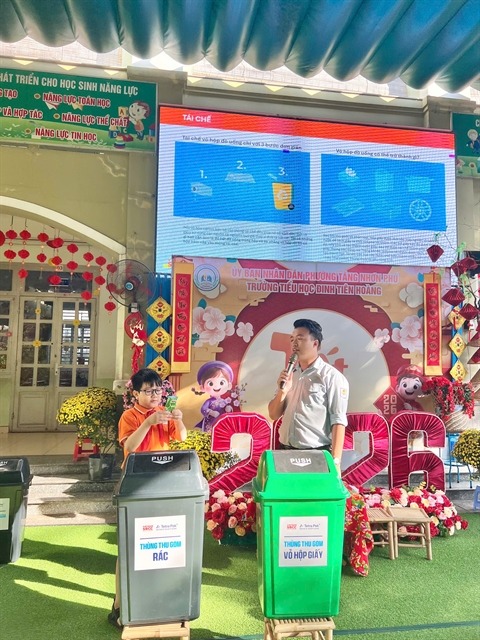 |
| Students participate in a hands-on experience of sorting waste at the source. — Photos courtesy of Tetra Pak |
Before this initiative, Tetra Pak had already rolled out its School Recycling Programme across Bắc Ninh and Bình Dương, reaching nearly 1,200 schools. The programme continues to expand with the aim of narrowing the gap between recycling potential and reality.
Ms Bùi Duyên, Director of SBCC Vietnam, a social enterprise specialising in social and behaviour change communication for sustainable development and a key implementing partner of the programme, said: “Through the programme, we are not simply teaching students how to sort waste, we are nurturing their identity as protectors of their city. Using tangible tools such as dedicated collection bins, posters and interactive games, the act of correctly handling a milk carton becomes an inspiring experience rather than a dry obligation.
“Real change begins when children bring these habits home and teach their parents how to handle cartons properly. The small actions of each family gradually ripple outward, through alleyways, neighbourhoods and communities, building a society that lives with responsibility and environmental care."
Tens of thousands of tonnes of cartons are awaiting a second life each year. These figures are not distant abstractions. They begin with the milk carton in a child’s hands on a school morning and with the small habit that child carries home to the family dinner table.
In major cities such as Hà Nội and HCM City, beverage cartons are becoming an increasing challenge in the daily waste stream. Despite being highly recyclable, they remain among the categories least consistently sorted at source.
Experts said Việt Nam generates billions of paper cartons each year, representing a substantial source of recyclable material. However, recycling rates remain well below potential, leaving much of this valuable resource stream untapped as the country works towards a circular economy. — VNS
Society
 Society
 Society
 Society
 Society
 Society
 Society
 Society
 Society
 Society
 Society
 Society
 Society
 Society
 Society