 Society
Int’l cooperation helps address nuclear power workforce shortages
1.
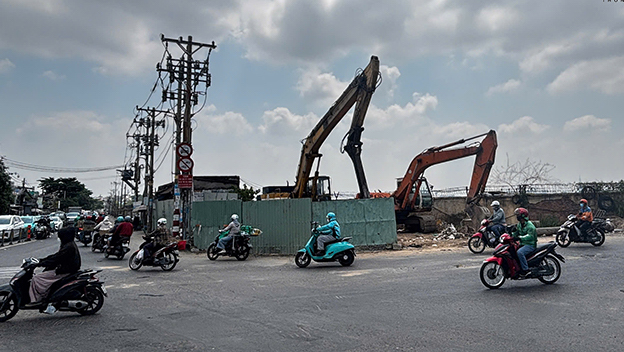 |
| The S10 station site in HCM City in preparation for underground construction, marking a significant milestone in the city's efforts to complete the underground section of Metro Line No. 2. — VNA/VNS Photo |
HCM CITY — HCM City is accelerating its ambitious metro network expansion, positioning urban rail as the primary driver for regional connectivity and sustainable economic development.
While construction on Metro Line No. 2 from Bến Thành Market to Tham Lương proceeds around the clock, the city is preparing to deploy a series of new routes.
These projects are designed to restructure the urban landscape and establish a seamless transport link between the city centre and key satellite hubs, including the Thủ Thêm New Urban Area and Long Thành International Airport.
Throughout late April, construction on Metro Line No. 2 has reached a fever pitch along major arteries such as Cách Mạng Tháng Tám (August Revolution) and Trường Chinh.
According to the Management Authority for Urban Railways (MAUR), multiple workstreams are being executed simultaneously, ranging from geological surveys and utility relocation to traffic diversion.
At major underground stations such as S5 (Lê Thị Riêng Park) and S10 (Phạm Văn Bạch Street), drilling operations are being carried out around the clock.
Heavy machinery is deployed primarily at night to mitigate the impact on local residents and traffic.
Data collected from these strata will inform the technical design for Tunnel Boring Machines (TBMs).
Notably, the project has increased its fleet of TBMs from four to five, allowing parallel excavation across multiple sections to shorten the overall delivery timeline.
Beyond Line 2, the city is fast-tracking several strategic routes:
Bến Thành-Thủ Thiêm: This line serves as a vital link between the existing city centre and the Thủ Thiêm New Urban Area, the site of a future international financial hub.
Thủ Thiêm-Long Thành Airport: An urgent feasibility study is underway for this route to ensure seamless connectivity once the new international airport becomes operational.
Bàu Bàng-Cái Mép-Thị Vải: Designed as a dedicated industrial artery, this link will transport goods from key manufacturing zones to deep-sea ports, significantly reducing logistics costs and road congestion.
The city’s ambitious master plan envisions a comprehensive network of 27 lines spanning over 1,012km.
This includes 12 lines within the former HCM City, 12 in the former Bình Dương Province, and three in the former province of Bà Rịa-Vũng Tàu.
Over the next decade, the city will prioritise nine key routes covering 374km, requiring an estimated investment of US$37.15 billion.
This expansion aims to create a seamless "urban-industrial-port" corridor, integrating the satellite cities of the southern economic zone.
The capital requirement for such a gargantuan network exceeds the capacity of the State budget alone. Consequently, the city is refining its policy framework to attract private sector participation.
The current financial model suggests the State budget will cover 30-40 per cent of total investment, primarily for land clearance and technical infrastructure.
The remainder is expected to be raised through Public-Private Partnerships (PPP), municipal bonds, and land value capture.
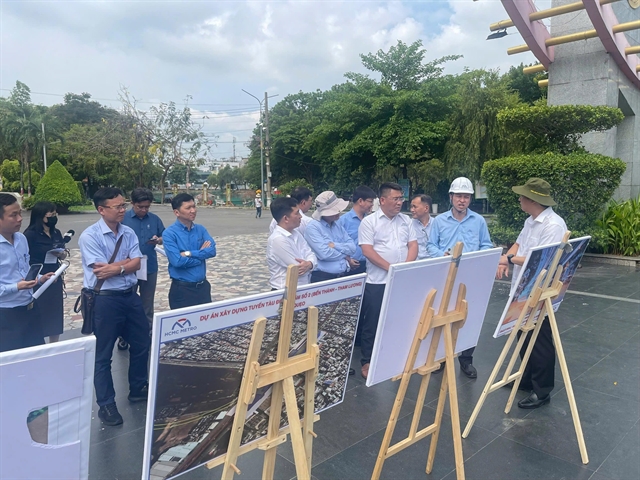 |
| Engineers conduct geological surveys at a Metro Line 2 site in HCM City on April 3. Data from these activities will inform the technical design for Tunnel Boring Machines (TBMs) as the city expands its rail network. — Photo courtesy of MAUR |
Bùi Anh Huấn, deputy head of MAUR, said the city is developing risk-sharing mechanisms to encourage private giants like THACO and Becamex to invest.
Metro projects have long payback periods and high revenue risks.
“We need policies that guarantee minimum revenue or provide financial support during the initial operational phases," he said.
The Transit-Oriented Development (TOD) model is viewed as the ultimate "financial lever". By developing high-density commercial and residential zones around metro stations, the city can generate significant revenue from land funds to offset construction costs.
According to urban planners, an integrated metro network will act as a catalyst for growth, driving urban expansion, attracting foreign capital, and unlocking higher labour productivity.
Architect Ngô Viết Nam Sơn said the success of this vision hinges on political resolve and organisational capacity.
In this new vision, the metro is not merely a transport project; it is a strategic tool to link industry, urban living, and logistics, ensuring the city remains the nation’s economic locomotive, he said. — VNS
Society
 Society
 Society
 Society
 Society
 Society
 Society
 Society
 Society
 Society
 Society
 Society
 Society
 Society
 Society