 Environment
Việt Nam looks to develop leading regional laboratories by 2045
1.
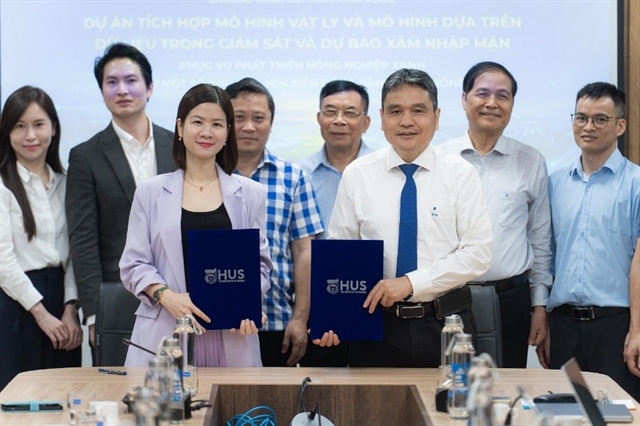 |
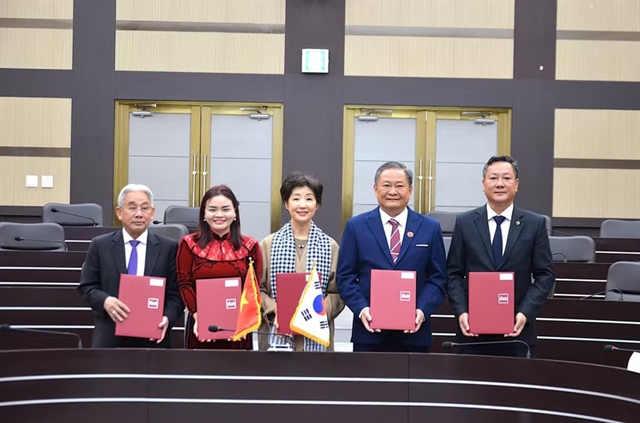
| The VinFuture Foundation and the University of Science officially announced their collaboration to implement the saltwater intrusion prevention project. — Photo courtesy of VinFuture Foundation |
HÀ NỘI — A project has been launched to apply artificial intelligence (AI) and advanced technologies to create a digital shield against saltwater intrusion, protecting green agriculture in the Red River Delta and strengthening climate resilience in coastal farming areas.
The project, entitled Integrating physical and data-driven models in monitoring and forecasting saltwater intrusion to support green agricultural development in some coastal areas of the Red River Delta, is jointly implemented by the VinFuture Foundation and the University of Science, Việt Nam National University, Hà Nội.
The project aims to apply AI and advanced technologies to enhance climate change adaptation capacity and promote green agriculture in the coastal areas of the Red River Delta.
It seeks to build an integrated multi-technology monitoring and forecasting system, combining physical models and AI models including machine learning and deep learning with remote sensing data, unmanned aerial vehicles (UAVs) and IoT sensor networks.
According to the project’s research team, all multi-source data will be synchronised on the DataCube spatio-temporal platform. When combined with physical models, AI systems, remote sensing, IoT and WebGIS technologies, the platform will generate digital maps capable of monitoring and providing near real-time warnings on saltwater intrusion. This is expected to serve as a key tool for localities to respond proactively and protect agricultural production from environmental impacts.
The platform will provide early warning of saltwater intrusion one to five days in advance. This golden period is expected to allow farmers to adjust planting schedules and plan water storage and management, thereby minimising economic losses caused by natural disasters.
Project leader Dr Nguyễn Hữu Duy, Deputy Head of the Department of Human Geography and Planning at the Faculty of Geography, University of Science, said the project is expected to shorten the distance from the laboratory to the field.
“The project not only provides data but will also transform complex data into easily understandable recommendations, helping farmers directly apply them to their daily production activities,” Dr Duy said.
Dr Lê Thái Hà, Executive Director of the VinFuture Foundation, said the project is expected not only to enhance monitoring and forecasting capacity for saltwater intrusion but also to provide practical support to people and management agencies in decision-making, thereby promoting the transition to a green and sustainable agricultural model better adapted to climate change.
The project is expected to be implemented over two years with collaboration from domestic and international organisations including the Water Resources University (Việt Nam), the Institute of Water Resources Science (Việt Nam), Nanyang Technological University (Singapore) and the University of Edinburgh (Scotland).
The research team said the project is expected to act as a digital shield helping farmers in coastal provinces proactively protect their livelihoods from saltwater intrusion while laying the foundation for a green agricultural model adapted to climate change. — VNS
Environment
 Environment
 Environment
 Environment
 Environment
 Environment
.jpg) Environment
Environment
 Environment
 Environment
 Environment
 Environment
 Environment
 Environment
 Environment
 Environment