 Society

Việt Nam, Cambodia seek to bolster all-round ties: PMs
1.
 |
| The Austrian tourist poses for a photo with local police and villagers after being helped. — Photo courtesy of the tourist |
HÀ NỘI — An Austrian tourist who got lost in a remote forest in northern Việt Nam has been rescued after spending a night alone in the hills – a detour he later realised began with a wrong turn on Google Maps.
The man had been travelling by motorbike through Lạng Sơn Province on March 31 when he followed directions onto a narrow dirt track leading into Lài Han Village.
By mid-afternoon, his bike lost traction and slid down a steep slope.
He tried for hours to get it back up, but the terrain was too difficult. Eventually, he left the motorbike behind and set off on foot, hoping to find a way out. As darkness fell, he lost his bearings and ended up spending the night in the forest.
Earlier that evening, a villager out searching for buffalo had noticed tyre marks cutting sharply down a hillside – a sign that something might have gone wrong. Residents organised a search, fanning out across the area, but with little information to go on and night closing in, they came up empty-handed.
By dawn, the tourist had reached the edge of the village and knocked on a door. The homeowner, Triệu Văn Hội, found him outside – exhausted, scratched and clearly shaken.
The man tried to explain himself using Google Translate, even dropping to his knees at one point to ask for help. Hội, who cannot read, quickly called for assistance from village officials.
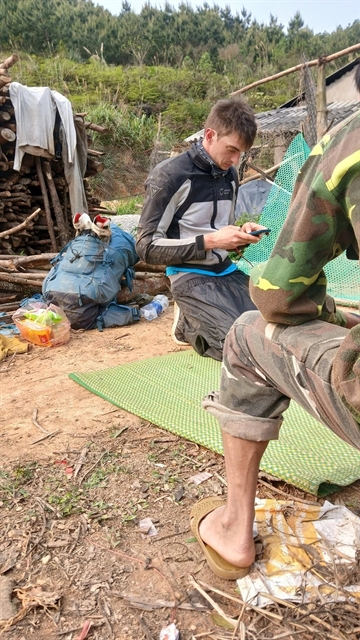 |
| The tourist uses Google Translate on his phone to communicate with villagers. — Photo courtesy of the village chief |
Within minutes, neighbours had gathered. They brought the tourist inside, gave him food and somewhere to rest, and tried to piece together what had happened.
“We don’t usually see strangers here,” said Triệu Hinh, the village chief.
“It’s a very remote place. No one expected a foreign visitor to end up here like that.”
At around the same time, the motorbike rental operator, who had lost contact with the tourist overnight, was trying to locate him using a GPS tracker on the vehicle. Not knowing anyone in the area, the owner called a number pinned on an online map – that of a local resident, Triệu Văn Lưu.
When Lưu arrived, the situation was already calmer, but the tourist was still visibly rattled. Using a translation app, Lưu learned that the man was from Austria and had rented the bike in Đà Nẵng, setting off on a solo trip from Hà Nội towards Lạng Sơn.
“He followed Google Maps onto a quiet dirt road. In the dark, he fell down a steep ravine,” Lưu said.
The tourist kept asking about the motorbike, worried about what would happen to it. A small group of villagers and local police set out to find it, tracing the tyre marks down the slope. It took about half an hour to locate the bike.
The incline was steep enough that several people had to work together, pushing and pulling to haul the vehicle back to the road.
 |
| A member of the search team locates the motorbike. — Photo courtesy of the village chief |
When they finally returned it, the tourist appeared visibly moved. He bowed repeatedly, thanking everyone. Before leaving, he tried to offer money in return, but the villagers refused.
“It’s just what you do when someone is in trouble,” one of them said.
The bike was later recovered and sent back to Đà Nẵng with the help of Hoàng Lăng Huy, an off-road specialist in Lạng Sơn. Huy also took the tourist into the provincial centre and showed him around before driving him to Hà Nội the next day so he could catch his flight home.
“He was travelling alone, so I just helped. That’s all,” Huy said.
For locals, the incident is unusual – but not entirely unfamiliar. In recent years, several foreign travellers have run into trouble after relying on digital maps to navigate remote parts of Việt Nam.
In October last year, two Dutch tourists followed Google Maps into dense forest in the central province of Quảng Trị, veering more than five kilometres off course.
One of their motorbikes slipped into a stream on a muddy track, leaving them injured and stranded overnight in an area without a phone signal. They were eventually rescued by police and villagers using tractors in heavy rain.
Stories like these have prompted repeated warnings from travel and rescue groups.
In mountainous regions, they say, digital maps often favour the shortest route – not the safest or most practical one. Dirt tracks that appear passable on a screen can quickly become impassable in reality, especially after rain or after dark.
The advice is simple: avoid unfamiliar routes late in the day, turn back if the road starts to look risky, and when in doubt, ask a local. — VNS
Society
 Society
 Society
 Society
 Society
 Society
 Society
 Society
 Society
 Society
 Society
 Society
 Society
 Society
 Society