 Society
SBV to curb property price inflation, enforce lending rate rules
1.
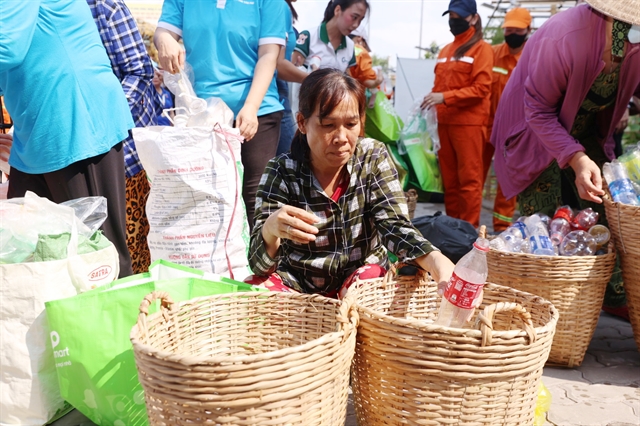 |
| Local people experience sorting waste at the Material Recovery Facility on April 3. Photo courtesy of the organisers |
HCM CITY The Material Recovery Facility (MRF) was officially inaugurated in Tân Mỹ Ward, Ho Chi Minh City on April 3.
The MRF is a key initiative within the project “Waste Separation at Source and Community-Based Plastic Recycling,” implemented by Unilever Vietnam in collaboration with the People’s Committee and the Vietnam Fatherland Front Committee of Tân Mỹ Ward. The project aims to establish a unified waste management model involving local authorities, businesses, and residents. This initiative combines technology with community participation, contributing to the implementation of the Politburo's Resolution 57/NQ-TW on promoting science, technology, innovation, and national digital transformation.
A standout feature of the Tân Mỹ Ward MRF is its digitalised operation. The model integrates local collection infrastructure with technology to monitor and manage the flow of recyclable materials in real-time. The entire process—from household sorting and station collection to transferring materials to recyclers—is recorded and reported via the Grac application.
This digital integration facilitates: accurate tracking of material volume and journey, traceability of waste origins, and verification and reconciliation between different stages of the supply chain.
By utilising standardised and transparent data, the MRF acts as more than just a recovery site; it serves as a digital link that optimises the "sorting–collection–recycling" chain. This digital transformation enhances operational efficiency and meets the increasing requirements for digital transition and ESG (Environmental, Social, and Governance) standards.
The model places the community at the center, with residents acting as the primary "touchpoint" for waste separation at the source. Proper sorting at the household level ensures the MRF receives clean materials, which streamlines data recording and connects the subsequent links in the collection, transfer, and recycling chain.
Consequently, sustainable waste-sorting habits are reinforced, creating a foundation for the recovery and recycling system to operate stably and expand in line with Việt Nam’s circular economy orientation.
"The 'Waste separation at source and community-based plastic recycling' project is not only an urgent activity but also a concrete and practical step toward achieving sustainable development goals and building a 'green, clean, beautiful, civilized, and modern' Tân Mỹ Ward," said Chairwoman of the Tân Mỹ Ward People’s Committee, Nguyễn Thị Bé Ngoan.
Addressing the event, National Chairwoman of Unilever Vietnam, Nguyễn Thị Bích Vân emphasised that there will be no circular economy without waste separation at the source.
"The MRF is not just a facility; it is a testament to the determination of the government, businesses, and the community to join hands in building civilised habits and a green community where children can grow up healthy, happy, and environmentally conscious," said Vân. VNS
Society
 Society
 Society
 Society
 Society
 Society
 Society
 Society
 Society
 Society
 Society
 Society
 Society
 Society
 Society