 Society
PM orders urgent completion of decree on petroleum trading by November 10
1.
|
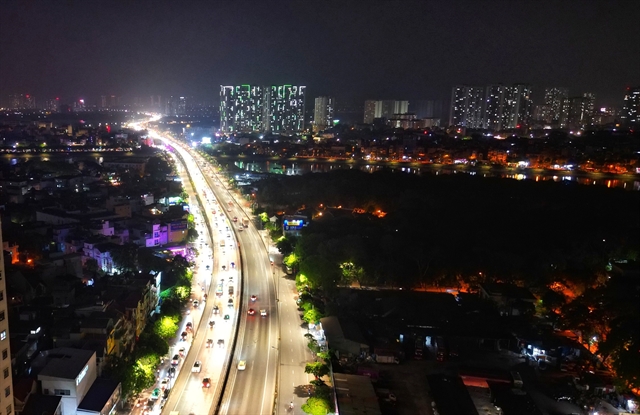
| The Ring Road 3 in Hà Nội. Ring roads will open up development space for the capital city. — VNA/VNS Photo Tuấn Anh |
HÀ NỘI — Closed ring road systems will help Hà Nội complete its infrastructure framework, ease traffic congestion and open up new development corridors along key transport axes, according to the municipal Department of Construction (DoC).
The DoC reported that the city’s ring road network currently comprises seven routes with a combined length of more than 303km. These include five primary ring roads (Ring Road 1, Ring Road 2, Ring Road 3, Ring Road 4 and Ring Road 5) and two supporting routes (Ring Road 2.5 and Ring Road 3.5).
Under the capital’s long-term planning orientation with a 100-year vision, an additional Ring Road 4.5 will be developed, currently designated as a north-south economic development corridor. Once completed, the system will consist of eight ring roads with a total length exceeding 377km.
All ring roads are designed to connect with major radial routes, helping distribute traffic across both intra- and inter-regional directions. Of the eight routes, five are classified as urban main axes (Ring Road 1, Ring Road 2, Ring Road 2.5, Ring Road 3.5 and Ring Road 4.5), two as urban expressways featuring elevated sections (Ring Road 3 and Ring Road 4), and one as a motorway (Ring Road 5).
To date, 98.14km of the planned 377.04km has been completed (26.02 per cent), while 134.55km (35.68 per cent) is under construction. Another 16.8km (4.48 per cent) is operational but has yet to meet planning standards, and 127.55km (33.83 per cent) has not yet been prepared for investment, with no feasibility studies conducted.
PPP investment
For Ring Road 2, the DoC has proposed that the city approve a project to construct, renovate and expand the route, including both elevated and at-grade sections from Ngã Tư Sở to Cầu Giấy. The proposed design includes a 53.5m-wide at-grade road and a 19m-wide elevated section, with total investment estimated at VNĐ21.3 trillion (US$812.8 million).
The department has also recommended assigning the Department of Finance to advise the municipal People’s Committee on pre-investment procedures for upgrading Nguyễn Văn Linh Road in line with the master plan.
For Ring Road 2.5, the city has instructed the Urban Transport Construction Investment Project Management Board to coordinate with the DoC to appraise post-basic designs for key segments, including Dịch Vọng–Dương Đình Nghệ, Vũ Phạm Hàm–Trần Duy Hưng, and Ngụy Như Kon Tum–Nguyễn Trãi, as a basis for completing construction within the year.
Regarding Ring Road 3, the Department of Finance has been tasked with coordinating with Quang Minh Commune authorities to finalise the pre-feasibility study for the section from Võ Văn Kiệt Road to Ring Road 4. Once approved, the route will help connect Ring Road 4 with the planned road linking Gia Bình Airport to Hà Nội.
For Ring Road 4.5, the city plans to upgrade the north-south economic axis to ring road status, enabling adjustments to its scale within the capital’s long-term master plan. The Department of Finance has been assigned to advise on implementing the project under a public-private partnership (PPP) model.
As for Ring Road 5, Hà Nội will continue to propose that the Ministry of Construction study and supplement investment options, including PPP mechanisms.
The city is currently working on its overall master plan with a 100-year vision, aiming to develop a modern, synchronised transport network that supports sustainable urban growth.
Once the aforementioned planning is approved by the competent authority, the DoC will continue to report to the people’s committee on options and timelines for investing to complete the ring roads in the city. — VNS
Society
 Society
 Society
 Society
 Society
 Society
 Society
 Society
 Society
 Society
 Society
 Society
 Society
 Society
 Society