 Society
Digital tools boost livelihoods in Nghệ An’s highlands
1.
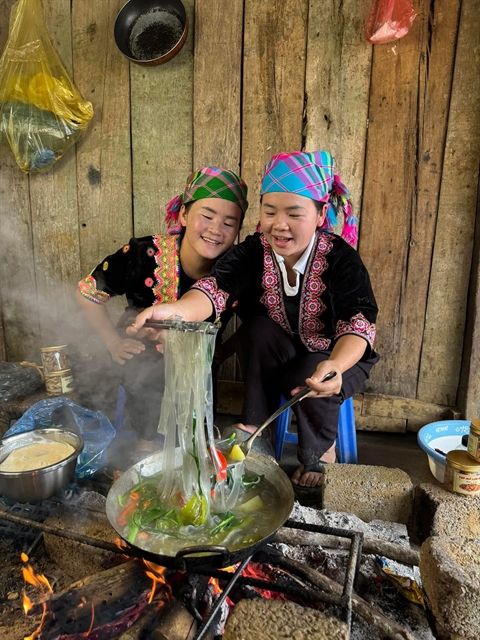 |
| Vừ Thị Xia and Vừ Thị Chứ during a video introducing local glass noodles of their hometown. — Photo courtesy of Vừ Thị Xia |
Khánh Dương
HÀ NỘI — In the past, ethnic farmers in Thành Lập Commune in the northern mountainous province of Lai Châu carried their produce to local markets or along roadside stalls, spending the entire day in the hope of selling everything. Others stayed at home, waiting for traders to buy their goods in bulk, often at modest prices.
Today, a quiet digital revolution is unfolding in the highlands, where smartphones are proving as vital as soil and rain.
Instead of heading to market, many farmers remain at home with a phone in hand.
They film short promotional videos on Facebook or host livestream sessions on TikTok, turning wooden houses into small online studios.
Through these platforms, their products now reach customers not only nearby but hundreds of kilometres away.
Each morning, siblings Vừ Thị Xia and Vừ Thị Chứ, from the Mông ethnic community, begin their day by brainstorming ideas for their next video rather than heading straight to the fields.
After taking a digital economy course in Hà Nội in 2022, the two sisters created social media pages to sell local farm products such as pork, poultry and vegetables online.
By introducing seasonal produce sourced from local households to customers across the country, they have become the first farmers in their village to pioneer digital sales.
To promote smoked black pork, a local delicacy known for its rich flavour, they capture authentic scenes of dark-coated pigs roaming the hills, the careful preparation process and strips of meat hanging above the kitchen fire.
When selling vegetables and other produce, they film themselves harvesting greens on misty hillsides, highlighting freshness and origin.
“I just film whatever is natural - my husband, my children, my family, our customs and traditions,” said Xia, 26. “Even when packing orders, I livestream the whole process - how I pack, how I ship and exactly what I send.
“I do everything sincerely. Naturally, that attracts people who genuinely love and support me.”
Online sales have significantly improved her family’s income. Once classified as a poor household, she now earns enough to cover her children’s tuition and daily expenses.
In 2025, she and her sister hosted a livestream session that helped local farmers sell 300 tonnes of yacon.
For Xia, the most meaningful achievement is passing on her knowledge to other ethnic minority women.
Village gatherings have grown livelier, with smartphones replacing traditional tools.
She teaches women how to film, edit videos and set up tripods for livestreaming.
“Women are able to sell products, build their own brands and start businesses. That is truly wonderful. I won’t stop here,” she said.
“My goal is to spread this model so local people have more opportunities to improve their lives.”
She has even mentored two women who cannot read or write, yet have successfully built online channels and are now selling pork and chicken independently.
Giàng Thị Chư from the northern mountainous province of Sơn La is among those who joined Xia’s e-commerce classes.
“She taught us how to shoot wide, medium and close-up shots,” Chư said.
“I have been told that videos don’t have to be fancy. They should tell our own stories.”
According to her, simple and down-to-earth storytelling is the most appealing feature of agricultural products from the northern highlands.
Age is not a barrier
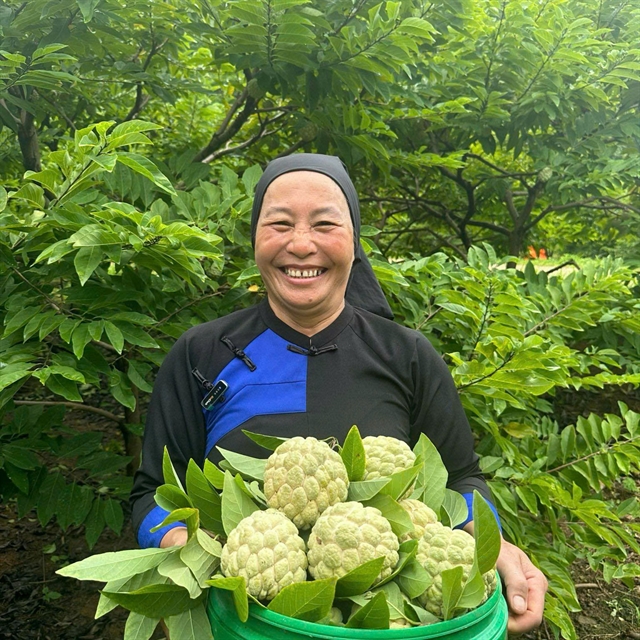 |
| Đặng Thị Thơ helps local people sell local specialities. — Photo courtesy of Thơ |
Unlike the younger Xia and Chứ, Đặng Thị Thơ from the northern mountainous province of Lạng Sơn began learning to sell farm produce online in her 50s.
At 56, she started making short videos and livestreaming with guidance from her niece.
Initially, she faced scepticism from neighbours who believed she was too old to appear online.
During her first month of daily livestreaming, she received no orders and nearly gave up.
“I kept trying for 30 days, and on the 31st day, I got my first order,” she said.
“In communication, we may not be eloquent. Our appearance may not be glamorous. But as ethnic people, the most important thing is to be genuine. The videos must be real and the products must truly be local,” she said.
Followers of her Facebook and TikTok channels, Cô Thơ ơi, have become familiar with her short, light-hearted skit-style videos about village life and farmers.
Through these clips, she introduces Lạng Sơn’s local specialities in a simple and cheerful way.
Thơ sells black grass jelly, Chinese sausage, khâu nhục (braised pork belly) and Lạng Sơn rock sugar custard apples.
After a period of livestreaming on TikTok, she realised that the most effective time slots are from 10am to 12pm and from 8pm to 10pm.
Thơ also encourages other ethnic minority women to take part in online sales, though many remain shy or lack confidence.
She hopes to expand the model to help raise incomes and create jobs, especially in remote areas.
Digital villages
Today, terms such as 'e-commerce,' 'livestream selling' and 'cashless payment' are becoming increasingly familiar in remote communities.
Highland residents are gradually shifting from traditional business models to digital opportunities.
Lê Hoàng Oanh, director general of the Việt Nam E-commerce and Digital Economy Agency under the Ministry of Industry and Trade, said that when rural and mountainous women gain digital skills, they not only improve their family livelihoods but also become drivers of community economic development.
Amid the rapid rise of artificial intelligence, Oanh stressed that authenticity remains the golden key. Livestream sessions held in fields and orchards, where sellers share their own life stories, continue to hold lasting appeal for urban consumers.
However, she also pointed to persistent challenges, including uneven internet infrastructure, high logistics costs and the lack of on-site guides — individuals who understand both technology and local realities.
Pioneers such as Vừ A Xia, Vừ A Chứ and Đặng Thị Thơ are spearheading digital economic initiatives in small villages, serving as digital skills trainers and key opinion leaders in their hometowns. — VNS
Society
 Society
 Society
 Society
 Society
 Society
 Society
 Society
 Society
 Society
 Society
 Society
 Society
 Society
 Society