 Society
84 individuals investigated for transnational online frauds
1.
|
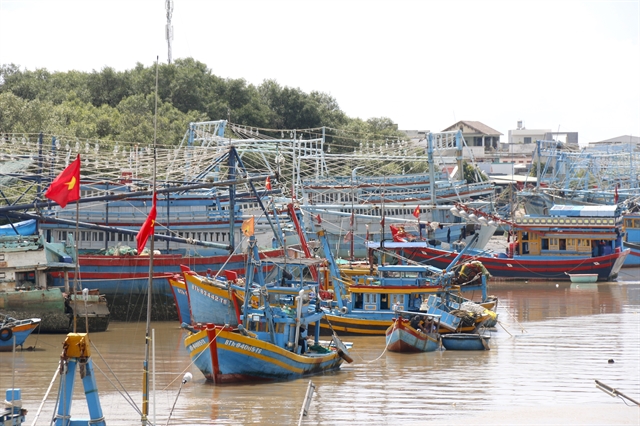
| Fishing boats dock on the Phú Hài River in Lâm Đồng Province’s Phú Thủy Ward while awaiting inspection and the issuance of fishing licences. — VNA/VNS Photo |
LÂM ĐỒNG — Lâm Đồng Province plans to develop its fisheries sector into a large-scale, commercially oriented industry that is transparent, responsible, competitive, and integrated into global markets.
Under a plan approved by the People’s Committee for the 2026–30 period, the sector will pursue green, modern and efficient growth with a strong focus on climate resilience.
Fisheries are expected to play a larger role in the province’s agriculture, forestry and fisheries economy, while contributing more to export earnings.
The plan covers the entire fisheries value chain, from fishing and aquaculture to processing and logistics services, and sets specific development targets for until 2030.
The sector’s average annual growth is projected at 4.5–5 per cent, accounting for about 18–20 per cent of the total value of the agriculture, forestry and fisheries sector.
The total fisheries catch is expected to reach 262,000 tonnes a year, including 260,000 tonnes from the sea and 2,000 tonnes from inland waters.
The aquaculture output target is 85,000 tonnes annually, including 55,000 tonnes from marine and brackish-water farming and 30,000 tonnes from freshwater farming.
Marine aquaculture will be developed on an industrial scale, with priority given to high-value species such as grouper, cobia, pompano, lobster, and seaweed.
Cold-water fish are identified as a key specialty product, with annual output targeted at more than 5,000 tonnes.
Production of aquatic seed is expected to reach 37 billion juveniles a year.
The province aims to build on its strength in shrimp seed production while expanding seed supply for marine fish, molluscs and freshwater specialty species.
A central goal of the plan is to increase annual fisheries exports to US$350–400 million.
To support this, Lâm Đồng will modernise processing facilities and increase the share of value-added and deeply processed products.
All industrial seafood processing plants will be required to meet international standards on food safety, traceability and environmental protection.
Seafood landed at ports will be closely monitored to prevent illegal products from entering export markets. Fishing vessels operating in nearshore and offshore waters will be equipped with electronic monitoring devices to ensure maritime safety and compliance with traceability requirements.
|
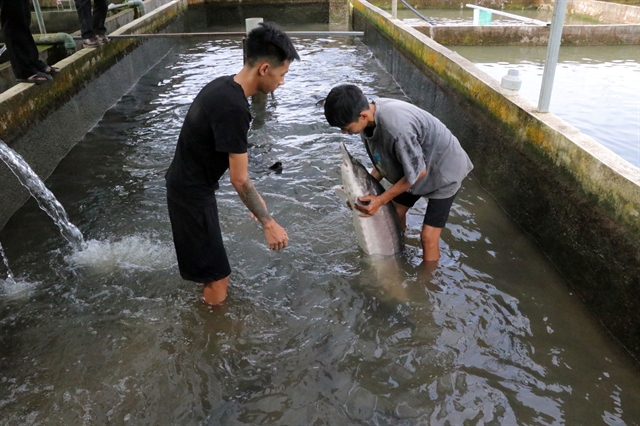
| A sturgeon farm in Lâm Đồng Province’s Đam Rông Commune. — VNA/VNS Photo |
By 2045 the province aims to develop a modern fisheries industry with high value added and deep international integration, built on green and sustainable principles and adaptable to climate change.
Lâm Đồng is expected to become one of the country’s major centres for fishing, fisheries logistics services, marine aquaculture, and cold-water fish farming linked to processing.
Alongside growth objectives, the plan places strong emphasis on environmental protection and livelihoods.
In recent years the fisheries sector has provided tens of thousands of jobs, helping increase incomes for fishermen and workers in related occupations.
Fisheries logistics fleets not only allow fishing vessels to operate at sea for longer periods but also strengthen the presence of Vietnamese boats in distant offshore and island waters, contributing to the protection of maritime sovereignty.
As of the end of last year the province had 8,210 fishing boats, with vessels measuring from six to 12 metres accounting for 52.7 per cent of the total.
Total fisheries output was estimated at 252,550 tonnes last year, up 4.9 per cent from 2024.
The province has five fishing ports with a combined capacity of 135,000 tonnes of seafood per year, which meets about 56 per cent of landing demand.
It has also built four storm shelters for fishing boats, covering around 60 per cent of berthing needs.
But despite this progress climate change and natural disasters are posing growing challenges.
In highland areas, drought, dry-season water shortages and flooding have disrupted cage aquaculture in rivers and reservoirs.
Coastal waters are frequently affected by storms and tropical depressions, causing losses to both aquaculture and fishing operations.
Infrastructure at fishing ports and storm shelters remains inadequate, with several facilities overloaded or degraded, posing safety risks for vessels and workers.
The province has identified environmental protection and the conservation of aquatic resources as long-term priorities.
Inspection and monitoring efforts are being strengthened to curb destructive fishing practices and the use of illegal gear.
Co-management models and restocking programmes are being implemented to restore aquatic ecosystems and ease pressure on natural resources.
At the same time the province is working to improve forecasting capacity and develop proactive plans to prevent, respond to and mitigate natural disaster risks in both aquaculture and fishing. — VNS
Society
 Society
 Society
 Society
 Society
 Society
 Society
 Society
 Society
 Society
 Society
 Society
 Society
 Society
 Society