 Society

AXA Global Healthcare Mind Health Report reveals global differences in how cost and stigma affect access to professional mental health care
1.
|
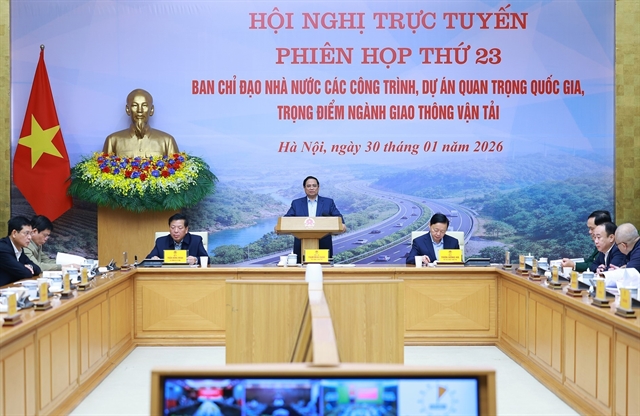
| Prime Minister Phạm Minh Chính chairs the 23rd meeting of the State Steering Committee for nationally significant transport projects on Friday morning in Hà Nội.— VNA/VNS Photo Dương Giang |
HÀ NỘI — With Việt Nam entering a decisive phase of infrastructure development, ministries, agencies and localities must give priority to expressway projects in the Mekong Delta, the northern mountainous provinces, the Central Highlands and routes linking the country with China, Laos, and Cambodia.
Prime Minister Phạm Minh Chính made the remarks on Friday morning in Hà Nội while chairing the 23rd meeting of the State Steering Committee for nationally significant transport projects, held both in person and online with 27 localities hosting major transport schemes.
Chính, who is also head of the committee, instructed the Ministry of Finance and the Ministry of Construction to coordinate in identifying priority projects under the medium-term public investment plan, aiming to complete at least 5,000km of roads nationwide by 2030 in line with resolutions of the Party Congress.
Particular emphasis was placed on the Mekong Delta, where 600km of expressways must be completed by the end of this year, followed by a further 600km by 2030.
Projects in the northern mountainous provinces of Cao Bằng, Tuyên Quang, Lai Châu, and Sơn La remain challenging, PM Chính said, urging relevant parties to identify the shortest and most feasible routes to connect these areas with the lowlands.
The Government leader also called for the completion of the Đồng Đăng (Lạng Sơn) – Trà Lĩnh (Cao Bằng) expressway, routes linking Việt Nam with Laos such as Vinh – Thanh Thủy and Mỹ Thủy – La Lay and key transport links serving the Central Highlands.
Ministries and local authorities were ordered to strictly implement Official Dispatch No. 05/CĐ-TTg, which calls for an urgent review and upgrading of expressways already built in phases.
On aviation infrastructure, he directed relevant ministries and agencies to intensify leadership and oversight of airport construction and expansion projects, including Long Thành, Cà Mau, Quảng Trị, Gia Bình, Phù Cát, Phú Quốc, and Côn Đảo.
While inspections and audits must be stepped up, with violations handled strictly, such measures should not disrupt project implementation, he said.
The northern mountainous province of Sơn La was asked to continue studying the restoration of Nà Sản Airport.
Regarding seaports, especially Cái Mép – Thị Vải, Lạch Huyện, Hòn Khoai and Liên Chiểu, he called for rapid investment and expansion, alongside the development of airport-centred and aviation-related economic zones.
He also stressed the urgency of transport links connecting ports and airports, particularly Long Thành Airport and the planned road linking Gia Bình Airport with Hà Nội.
The Prime Minister emphasised that resolutions of the 14th National Party Congress must be implemented immediately together with resolutions adopted by Party congresses at all levels, in a spirit of decisive action.
Ministries, agencies and localities were urged to proactively carry out their assigned duties within their authority, without waiting for further instructions or relying on others.
On site clearance, he underscored the responsibility of local leaders, especially Party secretaries, to directly oversee and drive the process, mobilising the entire political system to ensure timely handover of land.
Legitimate rights and interests of affected residents must be safeguarded, with resettlement conditions at least equal to or better than previous living standards, and dialogue strengthened to build public understanding and support.
In investor selection, bidding and procurement, he demanded strict compliance with the law, effectiveness and transparency.
He warned against breaking projects into smaller packages and subcontracting abuses, stressing zero tolerance for corruption and misconduct.
For expressway projects, priority should be given to reputable groups and companies with proven track records.
He also asked the Mekong Delta city of Cần Thơ to draw lessons to speed up work on sections under its jurisdiction of the Châu Đốc - Cần Thơ - Sóc Trăng expressway.
The Ministry of Construction, together with the Government Inspectorate and the Ministry of Finance, was instructed to conduct inspections, audits and reviews from the outset of projects and whenever irregularities emerge.
Calling on investors, contractors, engineers and workers to demonstrate the highest sense of responsibility, he urged strict compliance with the law and relentless effort on construction sites, ensuring workers are supported.
On construction materials, he called for close and flexible coordination among ministries, agencies and localities to avoid bottlenecks.
An Giang Province was encouraged to further expand exploitation of local mines to supply the delta, while other provinces with sand, stone and gravel resources were told to coordinate actively with neighbouring localities, investors and contractors.
The Ministry of Construction was tasked with adjusting prices in line with actual conditions and promoting the proper use of sea sand for land reclamation, while the Ministry of Agriculture and Environment was asked to promptly address material-related obstacles at key projects.
Highlighting that 2026 marks the first year of the 2026-30 socio-economic development plan, he called on all stakeholders to heighten responsibility, choose effective investment methods, swiftly remove institutional and policy bottlenecks and ensure timely commendation and rewards.
Chính assigned Deputy Prime Minister Trần Hồng Hà to continue to directly oversee efforts to resolve difficulties, while urging faster progress on infrastructure projects serving APEC 2027.— VNS
Society
 Society
 Society
 Society
 Society
 Society
 Society
 Society
 Society
 Society
 Society
 Society
 Society
 Society
 Society