 Society

2026 Swiss-Viet Economic Forum ties poised for growth as EFTA trade deal opens new opportunities
1.
|
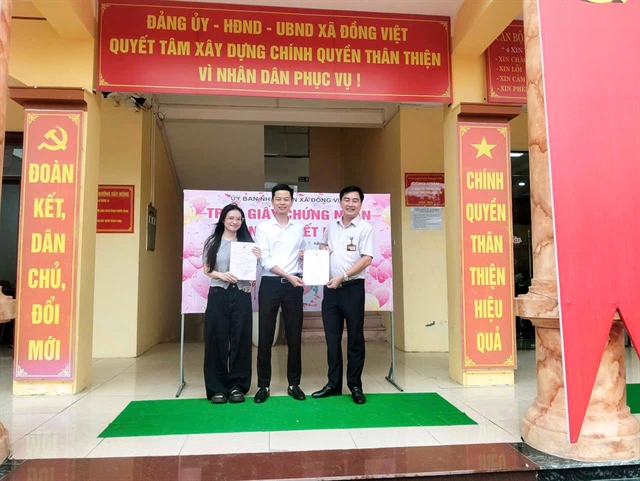
| An official of the People’s Committee of Đồng Việt Commune presented a marriage certificate to two local residents at the commune’s Public Administrative Service Centre in the northern province of Bắc Ninh.— Photos courtesy of the provincial People's Committee |
BẮC NINH — The Department of Justice of Bắc Ninh Province has rolled out the iUCHI software across all notary offices in the province over the past time.
This is an internal application that incorporates artificial intelligence to support notarial operations.
Its most important function is the detection of cases in which a land-use right certificate (“red book”) may be used as collateral at multiple banks or traded repeatedly through successive transactions.
Most recently, the department advised the provincial People’s Committee to issue Decision No. 62, which stipulates the transfer of a number of land-related certification tasks from commune- and ward-level People’s Committees to notary offices.
The move is intended to ease overcrowding at certain commune-level public administrative service centres and to advance the policy of socialising selected public administrative services.
Following the consolidation of its organisational structure and operations under the two-tier local government model, the department has promptly brought State management tasks within its remit into effective and efficient operation, including those related to notarial services.
|
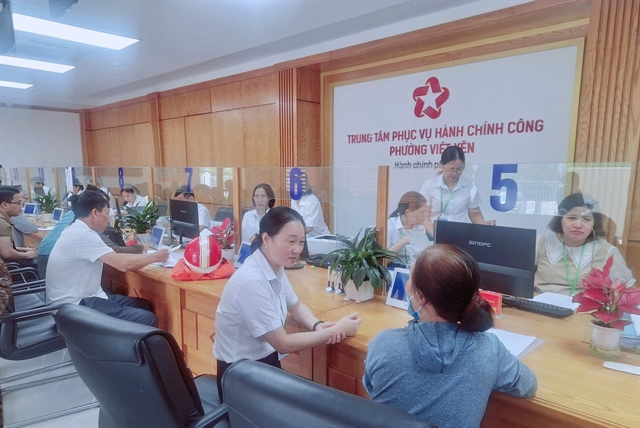
| Local citizens at the Public Administrative Service Centre in Việt Yên Ward, Bắc Ninh Province. |
From July 2025, the 2024 Law on Notarisation requires individuals seeking notarisation to have their photographs taken at the time of signing, under the direct supervision of a notary.
Image-based identification of the parties to a civil transaction helps dispel doubts as to whether the signatures are genuinely those of the principals involved, thereby strengthening the legal validity of notarised documents.
In the field of real estate transfers, the photo requirement is expected to minimise so-called “suspended notarisation” - a practice whereby the buyer’s details are left blank in notarised documents in order to evade taxes on subsequent transfers.
Although notarisation is formally classified as a public administrative service, the majority of assets subject to notarisation are high-value real estate properties worth billions of đồng.
Therefore, effective State management and the closing of loopholes in notarial practices will help minimise potential civil disputes and contribute to a stable environment for socio-economic development in the province.— VNS
Society
 Society
 Society
 Society
 Society
 Society
 Society
 Society
 Society
 Society
 Society
 Society
 Society
 Society
 Society