 Society

Việt Nam, Switzerland to turn education, sci-tech, innovation into cooperation focus
1.
 |
| Phạm Đức Luận, Director General of the Việt Nam Disaster and Dike Management Authority (under the Ministry of Agriculture and Environment). — VNA/VNS Photo Doãn Tấn |
Phạm Đức Luận, Director General of the Việt Nam Disaster and Dyke Management Authority, discussed with VietnamPlus e-newspaper how the country plans to tackle increasingly complex disasters and strengthen relief and response efforts.
What will be the hydro-meteorological trends for the final months of 2025, and which disasters require particular attention?
According to the National Centre for Hydro-Meteorological Forecasting (NCHMF), from now until the end of the year, about two to three storms or tropical depressions are expected to form over the East Sea (internationally known as the South China Sea), with one or two likely to affect Việt Nam, mainly in the central region, from Hà Tĩnh to Lâm Đồng provinces.
This will also be the peak flood season in the central region, with flood levels on rivers forecast to reach alert levels 2-3 (middle to high levels), and in some areas above level 3.
From late October, cold air will begin affecting Việt Nam and may intensify through November and December. Severe cold spells in the north are likely to occur in the latter half of December 2025. In addition, dangerous weather phenomena such as thunderstorms, tornadoes, lightning, hail and strong gusts are expected to continue nationwide.
Therefore, upcoming disaster prevention efforts should focus on storms and floods in the central provinces, especially typhoons and severe flooding in the final months of the year.
Despite various efforts, natural disasters continue to cause significant loss of life and property each year. What shortcomings still exist in disaster prevention and control?
Since the beginning of 2025, the country has experienced 20 types of natural disasters. They have occurred with high frequency, wide reach and abnormal intensity, exceeding historical records. In particular, recent storms No 5, 9, 10 and 11 (respectively Kajiki, Ragasa, Bualoi and Matmo) moved very quickly with strong, erratic intensity.
Extreme rainfall and record-breaking floods have occurred in many rivers across Tuyên Quang, Thái Nguyên, Lạng Sơn, Bắc Ninh, Thanh Hóa and Nghệ An provinces. Some areas faced multiple overlapping disasters, flash floods and landslides, especially in the northern mountainous and north-central regions.
Although early and remote disaster response measures have helped to minimise losses, several shortcomings remain. For example, there are still fatalities caused by travel during floods, or failure to comply with safety protocols for vessels during storms.
While storm forecasting is nearly on par with advanced countries, forecasts for extreme rainfall and record-breaking floods remain limited, and difficulties still exist in predicting flash floods and landslides.
In many places, preventive actions such as pruning trees, reinforcing homes and public buildings, and securing signs and billboards are still not carried out thoroughly, leading to extensive roof damage and collapse.
Infrastructure resilience also remains low, particularly against superstorms and record-breaking floods. Equipment and facilities for disaster response and rescue are still insufficient, especially for operations at sea or in remote areas.
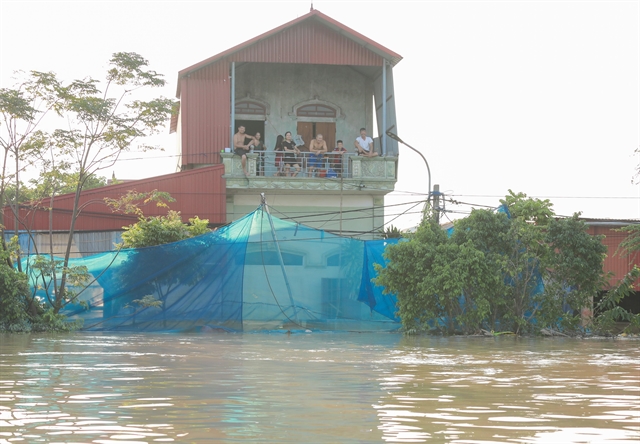 |
| Heavy flooding due to rising water level from the Cầu River isolate thousands of people in Vân Hà Ward, Bắc Ninh Province in early October 2025. — VNA/VNS Photo Phan Phương |
Given these challenges, what are the most fundamental and urgent solutions to enhance resilience to extreme weather under climate change?
It is essential to review and adjust institutional policies and frameworks and integrate disaster prevention and control into sectoral and regional development planning.
At the same time, construction standards and regulations must be updated to ensure safety and resilience against large-scale extreme disasters such as the superstorms and historic floods experienced recently.
Equally important is improving the accuracy and reliability of forecasts, especially rainfall forecasting for flood, inundation, flash flood and landslide warnings, in addition to developing detailed disaster risk maps down to the village level, relocating people from high-risk areas, and tailoring agricultural production models to local contexts.
Other key measures include reinforcing dikes, reservoirs and disaster prevention works, especially those that are degraded or vulnerable, upgrading river and sea dikes to withstand superstorms and heavy floods, and installing automated flash flood warning stations in high-risk zones.
Strict management is also needed to prevent construction that encroaches on rivers, streams and slopes, which increases disaster risks. Flood discharge areas along major river basins such as the Cầu, Hồng (Red) and Cửu Long (Mekong) rivers must be protected according to regulations.
Furthermore, efforts should focus on community-based risk management, communication and raising awareness, enhancing training on local disaster types, expanding international cooperation and scientific research, and applying digital transformation and real-time disaster monitoring. Recovery efforts should aim to build back more sustainably.
In the long term, how can the disaster and dike management authority improve the effectiveness of community-based disaster risk management, particularly by mobilising public engagement in this process?
To make community-based disaster risk management more effective, we need to strengthen the implementation of the project on raising public awareness and community-based disaster risk management by 2030, as detailed in the Prime Minister’s Decision No 553/QĐ-TTg dated April 6, 2021.
Accordingly, local authorities should develop annual plans and allocate funding for this project, prioritising communes frequently affected by storms, floods and landslides, and update training and communication materials to suit local conditions and meteorological developments.
Educational and communication activities should also be diversified, targeting officials, residents and vulnerable groups such as children, the elderly and people with disabilities.
In addition, localities should flexibly mobilise all available resources, encourage participation from the private sector, international organisations and NGOs, strengthen inspection and supervision and promptly address implementation challenges. Successful models should be documented, shared and replicated nationwide. — VNS
Society
 Society
 Society
 Society
 Society
 Society
 Society
 Society
 Society
 Society
 Society
.jpg) Society
Society
 Society
 Society
 Society