 Society

Tiny Titan domination: VinFast VF3 is the best-selling BEV model in the Philippines
1.
 |
| AHEAD OF THE SITUATION: While in Algeria, Prime Minister Phạm Minh Chính chaired an online meeting with authorities nationwide to coordinate rescue efforts. VNA/VNS Photos |
A series of intense storms swept across Việt Nam’s south-central coast and central highlands in mid-November, triggering the most severe flooding the region had seen in decades.
Đắk Lắk and Khánh Hòa bore the worst, with rivers breaching record levels and whole communities cut off. Locals soon began referring to it as the “Great Flood”, a crisis whose scale quickly surpassed all expectations.
For the authorities, it became a trial of leadership and coordination; for residents, a struggle to survive.
From abroad in Algeria, Prime Minister Phạm Minh Chính acted decisively. At 10pm Hà Nội time on November 20, he held an urgent online meeting with leaders in the worst-hit provinces. Deputy Prime Minister Hồ Quốc Dũng oversaw recovery in Khánh Hòa Province, while Deputy Prime Minister Nguyễn Hòa Bình directed rescue and evacuation in Đắk Lắk Province.
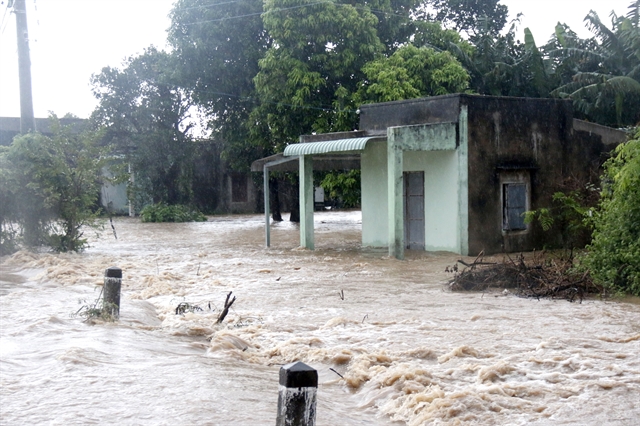
Water levels on the Ba and Kỳ Lộ rivers in Đắk Lắk and the Dinh Ninh River in Khánh Hòa surged above historical records. Entire neighbourhoods were submerged, trapping families who repeatedly called for help.
At 2am on November 23, PM Chính held another online meeting from Johannesburg, South Africa, urging officials to take swift, coordinated actions for rescue and relief work.
He also ordered additional emergency funding: VNĐ500 billion (approximately US$19 million) for Đắk Lắk, VNĐ150 billion each for Gia Lai and Khánh Hòa, and VNĐ300 billion for Lâm Đồng.
By November 23, the toll was grim: 102 dead or missing, over 1,100 homes damaged, nearly 186,000 flooded, 80,000 hectares of crops lost, and more than 3.2 million livestock swept away. Key roads and sections of the North–South railway were paralysed.
Race to rescue
The Government mobilised every available resource. The Ministry of Defence deployed around 44,600 soldiers with over 2,200 vehicles, while police dispatched more than 98,500 personnel and over 13,500 vehicles. Naval units in Khánh Hòa sent 400 sailors with boats and specialised equipment to reach isolated communities.
At the peak of the crisis, police and military personnel waded into rushing waters, risking their lives to save residents.
In Hòa Thịnh Commune, Đắk Lắk Province, Captain Nguyễn Văn Hoàng and hundreds of soldiers from Military Region 5 mobilised every available vehicle and boat to reach people isolated by floodwaters. Many of his colleagues had relatives trapped in the same areas, yet they stayed focused on the mission, delivering essential supplies and continuing rescue operations. “Helping the people is like helping our own families,” Cap Hoàng said.
With the coordination of local civil defence authorities, 38,380 households with nearly 120,000 people were safely evacuated. Ordinary residents also stepped forward, rowing boats and piloting speedboats to rescue neighbours, exemplifying the extraordinary solidarity that emerged amid the disaster.
 |
| URGENT MOVE: Rescue teams evacuate residents in Khánh Hòa Province to safer areas. |
In Diên Điền Commune, Khánh Hòa Province’s most isolated flood zone, officials delivered food, water, and care to the elderly, children, pregnant women, and other vulnerable residents.
Communities unite
Amid the chaos, stories of generosity and solidarity emerged. Field kitchens cooked hot meals for stranded families and rescue teams. Families like that of Đinh Tấn Ký in Nam Nha Trang prepared 8,000 meals, delivered by boat to those trapped by rising waters.
For 70-year-old Lê Văn Khiêm, surviving 72 hours without electricity or phone signal, a hot meal brought tears: “This is probably the best meal of my life,” he said.
Across the nation, donations poured in. HCM City sent VNĐ50 billion and thousands of relief packages. Khánh Hòa received more than 810 tonnes of supplies, including food, clothing, blankets, and medical equipment. Đắk Lắk collected VNĐ132 billion and 1,500 tonnes of goods, with aid also arriving from international organisations.
For the first time in history, the Government activated a special relief mechanism, assigning four high-revenue localities to support the central provinces: HCM City to Khánh Hòa, Hà Nội to Gia Lai, Quảng Ninh to Lâm Đồng, and Hải Phòng to Đắk Lắk. Hundreds of thousands of tonnes of goods poured in, in a vivid display of national solidarity.
Meteorologists described the floods as extreme and historically rare. Rainfall in some areas exceeded 1,000mm in a matter of days, while multiple major rivers of Kỳ Lộ, Ba, Dinh, and Ninh Hòa simultaneously breached previous records.
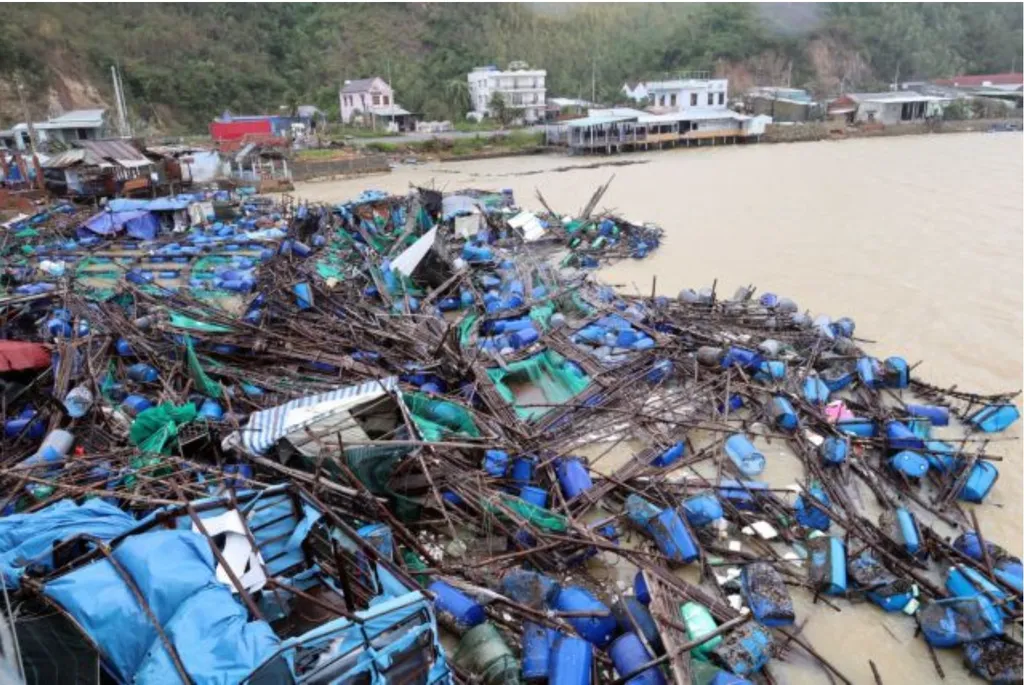 |
| DESTRUCTIVE FORCE: Floodwaters devastated aquaculture cages and rafts in Xuân Cảnh Commune of Đắk Lắk Province. |
The floods struck crop farming and fisheries hardest. Vineyards along the Cái Phan Rang River in Khánh Hòa were reduced to mud-covered remnants.
Sông Cầu, Đắk Lắk’s centre of lobster farming, saw over 80,000 cages containing 21,000 tonnes of lobsters lost, with damages estimated at VNĐ2.4 trillion. Families who spent decades building businesses were left with nothing.
By November 25, the official toll stood at 63 dead and eight missing in Đắk Lắk, 22 dead in Khánh Hòa, with preliminary infrastructure losses estimated at VNĐ5.5 trillion in Đắk Lắk and VNĐ5 trillion in Khánh Hòa.
Road to recovery
As the waters receded, the focus shifted to recovery. Families salvaged belongings, repaired homes, and restored livelihoods. Local authorities and banks coordinated emergency support, offering preferential loans to restart production.
PM Chính has called on local authorities to review all families who lost their homes in the floods. Latest reports from central provinces show around 1,900 houses were destroyed, collapsed, or swept away. He set a firm deadline: new homes must be completed in time for the 2026 Lunar New Year.
 |
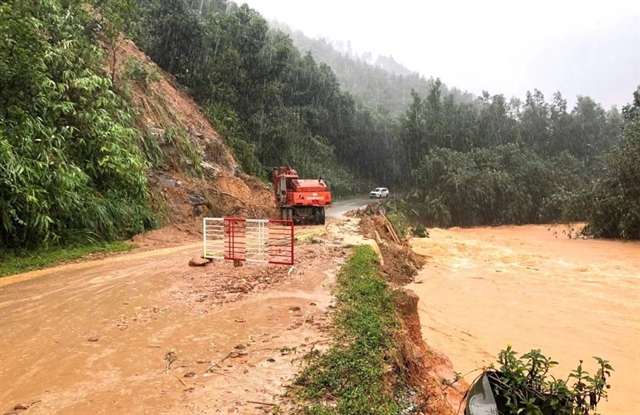
| AFTERMATH: Road maintenance units in Khánh Hòa Province work to clear landslide debris along Road 73. |
Nghiêm Xuân Thành, secretary of the Communist Party Committee of Khánh Hòa, said the province would mobilise all available resources, including support from the central Government and other provinces, to assist affected residents directly.
The plan includes VNĐ60 million for each completely destroyed house and VNĐ30 million for damaged homes.
In Diên Điền Commune, VNĐ38.5 billion was earmarked for households, alongside funds for students’ books and school supplies. Families received aid directly, even in flooded areas.
Lobster farmers in Xuân Đài Bay began salvaging cages and repairing homes. With interest rates on policy loans reduced and emergency capital provided, production is gradually resuming. Markets are reopening, farms restocking, and planting resumes, in a testament to resilience.
On November 21, PM Chính announced a reduction in interest rates for several social-policy loan programmes at the Vietnam Bank for Social Policies. The measure is designed to give residents affected by the floods easier access to capital, helping them rebuild homes, restore livelihoods, and restart production in the aftermath of the disaster.
Preparing ahead
Relentless rains in Khánh Hòa submerged nearly 490 mobile base stations. Power outages and damaged fibre-optic cables disrupted communication, hampering coordination from provincial authorities to local communes.
.jpg) |
| CLEAN-UP: A mobile command vehicle from Naval Region Four was deployed in Khánh Hòa Province, in an area left isolated by floodwaters. |
To overcome this, military units quickly established emergency communication systems. Lieutenant Colonel Bùi Xuân Đức, leading rescue operations in Diên Điền Commune, where over 9,600 households were isolated, said: “We built our plan around communication equipment. Shortwave radios linked all rescue points, and soldiers relied on at least one local resident in each community as a liaison to relay information."
Meteorologists emphasise that forecasts must reach residents directly via TV, radio, SMS, and social media, and residents need training to understand weather warnings and recognise local hazards.
The disaster also revealed limits in forecasting and infrastructure. Extreme rainfall exceeded historical patterns, while localised downpours and landslides remain difficult to predict. Sparse monitoring networks in upstream and mountainous regions mean authorities often lack real-time data for rapid response.
Mai Văn Khiêm, director of the National Centre for Hydro-Meteorological Forecasting, said authorities could predict the general area and timing of heavy rainfall, but pinpointing localised downpours remains difficult, especially in mountainous tropical regions. Landslide warnings still covered entire communes rather than specific slopes or roads, and sparse monitoring in upstream areas limited real-time alerts for flash floods.
Experts recommend expanding technology and data systems: more automatic rainfall and hydrological stations, X-band weather radar, and high-resolution flood maps. Artificial intelligence and big data can model flood patterns, allowing real-time alerts for urban flooding and landslides in vulnerable areas like Nha Trang and Phan Rang.
Urbanisation and extreme rainfall have reduced natural drainage, making coordinated reservoir management essential. Currently, many reservoirs operate independently with low technology adoption. Modernising management through digital systems would enable timely, precise, and flexible decision-making, ensuring safety, reducing flood risks, and supporting agriculture and local economies. VNS
.jpeg) |
| VOLUNTEERING: Hanoians sort and pack clothing for flood-affected communities in the central region. |
Society
 Society
 Society
 Society
 Society
 Society
 Society
Society
Society
 Society
 Society
 Society
 Society
 Society
 Society
 Society


.jpg)




