 Politics & Law

AITO Looks Ahead to Europe, Building a Thriving Automotive Ecosystem
1.
|
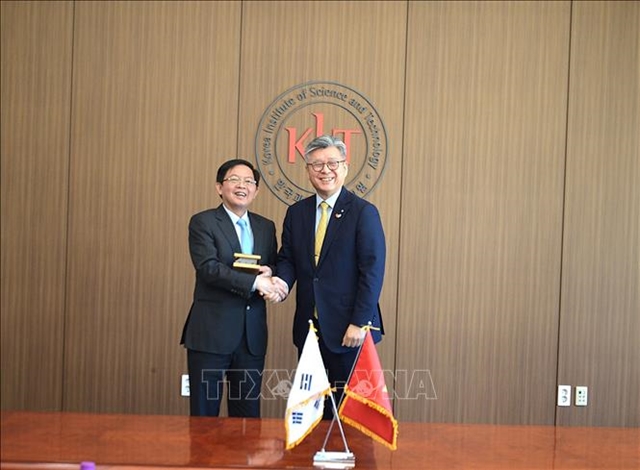
| Deputy Prime Minister Hồ Quốc Dũng (left) and KIST President Oh Sang Rok in South Korea on Tuesday. — VNA/VNS Photo Khánh Vân |
SEOUL — Deputy Prime Minister Hồ Quốc Dũng has called on the Korea Institute of Science and Technology (KIST) to expand cooperation with Vietnamese research institutes and universities in training and research, contributing to the development of products that address Việt Nam’s major challenges and support its socio-economic development.
He made the request during a field trip to the institute on Tuesday, part of National Assembly President Trần Thanh Mẫn’s official visit to the Republic of Korea (RoK).
Established in 1966, KIST, the RoK’s first multidisciplinary government-funded research institute, is tasked with promoting research and technological development for industry and national development, KIST President Oh Sang Rok said.
KIST conducts basic and applied research in fields including advanced materials, semiconductors, artificial intelligence (AI), robotics, biotechnology and biomedicine, energy, environment and carbon technologies. It also carries out interdisciplinary research to turn research results into technologies applicable to industry.
Oh said KIST plays an important role in the country’s national R&D ecosystem, focusing on foundational and emerging technologies and interdisciplinary research. Cooperation with the Vietnam-Korea Institute of Science and Technology (VKIST) has produced positive results, with the two sides implementing various research programmes and planning to expand cooperation.
Deputy PM Dũng said he was impressed by KIST’s 60-year journey alongside the RoK’s development.
Recalling cooperation between the two countries to establish VKIST about a decade ago, he described the decision as a milestone that laid the foundation for bilateral research cooperation.
Dũng also recalled his discussions with RoK Deputy PM and Minister of Science and ICT Bae Kyung Hoon in Hà Nội in April 2026, when the science and technology ministries of the two countries, together with the RoK Ministry of Foreign Affairs, signed a Framework Master Plan for bilateral cooperation in science, technology and innovation.
He said the visit demonstrated the potential to turn agreements reached at government and ministerial levels into substantive programmes and projects involving research institutes, universities and businesses.
Việt Nam hopes KIST will remain a strategic, long-term partner of Vietnamese research institutes, universities and the scientific community, he said, stressing that cooperation should go beyond ties between KIST and VKIST to serve as a bridge connecting scientists, universities and businesses of the two countries.
He proposed expanding joint research programmes, particularly in strategic areas where Việt Nam has development needs, and KIST has strengths, including semiconductor integrated circuits, AI, batteries and energy storage, and biotechnology.
Cooperation should focus on practical technologies and products capable of being tested and transferred to businesses, he added.
He also called on KIST to continue supporting Việt Nam, particularly VKIST, in training high-quality science and technology personnel by providing opportunities for young Vietnamese scientists and engineers to study and work in KIST research groups and laboratories alongside Korean scientists.
Such cooperation would facilitate the transfer of not only knowledge but also research experience, organisational methods and a culture of innovation, he said.
The Deputy PM suggested that KIST strengthen the sharing and joint use of research facilities, laboratories and modern equipment with VKIST and Vietnamese partners, while the two institutes continue exchanging experience in research governance, selecting strategic scientific tasks, connecting with businesses and commercialising research results.
On this occasion, the Vietnamese delegation visited KIST’s Semiconductor Technology Centre, Quantum Technology Centre, AI and Robotics Institute, and Energy Storage Research Centre.
Dũnghighly valued KIST’s research capabilities and its strong orientation towards practical applications and commercialisation of research results. — VNA/VNS
Politics & Law
 Politics & Law
 Politics & Law
 Politics & Law
 Politics & Law
 Politics & Law
 Politics & Law
 Politics & Law
 Politics & Law
 Politics & Law
 Politics & Law
 Politics & Law
 Politics & Law
 Politics & Law
 Politics & Law




