 Politics & Law
Việt Nam, Switzerland seek to deepen parliamentary cooperation
1.
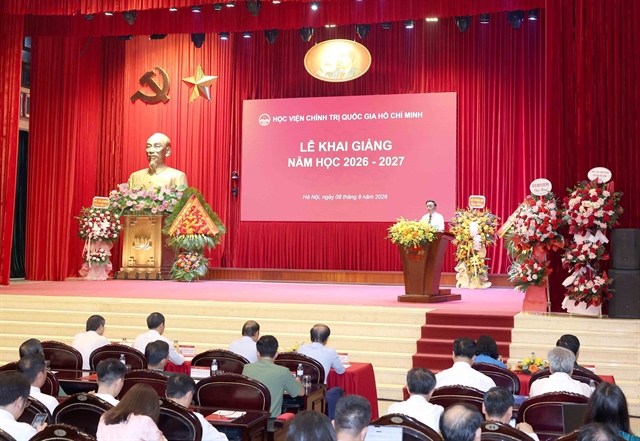 |
| Politburo member and Standing Member of the Communist Party of Việt Nam Central Committee’s Secretariat Trần Cẩm Tú spoke at the opening ceremony for the 2026–27 academic year at the Hồ Chí Minh National Academy of Politics in Hà Nội on September 8. — VNA/VNS Photo |
HÀ NỘI — Politburo member and Standing Member of the Communist Party of Việt Nam (CPV) Central Committee’s Secretariat Trần Cẩm Tú attended the opening of the 2026–27 academic year at the Hồ Chí Minh National Academy of Politics in Hà Nội on Tuesday.
More than 2,800 students admitted to the full-time 2026–27 advanced political theory training course attended the event, along with 60 members of the Lao People’s Revolutionary Party studying at the academy.
Tú directed the academy to fully absorb and translate the Resolution of the 14th National Party Congress into action plans with clear persons, tasks, timelines and outcomes. Training, research, policy advisory, consultation and international cooperation must all reflect the political mettle, brainpower and identity of the Party’s top school for political theory training.
He called for resolute delivery of instructions from Party General Secretary and President Tô Lâm during his working sessions with the academy, particularly the view that academy reform must be placed within the broader context of Party building, theory and personnel development.
At the same time, the academy should also step up theoretical research tied to reviews of practical experience, ensure effective rollout of national-level special sci-tech agendas for 2026–30, and focus on completing and developing the theory underpinning the Party’s reform policies in the new era.
As the standing agency, the academy should proactively coordinate projects serving the review of the Party’s 100-year leadership of the Vietnamese revolution from 1930 to 2030 and the 40-year rollout of the Platform on national construction in the period of transition to socialism, while preparing scientific arguments and theoretical materials for drafting documents for the 15th National Party Congress.
Underscoring fundamental and comprehensive reform of personnel training as the central task of the academic year, he asked the academy to thoroughly understand and concretise the philosophy behind personnel training reforms for 2026–35 with a vision to 2045, renew training content and ensure quality based on competency, position title and job standards.
Alongside courses for strategic-level officials, he said the academy must pay special attention to grassroots-level personnel.
The academy needs fundamental solutions to improve the quality of its affiliated academies and provincial-level political schools by standardising curricula and developing teaching staff, ensuring no gaps or disparities in training quality among localities and grassroots units, he said.
He stressed the need to build personnel and lecturers with firm political mettle, revolutionary ethics and high professional qualifications, deep understanding of practical realities, and the ability to conduct independent research and continuously update knowledge.
He also highlighted the importance of accelerating digital transformation under the Politburo’s Resolution 57-NQ/TW, completing shared data infrastructure, effectively operating the “Smart Academy” model, building a modern, open and adaptive digital training ecosystem, and reforming data-driven training management while ensuring cybersecurity and information security. — VNA/VNS
Politics & Law
 Politics & Law
 Politics & Law
 Politics & Law
 Politics & Law
 Politics & Law
 Politics & Law
 Politics & Law
 Politics & Law
 Politics & Law
 Politics & Law
 Politics & Law
 Politics & Law
 Politics & Law
 Politics & Law




