 Politics & Law

Banana stems find new life in art and craft
1.
|
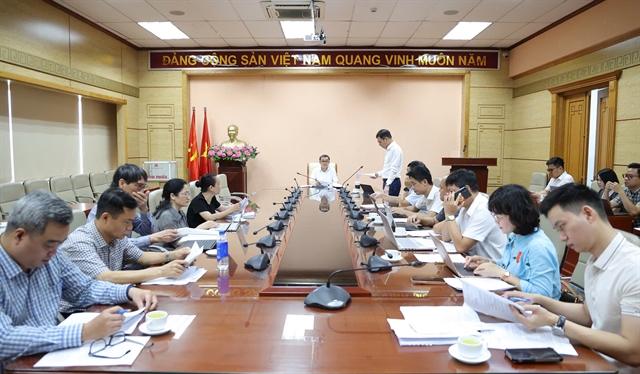
| Delegates attend the meeting. — Photo suckhoedoisong.vn |
HÀ NỘI — Delegates agreed that amendments were needed to fully institutionalise the National Assembly (NA)’s policies and to create a coherent legal framework for managing, preventing and sanctioning violations concerning new‑generation tobacco products.
They reached the consensus at a meeting of the drafting committee for the amended Law on Prevention and Control of Tobacco Harms, which was held on Tuesday morning under the chair of Professor Trần Văn Thuấn, Deputy Minister of Health and chairman of the National Medical Council.
The drafting committee members are experts from different departments under the Ministry of Health, including the Department of Medical Service Administration and the Department of Legal Affairs.
According to the law drafting committee, the current Law on Prevention and Control of Tobacco Harms does not contain specific definitions for e‑cigarettes and heated tobacco products, nor does it prohibit these two product groups.
The NA’s Resolution No. 173/2024/QH15 already provides for a comprehensive ban on e‑cigarettes, heated tobacco products and other products containing addictive or harmful substances to human health.
At the same time, the Investment Law has placed e‑cigarettes and heated tobacco products on the list of sectors and trades prohibited from investment and business activities.
The review report on 13 years of implementing the Law on Prevention and Control of Tobacco Harms shows that Việt Nam has achieved many positive results.
The prevalence of conventional cigarette smoking among adult men has fallen significantly; exposure to second‑hand smoke at home, in the workplace and in public places has also continued to decline.
However, the drafting committee noted that these gains are now at risk because of the rapid rise in use of e‑cigarettes and heated tobacco products, especially among adolescents.
Statistics from the Ministry of Health showed that among adolescents aged 13–17, smoking prevalence fell from 5.36 per cent in 2013 to 2.78 per cent in 2019, but the use of e‑cigarettes has increased.
The drafting committee reported that Việt Nam remains one of the 15 countries with the highest prevalence of smoking among adult men worldwide, and ranks third in the ASEAN region.
According to estimates from the Global Burden of Disease study cited by the World Health Organization (WHO), more than 100,000 people die in Việt Nam each year from tobacco‑related diseases, of whom about 84,500 are current smokers and 18,800 die from exposure to second‑hand smoke.
Display ban
One notable provision in the draft amended law proposes to prohibit all forms of tobacco product display at points of sale.
The drafting committee said that although the Advertising Law and the Law on Prevention and Control of Tobacco Harms already ban tobacco advertising, the display of products together with supporting items such as display cabinets, spotlights and signage nonetheless functions as a form of promotion in practice.
This is also a recommendation of the WHO Framework Convention on Tobacco Control (FCTC), of which Việt Nam is a party.
By the end of 2024, 59 countries worldwide had banned tobacco product displays at points of sale. In the ASEAN region, Thailand, Singapore, Brunei, Laos and Malaysia have all adopted such rules.
The drafting committee said that banning displays would help reduce the appeal of tobacco products, particularly to young people, and would support smokers in their attempts to quit.
Alongside policy refinement, delegates noted that enforcement of the law remains uneven across localities. In many mountainous provinces and areas with ethnic minority communities, communication, inspection and monitoring face considerable difficulties owing to limited information infrastructure, language barriers, customs and shortages of personnel.
Therefore, amendments to the law should be accompanied by measures to improve implementation effectiveness, increase resources at the grassroots level, and ensure people in all areas have adequate access to tobacco‑control information.
Concluding the meeting, Deputy Minister Thuấn commended delegates for their discussion, comments and exchanges.
The Deputy Minister requested the drafting committee to promptly incorporate and finalise the draft amended law based on the comments received; and to continue to review the contents carefully to ensure the draft is of high quality, meets practical requirements, and is submitted to competent authorities on schedule.
He also emphasised that, in addition to remarks made at the meeting, ministries, agencies and drafting committee members should continue to submit written comments for the leading agency to compile comprehensively, ensuring the dossier is of high quality.
He instructed the lead unit to adhere to the timetable, urgently complete the explanatory report, collate responses and edit the draft law for timely submission.
“We must take the opportunity to review thoroughly and update all agreed contents so that the version presented next time is more complete,” Deputy Minister Thuấn said. — VNS
Politics & Law
 Politics & Law
 Politics & Law
 Politics & Law
 Politics & Law
 Politics & Law
 Politics & Law
 Politics & Law
 Politics & Law
 Politics & Law
 Politics & Law
 Politics & Law
 Politics & Law
 Politics & Law
 Politics & Law