 Politics & Law
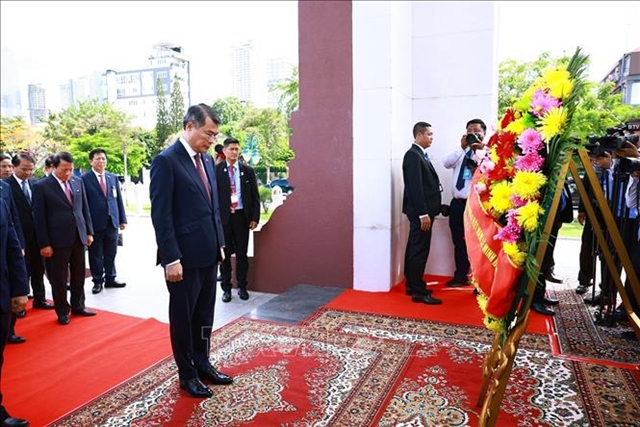
Vietnamese PM pays courtesy visits to Cambodian King, Queen Mother
1.
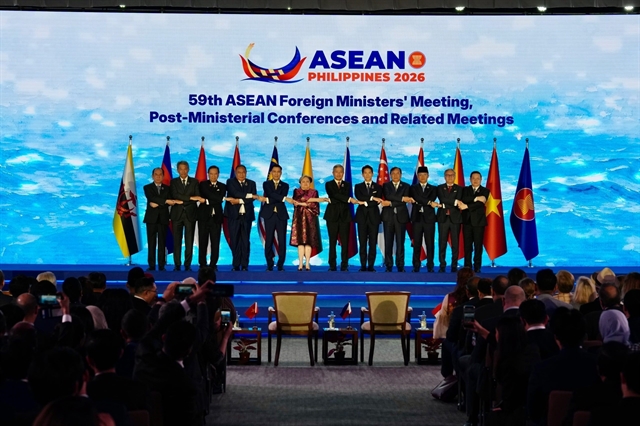 |
| Foreign ministers of ASEAN countries at the 59th ASEAN Foreign Ministers’ Meeting in Manila. —VNA/VNS Photo |
MANILA — Deputy Minister of Foreign Affairs Đặng Hoàng Giang, head of the ASEAN Senior Officials’ Meeting (SOM) delegation of Việt Nam, put forward four proposals to strengthen ASEAN’s solidarity, resilience and connectivity while addressing the 59th ASEAN Foreign Ministers’ Meeting (AMM-59), which opened in Manila on Tuesday.
First, he called for continued adherence to ASEAN principles and stronger dialogue and cooperation to address common challenges.
Second, it is necessary to promote deeper, more resilient, and more competitive ASEAN economic integration through the ASEAN economic security framework to enhance regional resilience in the face of future uncertainties.
Third, he proposed building a people-centred ASEAN that capitalises on the bloc’s “unity in diversity” and promotes mutual understanding among its peoples.
Finally, the official stressed the need to reinforce ASEAN’s strategic autonomy and centrality, particularly amid increasingly intense and complex major-power competition.
Giang, who attended the meeting on behalf of Minister of Foreign Affairs Lê Hoài Trung, also shared Việt Nam’s assessments of regional developments and ASEAN’s priorities in the coming period.
In her opening remarks, Philippine Secretary of Foreign Affairs Ma. Theresa P. Lazaro highlighted the significance of the meeting amid growing global uncertainty and unpredictability, saying that decisions made at this time's meetings will help shape the future of the region.
"In a fractured global landscape, no single nation can weather these storms alone. Our strength and resilience lie in our community," Lazaro told her counterparts.
She emphasised that acting together is ASEAN's shield against external pressures and engine for regional stability. "If we do not move forward as one, we risk being pulled apart."
Lazaro emphasised that ASEAN members should continue upholding the bloc’s fundamental principles based on the Treaty of Amity and Cooperation (TAC), strengthen collective strength and resilience, and make ASEAN a shield against external pressures and an anchor for regional peace and stability.
Following the opening ceremony, ASEAN foreign ministers convened a plenary session where they expressed satisfaction with cooperation achievements recorded during the first seven months of the year and reaffirmed their commitment to implementing the outcomes of the 48th ASEAN Summit, accelerating the ASEAN Community Vision building process and advancing the priorities of ASEAN Chairmanship 2026.
They agreed that the bloc’s immediate priority is to safeguard ASEAN's solidarity and resilience and strengthen its central role within an increasingly substantive and expanding network of partnerships.
They also called for more effective implementation of cooperation plans and programmes, including the coordinated and comprehensive execution of the ASEAN Leaders’ Statement on the response to the Middle East crisis across all three ASEAN pillars to safeguard energy and food security, maintain supply chain stability and support people affected by the crisis.
The officials reiterated support for Timor-Leste’s deeper integration into ASEAN and agreed to admit Türkiye as ASEAN’s 12th dialogue partner.
Later the same day, the ministers attended a retreat session and an expanded informal consultation on Myanmar.
Discussions noted that the world is undergoing profound changes driven by geopolitical and geoeconomic fragmentation, supply chain restructuring and the rise of non-traditional security challenges, all of which pose risks to regional and international peace and security and test national resilience.
They stressed the importance of international law, the United Nations Charter and multilateral mechanisms while highliting the role of ASEAN and ASEAN-led mechanisms in promoting dialogue, resolving differences, building trust and responding to common challenges.
Many ASEAN members underscored the importance of freedom of navigation and overflight in the East Sea, respect for international law, particularly the 1982 United Nations Convention on the Law of the Sea (UNCLOS).
Addressing the renewed escalation of conflict in the Middle East, the ministers issued a joint statement calling on all parties to exercise restraint, seek peaceful solutions, protect civilians and civilian infrastructure, and restore freedom, security and safety of navigation through the Strait of Hormuz.
On Myanmar, they reaffirmed that the country remains an integral part of ASEAN and that the Five-Point Consensus continues to guide the bloc’s efforts. They welcomed the positive developments in Myanmar and the outcome of the informal meeting between ASEAN foreign ministers and Myanmar on July 12, while encouraging Myanmar to continue efforts to make further concrete progress on the ground.
Speaking at the sessions, Giang said ASEAN must remain flexible, adaptive and proactive in shaping regional changes. Việt Nam supports a more flexible ASEAN approach towards Myanmar to enhance engagement, promote reconciliation and inclusive dialogue, and assist the country in addressing urgent economic and social challenges.
Reaffirming the importance of peace, security and stability, he stressed that ASEAN should maintain its principled position on the East Sea. He reinterated the necessity for complying with international law and resolving disputes peacefully on the basis of international law, especially the 1982 UNCLOS.
Việt Nam remains committed to working with other ASEAN members to fully and effectively implement the Declaration on the Conduct of Parties in the East Sea (DOC) and, together with China, strive for the early conclusion of an effective and substantive Code of Conduct in the East Sea (COC) that is in line with international law, particularly the 1982 UNCLOS, Giang stated. — VNA/VNS
Politics & Law
 Politics & Law
 Politics & Law
 Politics & Law
 Politics & Law
 Politics & Law
 Politics & Law
 Politics & Law
 Politics & Law
 Politics & Law
 Politics & Law
 Politics & Law
 Politics & Law
 Politics & Law
 Politics & Law