 Politics & Law
Vietnamese PM pays courtesy visits to Cambodian King, Queen Mother
1.
=
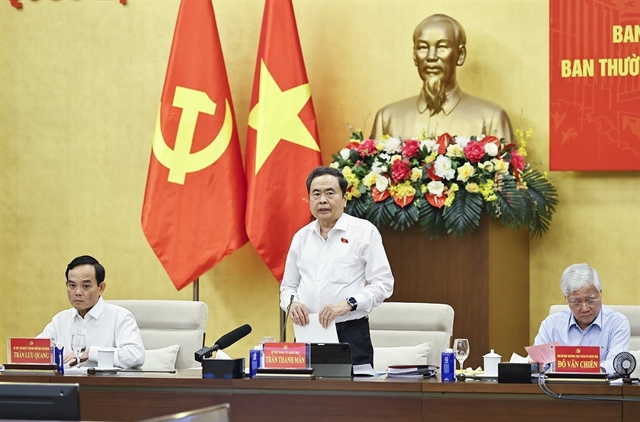 |
| National Assembly Chairman Trần Thanh Mẫn chairs a meeting between the Standing Board of the NA Party Committee and the Standing Board of the Ho Chi Minh City Party Committee in Hà Nội. — VNA/VNS Photo |
HÀ NỘI — National Assembly (NA) Chairman Trần Thanh Mẫn has called for a fundamental shift from administrative urban management to modern and development-faciltating urban governance, stressing that the proposed Law on Urban Development should provide a breakthrough legal framework to unlock the growth potential of HCM City and other urban centres across Việt Nam.
Chairman Mẫn, who is also Secretary of the NA Party Committee, made the remarks while chairing a meeting between the Standing Board of the NA Party Committee and the Standing Board of the Hồ Chí Minh City Party Committee in Hà Nội on Tuesday. The event reviewed the implementation of the city's special policies and mechanisms and the drafting of the Law on Urban Development.
Institutionalising the Party's policies, the bill retains appropriate provisions from Resolution No. 98/2023/QH15 on piloting some specific mechanisms and policies for HCM City, and draws on similar policies incorporated in the Capital Law.
Its guiding principle is stronger decentralisation, granting greater autonomy and accountability to administrations of special-level cities, and reinforcing control over the exercise of power, along with inspection, supervision and accountability.
Participants said the draft broadly reflects the major orientations set by the Politburo, particularly Resolution No. 09-NQ/TW on the development of HCM City in the new era, as well as other strategic resolutions on national development. They noted that the bill marks an important transition from temporary pilot mechanisms to a stable and long-term legal framework.
The NA leader praised the city's preparations for the draft law, describing it as a landmark piece of legislation that signals a shift in state thinking from urban administration to modern urban governance focused on enabling development.
Emphasising the need for a genuinely transformative law, the top legislator urged lawmakers to strengthen the urban governance system alongside an effective power control mechanism. He proposed granting city administrations greater on-the-spot authority, including approving investment policies and revoking licences, calling it a major breakthrough that must be made.
However, he stressed that decentralisation must be accompanied by clear quantitative criteria for enforcement capacity to ensure local authorities have sufficient resources and qualified personnel to exercise their new powers effectively.
Regarding power control and accountability, Chairman Mẫn said enhanced autonomy must be matched by independent ex-post supervision. He proposed establishing a set of urban governance performance indicators which should be published regularly for public scrutiny and supervision by the NA and People's Councils.
He further asked for incorporating the transit-oriented development (TOD) model and dynamic urban spatial planning into the draft legislation. He suggested clearly defining the radius of TOD zones, allowing local authorities to auction development rights for underground and elevated spaces around transport hubs, and capturing land value gains to reinvest in infrastructure.
Addressing urban finance, he identified the lack of self-generated investment capital as one of the biggest constraints facing cities, which remain overly dependent on traditional budget allocations and bank lending.
He therefore recommended adding provisions allowing local governments to issue project-specific municipal bonds for major infrastructure works and pilot market-based urban infrastructure development funds under public – private partnership (PPP) models.
The NA Chairman also highlighted the need for HCM City to invest in soft infrastructure such as digital transformation and innovation centres, streamline investment procedures for strategic urban projects, and accelerate urban renewal, particularly the redevelopment of housing along rivers and canals to improve urban aesthetics, safety and living conditions.
He underscored the importance of ensuring consistency between the proposed Law on Urban Development and other laws currently under revision, including the Land Law, Investment Law, Public Investment Law and State Budget Law. In particular, he called for clear regulations governing land acquisition for urban renewal, redevelopment and TOD projects based on community consensus thresholds.
Expressing broad support for submitting the draft law to the first extraordinary session of the 16th NA for approval, Chairman Mẫn urged the Government Party Committee to finalise the legislative dossier promptly so that NA agencies could complete their review on schedule, while maintaining a development-facilitating approach to urban governance. — VNA/VNS
Politics & Law
 Politics & Law
 Politics & Law
 Politics & Law
 Politics & Law
 Politics & Law
 Politics & Law
 Politics & Law
 Politics & Law
 Politics & Law
 Politics & Law
 Politics & Law
 Politics & Law
 Politics & Law
 Politics & Law