 Politics & Law
Cambodian PM Hun Manet chairs welcome ceremony for Vietnamese counterpart Lê Minh Hưng in Phnom Penh
1.
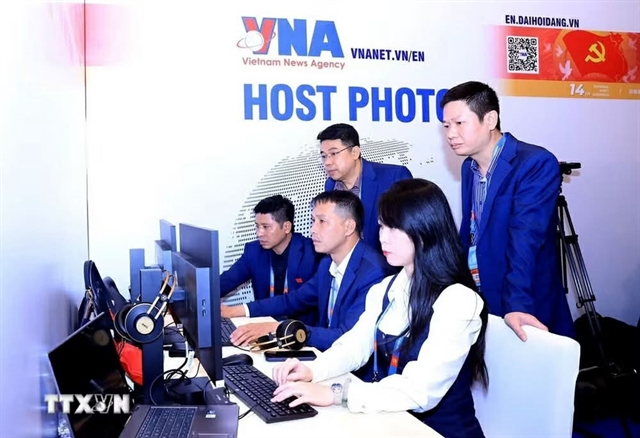 |
| Vietnam News Agency reporters work at the 14th National Party Congress. — VNA/VNS Photo |
HÀ NỘI — Amid the current digital era, a new mission of Việt Nam’s communications on external relations is to build national soft power through telling stories of the nation and people as set in Resolution No. 06-NQ/TW, issued by the Politburo on May 19, 2026.
Speaking at a national conference on the resolution implementation, Party General Secretary and State President Tô Lâm called for modernising external communications to project the image of a resilient, innovative and responsible Việt Nam, providing fresh direction for telling the country’s story in a more proactive way, as it seeks to win the international community's strategic trust.
Ambassador Phạm Quang Vinh, former Deputy Minister of Foreign Affairs, said Resolution 06 forms part of a broader strategic framework alongside Resolution 59 on international integration and other strategic resolutions on national development. Together, they mark a shift from a mindset of participation and adaptation to one focused on initiative, contribution and shaping global agendas.
According to Vinh, Việt Nam’s story should present the country as an active contributor to global peace, cooperation and development; a nation striving for scientific and technological breakthrough, innovation and digital transformation; and one shifting its growth model and pursuing green growth. It should also highlight Việt Nam as a peace-loving nation that is willing to share responsibility in addressing global challenges, from climate change to UN peacekeeping operations.
Former Director of the Diplomatic Academy of Việt Nam Associate Professor Dr. Dương Văn Quảng said digital-era communications must help build knowledge, trust and credibility through authentic and culturally distinctive stories. Amid intensifying strategic competition, he stressed that strategic autonomy and self-reliance remain essential to strengthening Việt Nam’s resilience to global uncertainties while enabling it to leverage partnerships for high-quality development.
As diplomacy increasingly extends into cyberspace and digital media, Nguyễn Văn Thuật, Deputy Director of the Department of Grassroots Information and External Communications under the Ministry of Culture, Sports and Tourism, noted that although Việt Nam has nearly 80 million internet users, 76 million social media accounts and 127 million mobile connections, it remains more of a technology user than a platform owner, leaving vulnerabilities to generative AI and deepfake manipulation.
With information warfare becoming a growing challenge, external communications have become closely linked to digital sovereignty and information security. Addressing a conference on July 2, Politburo member, Secretary of the Party Central Committee and Chairman of its Commission for Information, Education and Mass Mobilisation Trịnh Văn Quyết stressed that official information must be timely, comprehensive and capable of leading public opinion, leaving no space for rumours or disinformation.
He said the country must move beyond simply managing information towards actively managing public trust by communicating facts transparently and demonstrating Việt Nam’s development achievements.
Ambassador Nguyễn Phương Nga, former Deputy Minister of Foreign Affairs and former President of the Việt Nam Union of Friendship Organisations, argued that the distinction between domestic and external communications should be erased, with greater emphasis placed on fostering understanding and trust among people, both offline and online.
She noted that external communications should first strengthen public confidence at home. As every citizen represents Việt Nam’s image, this requires raising public awareness and treating external communications as a shared responsibility across the entire political system.
To translate Resolution 06 into practical action, Nga proposed shifting from traditional image promotion to building an integrated digital communications ecosystem that enhances national soft power. She also called for earlier engagement with public opinion, wider use of technology to reduce dependence on external platforms, and closer coordination among government agencies, media organisations, technology companies, overseas Vietnamese communities and digital content creators.
She said placing trust-building at the centre of external communications will help safeguard national interests and maximise Việt Nam’s influence in the digital era. — VNA/VNS
Politics & Law
 Politics & Law
 Politics & Law
 Politics & Law
 Politics & Law
 Politics & Law
 Politics & Law
 Politics & Law
 Politics & Law
 Politics & Law
 Politics & Law
 Politics & Law
 Politics & Law
 Politics & Law
 Politics & Law