 Politics & Law

HIIVE by fusion brings business and golf closer in Bình Dương
1.
|
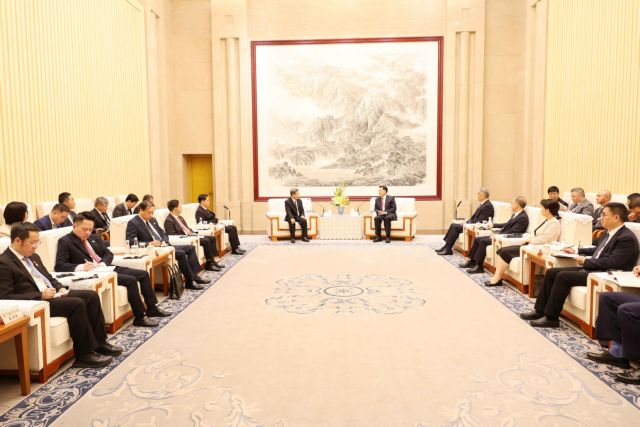
| An overview of the meeting. — VNA/VNS Photo Công Tuyên |
BEIJING — Politburo member, Secretary of the Communist Party of Việt Nam (CPV) Central Committee and Chairman of its Commission for Internal Affairs Lê Minh Trí on Friday held a meeting with Yuan Jiajun, member of the Political Bureau of the Communist Party of China (CPC) Central Committee and Secretary of the Chongqing municipal Party Committee, as part of his working visit to the Chinese city from Thursday to Saturday.
Congratulating Chongqing on its achievements in socio-economic development, urban modernisation and Party building, Trí expressed his confidence that under the leadership of the CPC Central Committee with General Secretary and President Xi Jinping at its core, the city will continue to achieve more successes.
He also conveyed his sympathy over the deadly landslide that struck Pengshui county on Friday morning.
Highlighting the longstanding ties between Việt Nam and Chongqing, he thanked the municipal authorities for preserving the historical sites and artifacts associated with President Hồ Chí Minh's revolutionary activities in the city, describing them as a shared and invaluable asset of the two nations.
He reaffirmed the Vietnamese Party and State's support for expanding comprehensive and substantive cooperation between Chongqing and Vietnamese localities, calling on both sides to continue effectively implementing the common perceptions reached by the two countries' high-ranking leaders.
He proposed further increasing delegation exchanges at all levels and sharing experience in the fields of common concern, including the Party building, urban planning and management, and development of key industries.
The official also called for stronger railway connectivity, including more efficient use of the existing Việt Nam–Chongqing rail freight corridor linking with Europe and better preparations to optimise new cross-border railway projects currently under construction.
Trí encouraged Chongqing enterprises to expand investment in Việt Nam, particularly in high technology, green development, manufacturing, automotive and advanced material industries.
He also proposed Chongqing facilitate market access for Vietnamese businesses and imports while strengthening cooperation in high-quality human resources training, tourism under the framework of the Việt Nam–China Tourism Cooperation Year 2026–2027, and locality-to-locality friendship exchanges to reinforce the social foundation of bilateral relations.
For his part, Yuan congratulated Việt Nam on its recent development achievements and presented Chongqing's progress in the Party building, socio-economic development, as well as its strategic role as the only centrally-run municipality in southwest China.
Emphasising the long-standing friendship nurtured by President Hồ Chí Minh and previous Chinese leaders, the host highly valued Chongqing's cooperation with Việt Nam and its localities. He affirmed the importance his city attaches to the cooperation with Việt Nam, and its commitment to implementing the common understandings of the two countries' high-ranking leaders to further step up mutually beneficial ties with Vietnamese localities.
He also underlined its readiness to expand practical collaboration in transport connectivity, trade, investment, tourism, education and high-quality workforce development.
Yuan pledged to make full use of the two countries' revolutionary heritage sites to pass on the traditional friendship to younger generations, and reaffirmed Chongqing's continued support for the Vietnamese Consulate General to operate efficiently, serving as a bridge for bilateral cooperation.
During the visit, Trí and the Vietnamese delegation visited the Hongyan Memorial Museum, which houses a room in which late President Hồ Chí Minh lived and worked around 1939–40 while conducting revolutionary activities in Chongqing under the alias Hồ Quang.
The delegation met officials and staff of the Vietnamese Consulate General in Chongqing, along with representatives of the Vietnamese community in Chongqing and Sichuan. They also visited several industrial, urban planning and legislative institutions in the city. — VNA/VNS
Politics & Law
 Politics & Law
 Politics & Law
 Politics & Law
 Politics & Law
 Politics & Law
 Politics & Law
 Politics & Law
 Politics & Law
 Politics & Law
 Politics & Law
 Politics & Law
 Politics & Law
 Politics & Law
 Politics & Law