 Politics & Law
Vĩnh Long sees technology, digital transformation as growth drivers
1.
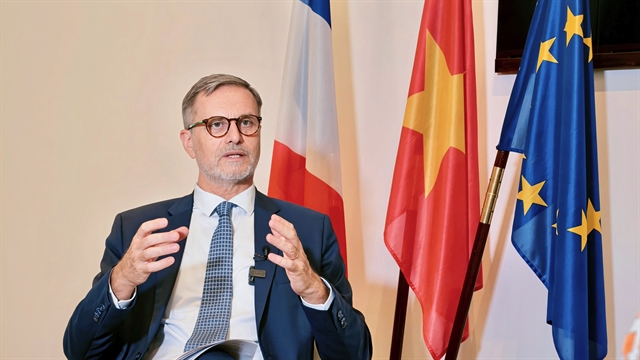 |
| French Ambassador to Việt Nam Olivier Brochet speaks to local media on the occasion of the National Day of the French Republic, July 14. VNA/VNS Photos Hà Quỳnh |
On the occasion of the National Day of the French Republic, July 14, the country’s Ambassador to Việt Nam Olivier Brochet hosted a press briefing with the local media. The Ambassador highlighted outcomes of the bilateral relationship between France and Việt Nam over the past three years, discussing key milestones, the depth of the Comprehensive Strategic Partnership and the promising prospects for a bright future for the two countries.
Since you began your term in 2023, the bilateral relationship between Việt Nam and France has yielded certain milestones, especially the establishment of the Vietnam-France Comprehensive Strategic Partnership in 2024. How do you view the achievements gained over the past three years?
Three years have passed so quickly, particularly in Việt Nam – a remarkably dynamic country. To keep pace and accompany Việt Nam’s development goals, we must also be very proactive.
The relationship between France and Việt Nam is long-standing, with diplomatic ties established over 50 years ago. Since Việt Nam initiated its Đổi mới (Renewal) process, France has significantly strengthened its cooperation with the country. Collaborative projects over the past three years have been built upon this solid and enduring foundation.
Recognising the historical depth, special friendship, and immense potential of our bilateral relations, Party General Secretary and President Tô Lâm, during his visit to France in October 2024, proposed to the French President that the relationship be upgraded to a Comprehensive Strategic Partnership.
The Comprehensive Strategic Partnership has been demonstrated through practical deeds. Specifically, last week the Secretary General of the French Ministry for Europe and Foreign Affairs, Martin Briens, had a meeting with Minister of Foreign Affairs of Việt Nam Lê Hoài Trung. The two officials agreed to accelerate the implementation of the Comprehensive Strategic Partnership through an Action Plan.
And as we know, during his State visit to Việt Nam in May 2025, French President Emmanuel Macron and Party General Secretary and State President Tô Lâm set forward priorities for the bilateral ties in the coming period.
Cooperation with Việt Nam during this period of time not only serves Việt Nam’s robust development needs but also underscores the productive partnership between our two nations on the international stage. This collaboration is rooted in a deep alignment on multilateralism, respect for international law, and the upholding of sovereignty and territorial integrity. In today’s context of unpredictable global volatility, the partnership and shared vision between France and Việt Nam are of paramount importance.
The Vietnam-France Comprehensive Strategic Partnership has opened up new cooperation prospects. Which area do you think is the most promising to further strengthen the relationship between the two countries?
In the realms of defence, security and aerospace, the upcoming aerospace summit this September will serve as a pivotal occasion to highlight the cooperation between France and Việt Nam in the space sector.
Another area I wish to emphasise is critical and strategic minerals. France aims to partner with Việt Nam in this field by providing the necessary French technologies to ensure Việt Nam achieves autonomy in extraction and processing, thereby enhancing the value of its own mineral resources. Conversely, France hopes these activities will help secure the supply of these vital raw materials, which are essential for France’s own development.
Furthermore, our commitment to future-oriented cooperation is best exemplified by the training of Việt Nam’s younger generation. This was the central message delivered by President Emmanuel Macron during his speech to students at the University of Science and Technology of Hanoi (USTH).
This vision is reflected in our joint training projects and a series of dual-degree programs for scientific cooperation. It is also evidenced by France’s invitation for an increasing number of Vietnamese students to study abroad in France. Finally, this cooperation extends to a range of projects in scientific research and innovation between our various partners in fields essential to Việt Nam's progress, such as semiconductors, artificial intelligence (AI), quantum computing, space, and aviation. Collectively, these are the sectors Việt Nam requires for its ongoing development process.
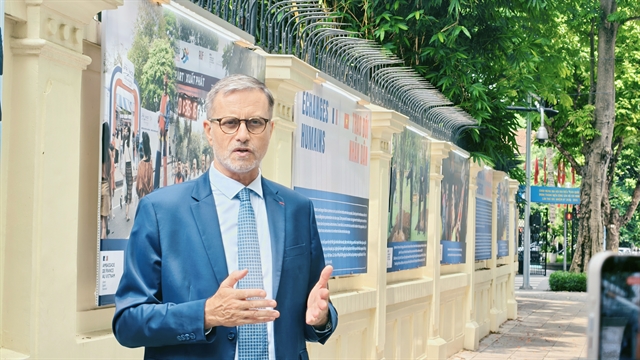 |
| Olivier Brochet introduces a photo exhibition displayed outside the French Embassy in Hà Nội on the occasion of the National Day of the French Republic, July 14. The photos highlight the relationship between France and Việt Nam over the past decades. |
Alongside diplomatic advances, how can the Comprehensive Strategic Partnership bring practical benefits for the people, businesses and young generations in both countries?
The people as well as the young generation are the centre of the bilateral relationship between France and Việt Nam, which is clearly demonstrated through the sustainable development goals pursued by both countries. Ultimately, sustainable development is about enabling citizens to improve their lives or adapt to the conditions we face today, such as climate change. Regarding climate change, it is evident that Việt Nam is one of the countries most vulnerable to its consequences, as seen through the recent natural disasters. Of course, Việt Nam is not alone in this struggle. France is also currently experiencing periods of extreme weather conditions driven by climate change.
Rather than restating the priority areas of cooperation mentioned earlier, I would like to offer two specific examples of how the France-Việt Nam relationship directly serves the people. For instance, Hà Nội is implementing urban rail projects that facilitate smoother commuting for its residents. Furthermore, through this low-emission mode of transport, citizens can breathe cleaner air. This partnership is not merely about technical or technological cooperation; it involves transferring equipment tailored to Việt Nam’s development while ensuring the transfer of expertise so that Việt Nam can achieve autonomy in this sector.
Another vital area is healthcare, an exceptionally important pillar of our cooperation. This field is not only a model for local governance but also a standout feature when comparing France’s relations with other nations. Over the past 30 years, we have trained more than 3,000 doctors who have contributed to the growth of Việt Nam's healthcare system. This cooperation continues today, with many doctors benefiting from French training programmes every year.
In our current partnership, we are also accounting for the evolving context, specifically Việt Nam's robust economic growth and the new medical challenges the country faces, such as an ageing population and emerging diseases. This is why both sides are currently negotiating a new agreement in the field of healthcare to be signed in the near future.
Finally, I would like to mention a new area of cooperation: sports. This idea emerged as France hosted the 2024 Summer Olympics, providing an occasion to strengthen our athletic ties. We have seen very concrete results over the past two years, with Vietnamese athletes training in France before returning to win gold medals at the SEA Games. This demonstrates that cooperation in this new field is already proving highly effective. Beyond high-performance sports, we also hope to expand our partnership toward promoting 'sports for all' among the general public.
The Comprehensive Strategic Partnership is resulting in numerous specific projects. Which ones do you think clearly demonstrate France's contributions to Việt Nam's development?
First of all, regarding transport, Việt Nam currently possesses many ambitious and specific visions for its development orientation in the coming period. France is keen to accompany Việt Nam in this journey, particularly in the railway sector. This is the core significance of the recent cooperation between the French Development Agency (AFD), the French National Railway Company (SNCF), and the Vietnam Railways Corporation (VNR).
Our activities include training programmes as well as field study trips. For instance, a delegation from the railway corporation visited Morocco, as France and Morocco collaborated on the implementation of Morocco's first high-speed rail line. That project involved both training and technology transfer, which are precisely the types of activities France wishes to propose to Việt Nam.
While current cooperation between the three aforementioned entities is focused on the master design for Việt Nam’s railway development system, including high-speed rail, we aim to move toward more concrete cooperative activities beyond these institutional frameworks.
The second area I would like to emphasise is energy. Given Việt Nam's development ambitions, the country cannot succeed without a leap in energy production, especially within the context of the need to reduce carbon emissions. Therefore, France is promoting cooperation with Việt Nam, particularly through the Just Energy Transition Partnership (JETP), to ensure Việt Nam can robustly increase its power generation while contributing to decarbonisation.
The French government has committed 500 million euros (US$570 million) to support the energy transition and transport emission reduction projects in Việt Nam under the JETP framework. To date, approximately half of that budget has been committed to specific projects.
Another entirely different but, in my view, vital field in France-Việt Nam relations is heritage and culture. This is an area where we share many commonalities, rooted in our shared history and reflected in the mutual tastes of France and Việt Nam. These elements are essential for expressing our identities on the international stage, while also serving as a resource for economic development.
Furthermore, museum projects represent another significant area of cooperation. This is a long-standing field, with examples such as the Museum of Ethnology and the Women’s Museum, and recently the Điện Biên Phủ museum, exhibitions held at the Temple of Literature, and historical trail projects in Hà Nội and Điện Biên.
And of course, when speaking of culture and heritage, we cannot overlook a symbolic project: the Long Biên Bridge. To date, France has provided over 700,000 euros (nearly $780 million) for technical studies to provide Hà Nội with a basis for making decisions on how to renovate the bridge in the future. France stands ready to accompany Việt Nam in those next steps. VNS
Politics & Law
 Politics & Law
 Politics & Law
 Politics & Law
 Politics & Law
 Politics & Law
 Politics & Law
 Politics & Law
 Politics & Law
 Politics & Law
 Politics & Law
 Politics & Law
 Politics & Law
 Politics & Law
 Politics & Law