 Politics & Law
.jpg)
Hà Nội changes mindset in attracting high-quality capital
1.
|
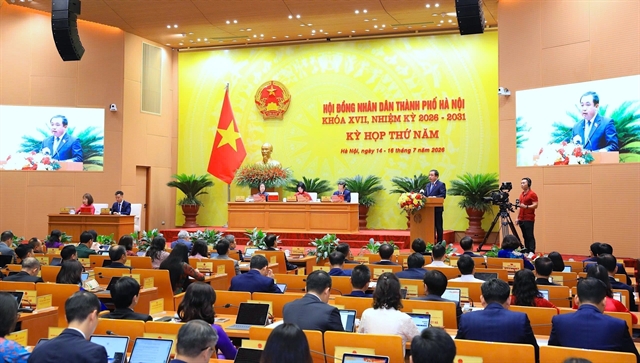
| The Hà Nội People's Council opening its mid-year session, the fifth sitting of its current five-year term, on Tuesday. — VNA/VNS Photo |
HÀ NỘI — The Hà Nội People's Council opened its mid-year session on Tuesday, with city leaders warning that reaching the capital's 2026 economic growth target of 11 per cent or higher will require sharper focus and faster execution in the second half of the year, even as the city has posted its strongest first-half growth in years.
Council Chairwoman Phùng Thị Hồng Hà told delegates that Hà Nội's gross regional domestic product grew 8.22 per cent in the first six months of 2026, the highest rate in recent years.
State budget revenue reached nearly VNĐ411 trillion (roughly US$15.7 billion), or 63.2 per cent of the annual target, while foreign direct investment hit $3.23 billion and tourism revenue rose by more than 20 per cent.

|
| Phùng Thị Hồng Hà, chairwoman of the Hà Nội People's Council. — VNA/VNS Photo |
Several major infrastructure projects also saw faster progress, while security and social welfare programmes held steady, the chairwoman said.
Even so, Hà acknowledged that meeting the full-year growth goal, along with rolling out new policies and freeing up resources, would demand greater resolve.
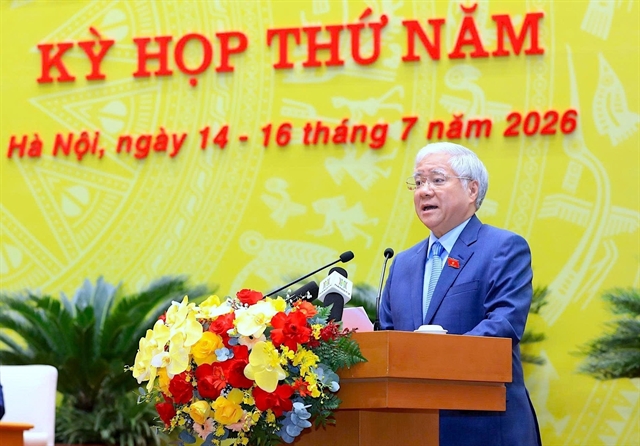
That message was echoed by Đỗ Văn Chiến, a Politburo member and permanent vice chairman of the National Assembly (NA).
Chiến praised Hà Nội's role as the country's leading growth engine, but pressed the city to move faster by recalibrating its growth targets to reflect conditions on the ground, clearing remaining bottlenecks and maximising the resources at its disposal.
He also called for accountability to be tied directly to results. Economic growth, budget collection, project progress and disbursement of investment capital should be the measure by which officials and institutions are assessed, with the performance of agency heads judged by the outcomes their units deliver, Chiến said.
As for oversight, the senior legislator highlighted a broader push to give localities more say in deciding and answering for their own affairs.
He urged Hà Nội's city, ward and commune-level councils to move away from oversight based mainly on paperwork and inspection teams, toward data-driven monitoring that runs alongside policy rollouts rather than after the fact, catching warning signs early and following through on recommendations as they're implemented.
Chiến also credited the council with adopting new working methods, including a 'digital council' system, paperless sessions and the use of artificial intelligence for document digitisation and centralised operations.
|
| Đỗ Văn Chiến, a Politburo member and permanent vice chairman of the National Assembly. — VNA/VNS Photo |
After the NA passed the 2026 Capital Law, the council moved quickly to issue implementing resolutions to resolve planning bottlenecks, support resettlement and unlock resources for key projects, he said.
The session, which runs through July 16, is reviewing 51 agenda items in total, including 16 reports and 35 draft resolutions spanning economic development, urban management, education, healthcare, science and technology, the environment and social welfare.
Among the policies under consideration are a subsidy programme for primary school lunches beginning in the 2026-2027 school year, new measures to expand elder care services and encourage continued employment of older workers, and funding for community digital transformation teams through 2030.
Delegates are also weighing adjustments to the Yên Xá Wastewater Treatment project, as well as dike reinforcement and pollution control work along the Nhuệ River.
Hà said residents expected more than debate on the floor of the chamber. Results, not rhetoric, would be what count, she noted.
"The value of any resolution isn't measured at the moment it's passed, but by how it's carried out – by changes people can actually feel, and benefits businesses can actually see," she said.
The session comes months after Hà Nội completed a broader restructuring of local government into a two-tier system and reorganised its wards and residential groups.
City officials noted that recent NA and People's Council elections drew a 99.57 per cent voter turnout, after which the council moved swiftly to reconstitute its leadership and staff to keep the new two-tier government running without interruption. — VNS
Politics & Law
 Politics & Law
 Politics & Law
 Politics & Law
 Politics & Law
 Politics & Law
 Politics & Law
 Politics & Law
 Politics & Law
 Politics & Law
 Politics & Law
 Politics & Law
 Politics & Law
 Politics & Law
 Politics & Law

.jpg)




