 Politics & Law

Hà Nội exhibition brings forest experience to the city
1.
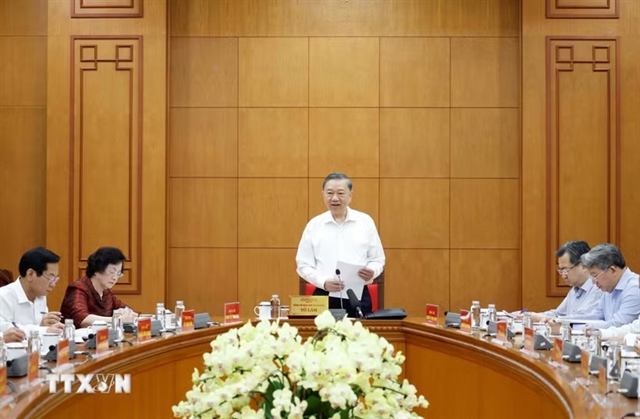 |
| Party General Secretary and State President Tô Lâm delivers a speech at a working session with the Ministry of Home Affairs on Wednesday. — VNA/VNS Photo Thống Nhất |
HÀ NỘI — Party General Secretary and State President Tô Lâm has called for the development of a modern, transparent, flexible and globally integrated labour market, urging Việt Nam to shift from relying on low-cost labour to building a competitive advantage based on a highly skilled workforce.
He made the remarks on Wednesday morning at the Party Central Committee headquarters while chairing a working session with the Ministry of Home Affairs on workforce quality, promoting sustainable employment and developing personnel for the nation's next stage of development.
The top leader said the country must complete an integrated labour market information system linking employment, social insurance, training, businesses and population databases, while developing a modern and professional public employment service network.
He also called for the establishment of a national system to analyse and forecast demand for labour and skills by sector and locality.
Lâm stressed the need for an open, flexible and lifelong learning system that enables workers to retrain, change careers and upgrade their skills, adding that people must remain at the centre, the driving force and the ultimate objective of national development.
The Party chief and president said workforce development reforms must be underpinned by a national skills development framework.
“Training should move beyond meeting short-term labour demand towards strengthening the country's long-term competitiveness,” he said.
This requires a shift in mindset from focusing on academic qualifications to occupational skills, and from training based on existing institutional capacity to programmes tailored to labour market demand, skills standards and measurable outcomes.
Alongside creating jobs at home, the new paradigm should take a broader view of employment, skills development and the supply of high-quality workers for the economy.
As technology, supply chains, labour and knowledge become increasingly mobile, the country must both create sustainable jobs domestically and expand opportunities for Vietnamese workers in international labour markets to gain experience, while selectively attracting experts, skilled professionals and talented individuals to support national development, particularly in strategic and high-priority sectors, he said.
Lâm assigned the Government’s Party Committee to prepare a national workforce and modern labour market development plan.
The scheme should review the current quality of the workforce, map labour and skills shortages by industry, region and locality, identify priority occupations and restructure vocational education institutions to align with the country's new growth model and development landscape.
Bottleneck
According to the top leader, the country's main bottleneck is no longer a shortage of workers in terms of numbers, but a mismatch between workforce capabilities and development needs.
He noted persistent shortages of vocational skills, workplace discipline, industrial work practices, foreign language proficiency, digital and green skills, as well as technicians, skilled workers, practical professionals, technology specialists and middle managers.
At the same time, the informal labour sector remains large, youth unemployment remains high, training and employment structures are poorly aligned and population ageing is accelerating, Lâm said.
Assessments of workforce quality should therefore shift away from measuring quantity towards evaluating quality, productivity and workers' contributions to economic performance.
The question is not simply how many people have jobs, but whether those jobs are formal, sustainable, productive and high value; whether workers possess the necessary skills, receive adequate incomes and social insurance and have opportunities for lifelong learning and career transitions.
"The ultimate measure is the quality of employment, the quality of personnel and workers' contribution to national competitiveness."
Sustainable employment
Lâm also stressed that sustainable job creation in urban areas must be aligned with the country's new growth model, business development and improvements in quality of life.
Cities are home to industry, services, science and technology, innovation, the digital economy, the green economy and modern business models.
They also attract large numbers of migrant workers, informal workers and platform workers, while facing mounting pressure on housing, social infrastructure and public services.
"The objective is not merely to create more jobs, but to create better jobs that are formal, productive and offer higher incomes, social insurance coverage, skills development and career advancement opportunities," he said.
In rural areas, sustainable employment should focus on raising the value of labour, supporting skilled workforce transitions and promoting sustainable livelihoods.
The aim is not simply to reduce the proportion of agricultural workers, but to increase rural incomes by shifting labour from low-productivity farming into high-value agriculture, manufacturing, processing industries, modern services and emerging sectors within local communities.
For ethnic areas, sustainable employment should help unlock local potential, support lasting poverty reduction and preserve cultural identity.
Although the workforce in these regions represents an important development resource, it continues to face challenges including limited vocational skills, language barriers, inadequate infrastructure, insufficient access to labour market information, training opportunities, credit and employment services.
As such, creating sustainable employment in ethnic communities should be viewed as more than just a labour policy; it should also be seen as an ethnic affairs policy, a poverty reduction strategy, a human development initiative and a means of strengthening public confidence.
Concluding the meeting, the top leader said the quality of Việt Nam's workforce is one of the nation's most valuable assets.
Lâm said that caring for workers is investing in the country's future, adding that investment in human capital is not merely a social policy, but a national development strategy.
He said: "If we can effectively nurture, train, utilise, protect and unlock the potential of our people, we will transform our demographic advantage into a development advantage, turn aspiration into strength and enable the country to achieve rapid and sustainable growth in the new era." — VNS
Politics & Law
 Politics & Law
 Politics & Law
 Politics & Law
 Politics & Law
 Politics & Law
 Politics & Law
 Politics & Law
 Politics & Law
 Politics & Law
 Politics & Law
 Politics & Law
 Politics & Law
 Politics & Law
 Politics & Law