 Politics & Law
Hưng Yên outlines three economic zones, two development corridors
1.
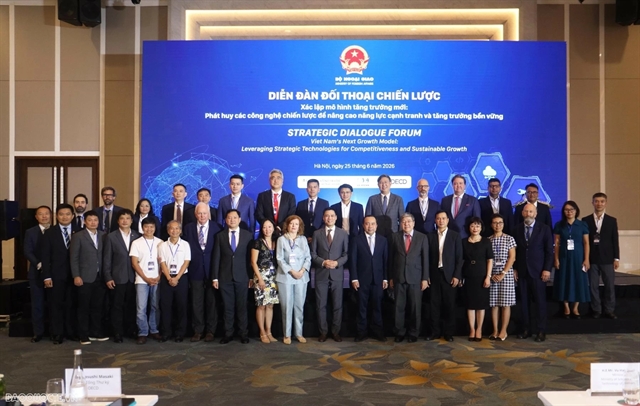 |
| Delegates at the “Việt Nam's Next Growth Model: Leveraging Strategic Technologies for Competitiveness and Sustainable Growth” forum in Hà Nội on June 25. — Photo from the Ministry of Foreign Affairs |
HÀ NỘI — Strategic technologies such as artificial intelligence (AI), semiconductors, quantum computing and clean energy will play a decisive role in helping Việt Nam establish a new growth model and strengthen its competitiveness, speakers said at a strategic dialogue forum held in Hà Nội on Thursday.
The Strategic Dialogue Forum, themed “Việt Nam's Next Growth Model: Leveraging Strategic Technologies for Competitiveness and Sustainable Growth”, was jointly organised by the Ministry of Foreign Affairs, the Ministry of Science and Technology, Columbia University, the US-ASEAN Business Council (USABC) and the Organisation for Economic Co-operation and Development (OECD).
The event brought together around 200 delegates, including policymakers, academics, international organisations and representatives from leading technology companies such as Google, Intel, Amazon, Meta, as well as domestic players such as FPT, Viettel Hightech, and VNG.
Opening the forum, Deputy Minister of Foreign Affairs Đặng Hoàng Giang said the world was undergoing profound transformations as emerging technologies increasingly reshape global growth models and economic competition.
After four decades of Đổi mới (Renewal), science, technology and innovation must be placed at the centre of Việt Nam’s development strategy and become a more powerful engine of growth, he said.
Giang called for discussions to focus on the role of enabling institutions, the development of modern infrastructure, the attraction of international investment funds and the strengthening of collaboration among the State, universities and businesses to accelerate the commercialisation of technological innovations.
Minister of Science and Technology Vũ Hải Quân said future competitiveness would no longer be determined by natural resources or cheap labour, but by creativity, innovation and human capital.
He outlined three strategic shifts needed to realise a knowledge-based development model.
First, Việt Nam should move from technology adoption to technology mastery, participating more deeply in research and innovation value chains, particularly in strategic sectors such as AI, semiconductors, clean energy and advanced materials.
Second, the country should shift from resource-driven growth to innovation-led growth by attracting and empowering talented individuals and fostering a dynamic innovation ecosystem.
Third, Việt Nam needs to transition from competing on low costs to competing through technological capabilities, enhancing self-reliance and moving up global value chains.
Quân also highlighted the need for flexible regulatory sandboxes, stronger public-private partnerships and large-scale investment mechanisms to facilitate the widespread adoption of strategic technologies across the economy.
During the forum, OECD Deputy Secretary-General Yasushi Masaki released the OECD FDI Qualities Review of Việt Nam, which recognised the country’s strong growth prospects and its increasingly important role in global manufacturing and supply chains.
However, Masaki warned that Việt Nam’s traditional growth model, based largely on expanding production and exports, was approaching its limits due to weak linkages between foreign-invested enterprises and domestic firms, as well as relatively low spending on research and development.
To attract higher-quality foreign direct investment and advance digital and green transitions, he recommended four priority reforms: improving policy consistency, modernising the legal framework, strengthening connections between multinational corporations and local businesses, and adopting a more data-driven approach to investment promotion.
The forum featured five thematic sessions involving more than 30 speakers from Việt Nam and abroad. Discussions focused on enhancing collaboration among the Government, academia and industry to boost technology application and commercialisation, creating regulatory frameworks to support scientific and technological innovation, and enabling Vietnamese firms to participate more deeply in global supply chains and absorb strategic technologies.
Participants also stressed the need to move swiftly from policy orientation to implementation by establishing concrete partnerships and projects in priority areas, including artificial intelligence, semiconductors, the digital economy, clean energy and advanced materials. — VNS
Politics & Law
 Politics & Law
 Politics & Law
 Politics & Law
 Politics & Law
 Politics & Law
 Politics & Law
 Politics & Law
 Politics & Law
 Politics & Law
 Politics & Law
 Politics & Law
 Politics & Law
 Politics & Law
 Politics & Law