 Politics & Law

Việt Nam national youth ice skating championships attract record 112 athletes
1.
|
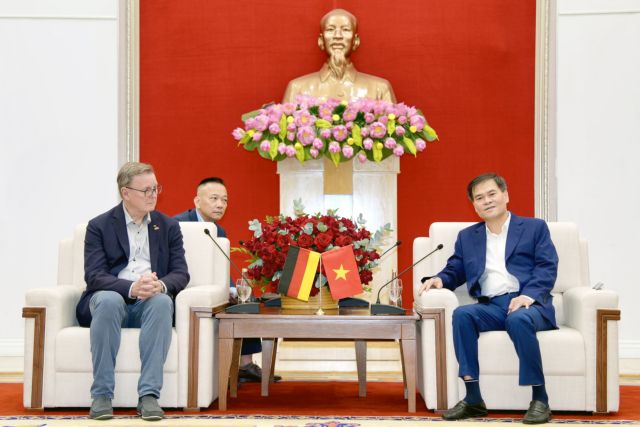
| Chairman of the People's Committee of Quảng Ninh Bùi Văn Khắng (right) receives Vice President of the German Bundestag Bodo Ramelow. VNA/VNS Photo |
HÀ NỘI — Visiting Vice President of the German Bundestag Bodo Ramelow and his delegation held working sessions with leaders of Hải Phòng city and Quảng Ninh province and visited Bạch Mai Hospital in Hà Nội on Wednesday.
Strengthening investment links and green development
Receiving the delegation, Chairman of the People's Committee of Quảng Ninh Bùi Văn Khắng introduced the province’s strengths, development orientation, and recent achievements.
He said Quảng Ninh posted a GRDP growth rate of 11.89 per cent in 2025, the highest in Việt Nam, while its economy reached nearly VNĐ400 trillion (US$15.2 billion). The province welcomed more than 21.2 million visitors in 2025 and is home to UNESCO-recognised heritage sites, including Hạ Long Bay and the Yên Tử historical and scenic complex.
Khắng expressed hope that the German Bundestag, the German Embassy in Việt Nam and German partners would further strengthen links between Quảng Ninh and German localities, associations and businesses, helping attract investment in high technology, green industry, logistics, renewable energy and digital transformation.
He also highlighted opportunities for cooperation in tourism, heritage conservation, vocational education and training, and high-quality workforce development.
Impressed by Quảng Ninh’s achievements, Ramelow praised the province’s sustainable development vision, particularly in infrastructure development, green tourism linked with heritage preservation, and the attraction of high-quality investment.
He said the visit will strengthen mutual understanding and trust while opening up new opportunities for cooperation in investment, trade, tourism, education and training, science and technology, and digital transformation. Both sides also discussed collaboration in heritage preservation, sustainable tourism, the green economy and business connectivity.
Ramelow affirmed his support for stronger cooperation between German localities, organisations and businesses and Quảng Ninh, contributing to deeper Việt Nam-Germany ties.
Earlier the same day in Hải Phòng, Chairman of the municipal People’s Committee Đỗ Thành Trung welcomed the German delegation.
He described the visit as an important opportunity to deepen cooperation and create new prospects for Hải Phòng to expand trade ties with Germany. Areas for cooperation include logistics, green and digital development, and integration into global supply chains, while opening new investment opportunities for businesses from both countries.
According to Trung, Hải Phòng boasts the third-largest economy in Việt Nam and a population of 4.6 million, and is the only locality in the country to have maintained double-digit growth for 11 consecutive years. The city hosts businesses from many countries and is pursuing green industrial development backed by modern infrastructure.
Hải Phòng is studying Germany’s development models while prioritising high-quality workforce training. The city plans to devote significant resources to vocational training through 2030 to meet the needs of foreign-invested enterprises, including German companies.
Congratulating Hải Phòng on its socio-economic achievements, Ramelow said there remains considerable potential for cooperation, particularly in education and training.
He noted that Hải Phòng’s focus on green industry, logistics, and digital transformation aligns with Germany’s strengths and offers ample room for deeper cooperation between localities and businesses in both countries.
The two sides agreed to strengthen links among businesses and training institutions to expand cooperation in renewable energy, mechanical engineering, processing and manufacturing industries, and high-quality workforce development.
New prospects for Việt Nam-Germany healthcare cooperation
Earlier the same day, at a meeting with Bạch Mai Hospital in Hà Nội, Associate Professor Dr Đào Xuân Cơ, the hospital’s director, said the visit reflected the growing friendship, trust, and cooperation between Việt Nam and Germany.
Recognising Germany’s expertise in healthcare governance, nursing workforce development, elderly care, and long-term care services, Bạch Mai Hospital proposed several cooperation initiatives. These include establishing a strategic partnership on nursing and elderly care with German associations, hospitals, training institutions, and care facilities, creating a mechanism for licensed Vietnamese nurses to study and work in Germany for two to three years before returning to Việt Nam to transfer expertise, and exploring the establishment of a German-style elderly and long-term care centre at the hospital.
The hospital also proposed setting up a Việt Nam-Germany elderly care nursing simulation centre at Bạch Mai Medical College through support in expertise, curriculum transfer, simulation equipment, and academic exchanges. It also sought expanded cooperation in research, training, and technology transfer in advanced fields such as gene technology, stem cells, molecular biology, robotic surgery, multi-organ transplantation, intensive care, cardiology, and oncology.
Ramelow said he is impressed by Bạch Mai Hospital’s development and praised the quality of Việt Nam’s nursing education. He noted that Germany hopes to integrate its elderly care standards into training programmes in Việt Nam and work towards certification based on German standards.
Expressing support for the hospital’s proposals, he said he would continue discussions with the German Government, health authorities, and relevant agencies in both countries to advance cooperation between Bạch Mai Hospital and German medical organisations.
The two sides also discussed long-term cooperation programmes based on sharing expertise, professional knowledge, and advanced management models, helping strengthen healthcare collaboration between Việt Nam and Germany. — VNA/VNS
Politics & Law
 Politics & Law
 Politics & Law
 Politics & Law
 Politics & Law
 Politics & Law
 Politics & Law
 Politics & Law
 Politics & Law
 Politics & Law
 Politics & Law
 Politics & Law
 Politics & Law
 Politics & Law
 Politics & Law