 Politics & Law
European business confidence remains at historic high in Q3
1.
|
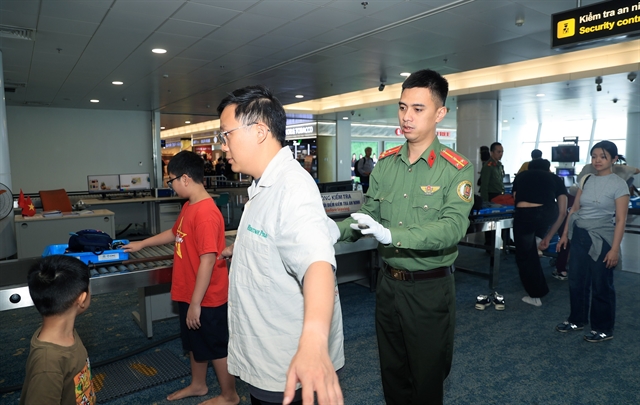
| Aviation security personnel screen passengers before they enter the departure lounge at the Nội Bài International Airport. — VNA/VNS Photo Quốc Khánh |
HÀ NỘI — In the context of digital transformation and deepening international integration, building a modern, unified and highly adaptive aviation security system is an imperative.
Aviation security must be approached with a 'constructive security' mindset and regarded as an integral part of national security.
Việt Nam is entering a new phase of development.
According to Colonel Trương Thị Thu Ba, deputy director of the Việt Nam Immigration Department under the Ministry of Public Security, this is a period of digital transition, intelligent infrastructure and rapidly expanding international air links, which places comprehensive and urgent demands on aviation security provision like never before.
Current aviation security is affected by multiple factors, including the risk of terrorism, unlawful interference, challenges arising from digital transformation and the need to secure information systems.
At the same time, the rising passenger volumes – projected to reach 95 million passengers this year and to exceed 100 million next year – increase the scale and likelihood of threats related to national security, requiring a comprehensive, wide‑ranging and highly resilient protective system.
To guide strategic measures, it is essential to internalise the leadership thinking of Minister of Public Security General Lương Tam Quang on 'proactive security', 'comprehensive security' and, in particular, 'constructive security'.
Colonel Ba explained that the constructive security concept establishes a new approach: security provision must not be an obstacle but should become a driver for development, closely linking protection tasks with the aviation sector’s growth objectives.
Accordingly, the aviation security system must shift decisively from a reactive posture to proactively identifying risks early and at a distance, covering both the physical and digital domains.
“A constructive mindset does not mean lax control,” Ba emphasised.
Reflecting the Prime Minister’s Directive No. 21/CT‑TTg dated August 12, 2025, the aviation sector operates under the principles: 'Do not trade safety and aviation security for any reason' and 'no violation is a minor violation'.
All facilitation measures for the public and businesses, such as the VNeID application or biometric systems, must be founded on sufficiently robust risk management and quality-control capabilities so as not to create any 'security gaps'.
At the same time, strategic thinking emphasises 'discipline in implementation'.
Moving strongly towards a proactive, constructive security environment is the key to maintaining national reputation and standing, and will help Việt Nam step confidently into a new era of safety and prosperity.
Moreover, to relieve pressure from rising transport volumes, implementing 'constructive security' solutions will stimulate development. Recently, expanding the use of VNeID, biometric systems and Autogate has aimed not only to reduce congestion but also to enable accurate identification and risk‑based passenger segmentation.
This allows the system to concentrate resources on high‑risk individuals while creating seamless journeys for trusted passengers.
Modern aviation security
On legal issues and core standards for aviation security, Ba noted that international legal trends were shifting strongly from a mindset of 'mere compliance' to one of 'securing based on assessment of actual risk' in order to adapt to constantly evolving threats.
Domestically, the legal basis for aviation security is being refined to be coherent, stringent and compatible with international standards.
Việt Nam’s current legal system is progressively adapting to cover both the physical and digital domains, facilitating the use of artificial intelligence, biometrics and automation in security control.
Alignment between the International Civil Aviation Organisation (ICAO)’s legal foundations and domestic instruments is the precondition for Việt Nam to implement the philosophy of 'constructive security', ensuring robust protection to support the aviation sector’s development in the new era.
For Việt Nam, the requirements in the coming phase go beyond completing the legal framework, policies or investing in technology; more importantly, they require building a modern, unified and highly adaptive aviation security system.
This system must be recognised as an inseparable part of national security, firmly linked with the task of protecting sovereignty and maintaining social order and safety in the new era.
Regarding legal and institutional development, the Việt Nam Immigration Department emphasises the need to continue reviewing and updating the body of legal instruments to keep pace with technological advances and new methods of unlawful interference.
Priority should be given to drafting an Aviation Security Law to establish a unified, highest‑authority legal framework to regulate specialised relations and to achieve a breakthrough in codifying aviation security provisions.
Additionally, solutions are needed to establish effective inter‑agency coordination mechanisms; standardise human resources and strengthen security culture; modernise security infrastructure and technology; and proactively prevent and respond to emerging threats. — VNS
Politics & Law
 Politics & Law
 Politics & Law
 Politics & Law
 Politics & Law
 Politics & Law
 Politics & Law
 Politics & Law
 Politics & Law
 Politics & Law
 Politics & Law
 Politics & Law
 Politics & Law
 Politics & Law
 Politics & Law