 Politics & Law
Vietnamese Prime Minister meets Cambodian National Assembly President
1.
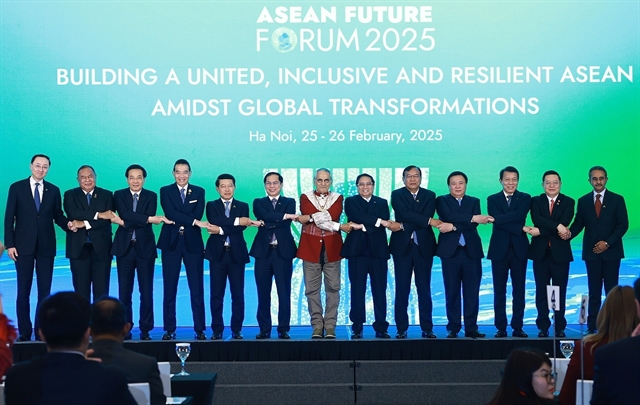 |
| Then-Prime Minister Phạm Minh Chính (sixth from right) and other heads of delegations at the ASEAN Future Forum 2025. — VNA/VNS Photo |
Ngô Di Lân*, a researcher at the Institute for Foreign Policy and Strategic Studies, Diplomatic Academy of Vietnam
HÀ NỘI — Southeast Asia's success has never been automatic, and in 2026 it is harder than ever to take anything for granted. The region is navigating a landscape shaped by trade tensions, technological disruption, climate pressure and deepening great power competition.
These forces are intertwining and mutually reinforcing, pushing governments, businesses and societies to think beyond the old policy silos and confront how economic, political and security questions have become inseparable.
One of ASEAN's enduring strengths has been its willingness to keep talking despite the differences among its members. Consensus-building can be slow, and critics have long mistaken that pace for weakness.
Yet the same patience has held a diverse group of states together, preserved regional stability and kept channels open among countries with very different systems and interests. In a fragmenting international order, that tradition is not a relic. It is one of the few assets that still holds value.
The harder truth is that old habits may no longer be enough on their own. Issues such as artificial intelligence, the energy transition, supply chain resilience and demographic change cut across borders and across ministries. They rarely fit the architecture of summit diplomacy, which was built for an era of clearer lines between domestic and foreign, economic and strategic policies.
To address these issues, ASEAN needs wider conversations: policymakers in the room with researchers, business leaders and young people, working alongside formal processes rather than waiting for them.
This is a pivotal year for the region's longer outlook. July 2026 marks the fiftieth anniversary of the Treaty of Amity and Cooperation, the agreement that codified restraint, dialogue and mutual respect as the guiding norms of Southeast Asia. It is also the first year of implementation for the ASEAN Community Vision 2045. Those two milestones sit in relative tension.
One asks whether half-century-old principles can still hold under pressures their drafters never imagined. The other asks what the region intends to become over the next two decades. Neither has an easy answer.
Demography raises the stakes further. ASEAN's 680 million people include more than 200 million young people between the ages of 15 and 34, a cohort now entering the workforce and inheriting the consequences of decisions being made today.
Whether that scale becomes a dividend or a strain will depend on choices about jobs, skills and the role young people are given in shaping the region's direction. Treating their participation as a courtesy rather than a strategic input would be a wasteful habit.
It is against this backdrop that the third ASEAN Future Forum convenes in Hà Nội from June 9 to 10. Conceived by Việt Nam as a Track 1.5 platform and now in its third edition, the forum exists to do what official channels often cannot: bring policymakers, experts, business leaders and other stakeholders into the same conversation, put difficult questions on the table, and work toward answers specific enough to translate to action.
Its value is not in replacing ASEAN's formal mechanisms, but in giving them a space to test ideas before they formalise into positions.
This year's agenda reflects how interconnected the regional picture has become. Sessions span regional resilience and conflict prevention, new development models and energy security, the adoption of AI across member states, and the role of youth in regional policymaking. No single gathering can resolve any of these.
What sustained dialogue can do is deepen understanding, identify common interests and encourage cooperation across sectors that too often work in isolation.
In the end, the region's future will rest not only on the policies it adopts but on its capacity to exchange constructive ideas, learn from competing perspectives and assess long-term developments together.
In a period of constant change, fora that support open and constructive discussion make a real contribution. They help keep regional cooperation responsive, relevant and grounded in a shared understanding of the challenges ahead.
That capacity for honest dialogue, more than any single decision, is what will determine how well ASEAN navigates the future ahead. — VNS
* Ngô Di Lân, researcher at the Institute for Foreign Policy and Strategic Studies, Diplomatic Academy of Vietnam
Politics & Law
 Politics & Law
 Politics & Law
 Politics & Law
 Politics & Law
 Politics & Law
 Politics & Law
 Politics & Law
 Politics & Law
 Politics & Law
 Politics & Law
 Politics & Law
 Politics & Law
 Politics & Law
 Politics & Law