 Politics & Law
Việt Nam, EU and Belgium seek deeper, practical cooperation
1.
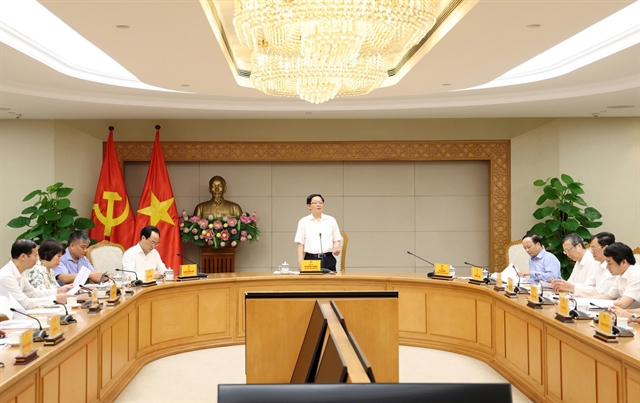 |
| Deputy Prime Minister Hồ Quốc Dũng chairs the meeting of the Government's Task Force on Strategic Technology Development in Hà Nội on June 4. VNA/VNS Photo |
HÀ NỘI — Deputy Prime Minister Hồ Quốc Dũng has called on ministries and agencies to move from planning to action, with a focus on developing strategic technologies, products and businesses, so that Việt Nam can launch its first strategic technology products in 2026.
He made the remarks while chairing the first meeting of the Government's Task Force on Strategic Technology Development, which reviewed progress in implementing two key decisions issued earlier this year. The decisions set out a list of strategic technologies and strategic technology products to guide the country's development efforts.
The Deputy Prime Minister requested ministries and agencies to clearly report on implementation progress, difficulties and obstacles encountered during the process, and to propose solutions relating to ordering mechanisms, resource mobilisation, funding allocation, the selection of participating enterprises and investment in research infrastructure and laboratories.
Dũng also stressed that assigned agencies must proactively address difficulties and accelerate progress on their assigned tasks.
The Ministry of Science and Technology has proactively guided and supervised implementation, while reviewing and completing conditions necessary for implementation, including institutions, policy mechanisms, technical standards and regulations, research and testing infrastructure, human resources and monitoring and supervision tools.
To date, ministries and relevant sectors have identified focal points for implementation, reviewed tasks, developed proposals and determined outputs, resource requirements and other necessary conditions for implementation.
The ministry has issued guidance documents, organised numerous meetings and workshops and worked directly with ministries, agencies, businesses, research institutes and universities to support the development and implementation of strategic technology tasks.
Although the implementation period has been relatively short, ministries and agencies have proactively mobilised the participation of businesses, research institutes, universities and experts to develop the tasks.
Many tasks have identified output products, participating businesses, resource requirements and implementation roadmaps through to 2030.
So far, ministries, agencies and organisations have proposed a total of 48 tasks.
Among them, the Ministry of Agriculture and Environment plans to implement 12 tasks involving next-generation plant, animal and aquatic species, veterinary vaccines, biological products and agricultural product traceability systems.
The Ministry of Industry and Trade plans to implement three key projects: a digital twin for the national power grid operating system, switching equipment for voltages ranging from 22kV to 500kV and a two-armed industrial robot using a domestically developed control programme.
Objectives, outputs, implementation roadmaps and resource requirements for the 2026-30 period have been defined for these projects.
The Ministry of Health has proposed 11 projects related to next-generation vaccines for humans, cell therapy and 3D-printed medical devices, with eight expected to begin implementation in 2026.
The Ministry of Education and Training has proposed developing a national smart education platform that applies artificial intelligence and virtual reality technology.
The Ministry of National Defence is leading the development of a national unmanned aerial vehicle (UAV) management system to support airspace management and low-altitude economic development. The system is expected to be tested in 2026.
The Ministry of Public Security is implementing three tasks related to a domestic cloud computing platform, a national cybersecurity platform and UAV monitoring, detection and suppression systems. The ministry has established specialised research groups, built research and testing centres and developed a specific implementation roadmap for each task.
The Ministry of Science and Technology has initially formulated around 13 tasks focusing on artificial intelligence (AI), AI cameras for border processing, UAVs, autonomous robots, rare-earth deep-processing technology and next-generation mobile network infrastructure.
However, the implementation process continues to face challenges related to mechanisms for ordering and assigning tasks, financial mechanisms and resource mobilisation, research and testing infrastructure, standards and technical regulations, inter-sectoral coordination and product commercialisation.
The Deputy Prime Minister added that strategic technology is of particular importance to the country's development, serving as a key driver of growth and playing a central role in the three pillars of science and technology, innovation and digital transformation.
The Government has selected 20 strategic technology areas and assigned specific tasks to 10 ministries and agencies.
He said ministries and agencies must now move immediately from the preparation phase to practical implementation, focusing on creating specific products, technologies and businesses capable of delivering measurable results.
The Deputy PM requested that the decree guiding implementation of the High Technology Law be completed in June, including provisions related to strategic technology, while also researching and proposing a mechanism to identify, certify and label strategic technology products. — VNS
Politics & Law
 Politics & Law
 Politics & Law
 Politics & Law
 Politics & Law
 Politics & Law
 Politics & Law
 Politics & Law
 Politics & Law
 Politics & Law
 Politics & Law
 Politics & Law
 Politics & Law
 Politics & Law
.jpg) Politics & Law
Politics & Law