 Politics & Law
Weaving the unique heritage of the Thu Lao
1.
|
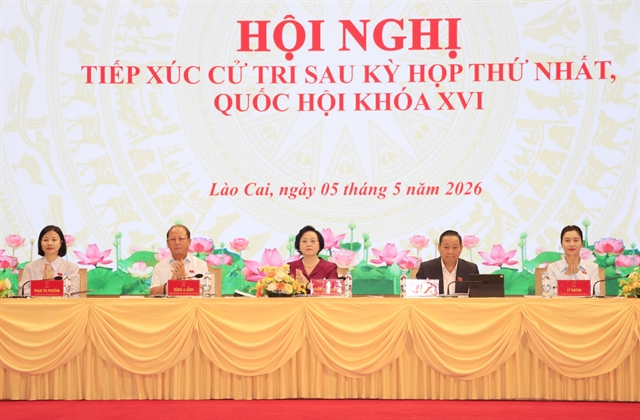
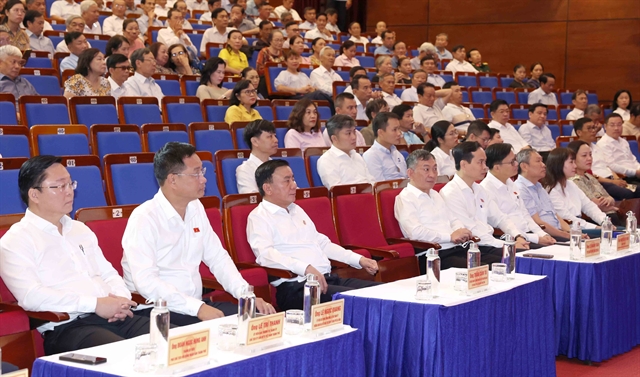
| Deputy Prime Minister Phạm Thị Thanh Trà and the delegation of National Assembly deputies of Lào Cai Province meet with local voters on Tuesday. — VNA/VNS Photo Tuấn Anh |
LÀO CAI — Secretary of the Party Central Committee and Deputy Prime Minister Phạm Thị Thanh Trà underscored the importance of reforms and restructuring for growth as she met with voters in the northern province of Lào Cai on Tuesday.
During this process, voters’ recommendations would be an important basis for policy refinement, she said as she discussed administrative reforms, socio-economic management, as well as local government staffing and wage reforms with local voters.
At the meeting, voters were briefed on socio-economic performance in the first quarter of 2026, the outcomes of the first session of the 16th National Assembly (NA) and the activities of the provincial NA delegation. They also commended socio-economic progress to help stabilise production and livelihoods for the people.
However, they noted that challenges remained in governance structure and policy implementation, and called on central authorities to complete the legal framework to timely address these issues.
Among their concerns was the inconsistent and complicated job positions and staffing at the local level. They urged that regulations be issued soon to ensure coherent job descriptions and competency standards, in accordance with the local context.
Voters also noted that allowances for commune-level leadership positions remained low relative to workload. They called for adjustments based on administrative classifications, wage reform and support mechanisms for officials holding concurrent positions.
Speaking at the meeting, Deputy PM Trà praised Lào Cai’s efforts, particularly the successful organisation of elections with a voter turnout of 99.998 per cent, among the highest nationwide.
Amid global volatility, Việt Nam’s leadership quickly consolidated its apparatus, focused on removing bottlenecks for stalled projects, reforming administrative procedures, and strengthening decentralisation.
“In less than three weeks after leadership consolidation, the Government issued eight thematic resolutions to simplify and decentralise administrative procedures and business conditions, the largest reform effort to date.
“This is only the beginning and further reductions will follow, especially regarding conditional business procedures that hinder development and cause delays for people and businesses,” Trà said.
So far, 890 business conditions had been abolished and 134 tasks delegated to local authorities. The Government had also flexibly managed fuel prices, effectively used fiscal tools, promoted public investment, maintained macroeconomic stability, controlled inflation, ensured social welfare and enhanced the country’s international standing.
However, multiple challenges remained, including growth pressures, inflation risks, slow public investment disbursement, limited human resource quality and the need to modernise local governance, she said.
Regarding staffing and job positions, the Government tasked the Ministry of Home Affairs with consolidating criteria, such as administrative classification, population size, land area and economic scale, for submission to the central leadership to ensure consistent staffing management across the political system.
This would be the basis for local authorities to improve recruitment, training and public workforce restructuring, especially at the commune level.
Following the Government’s direction, job positions had been designed based on a general framework, allowing local authorities to proactively customise in line with practical needs, enabling more efficient use of public staffing quotas.
Starting from July 1, the base salary would also be raised by 8 per cent for public employees, armed forces and social policy beneficiaries. Allowances for civil servants would also be reviewed.
Trà noted that wage reform would be both a resource and a driver for development, but must be implemented cautiously in line with the state budget and broader policy balance.
During the meeting, the deputy PM also discussed voters’ concerns on food safety, forestry violation handling and industrial cluster development. — VNS
Politics & Law
 Politics & Law
 Politics & Law
 Politics & Law
 Politics & Law
 Politics & Law
 Politics & Law
 Politics & Law
 Politics & Law
 Politics & Law
 Politics & Law
 Politics & Law
 Politics & Law
 Politics & Law
 Politics & Law