 Politics & Law
 Rikkeisoft ký kết MOU với LAC.Co, LTD - thúc đẩy hợp tác kinh doanh toàn diện trong lĩnh vực an ninh mạng.jpg)
Rikkeisoft expands cybersecurity operations in Japan with LAC partnership
1.
|
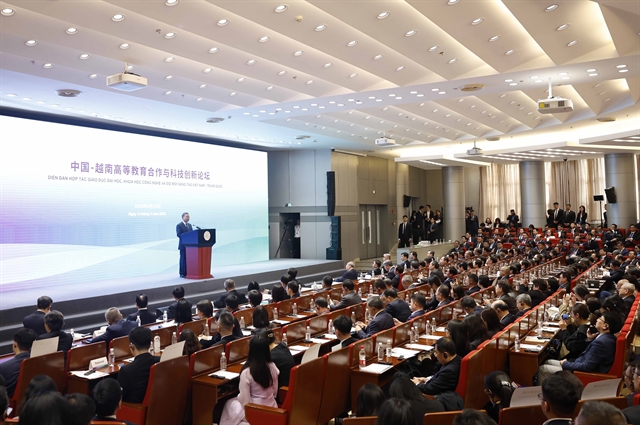
| Party General Secretary and State President Tô Lâm delivers a policy speech at a forum held at Tsinghua University in China on Tuesday. — VNA/VNS Photo |
HÀ NỘI — Party General Secretary and State President Tô Lâm expressed the hope that Việt Nam-China cooperation will grow stronger in trade and investment as well as knowledge, technology, innovation and the capacity to shape the future.
He made the statement while delivering a policy speech at a forum held at Tsinghua University in Beijing as part of his ongoing visit to China, which will last until Friday.
The Việt Nam-China Forum on Higher Education, Science, Technology and Innovation Cooperation was co-organised by China’s Ministry of Education and the Vietnamese Ministry of Education and Training.
Lâm noted that Tsinghua University trained many close friends of the Vietnamese people, including Chinese leader Xi Jinping and other senior Chinese leaders.
He said that Việt Nam and China are neighbouring countries sharing many cultural similarities and longstanding ties nurtured over thousands of years of exchanges and strengthened by the peoples’ shared aspirations for peace, stability and development.
The Vietnamese leader expressed satisfaction with the growing cooperation between Vietnamese educational and research institutions and Tsinghua University, particularly in priority areas such as artificial intelligence, semiconductors, science and technology and high-quality workforce training.
About 25,000 Vietnamese students are currently studying in China, reflecting the deepening educational exchanges between the two countries.
“I believe that every Vietnamese student studying in China, including those at Tsinghua University, serves as a bridge of friendship, a cultural ambassador and a representative of the Vietnamese youth’s spirit of learning, openness and aspiration to rise," Lâm said.
"I also believe that each Chinese student coming to Việt Nam to study, conduct research and gain practical experience will contribute to deepening mutual understanding between the two peoples."
He called for further strengthening the political and social foundations of bilateral ties, emphasising that developing relations in a stable, healthy and sustainable manner must first be built on a foundation of political trust and mutual respect and understanding between the two peoples and the shared determination of successive generations of leaders of both Parties and countries.
Lasting friendship must be passed down from one generation to the next and nurtured among the people, especially the younger generation, he said.
Alongside high-level exchanges and cooperation among ministries, sectors and localities, greater attention should be given to people-to-people exchanges, youth exchanges, academic exchanges and cooperation in culture, education and tourism, so that every citizen and every young person in both countries feels a responsibility to preserve and further strengthen the Việt Nam–China friendship, he said.
He urged stronger, more substantive cooperation, with strategic connectivity as the focus, tangible results as the measure and the interests of the two peoples as the ultimate goal.
Science, technology, innovation and digital transformation should become new pillars of bilateral relations in the years to come, he said.
He said Việt Nam was entering a new development phase, with science, technology and innovation identified as key drivers to achieve strategic goals by 2030 and 2045. The country placed great importance on cooperation with China in areas of mutual strength, including artificial intelligence, big data, cloud computing, semiconductors, automation, robotics, green technology, biotechnology, new materials, clean energy and other strategic industries.
In this context, education and training, particularly the development of a skilled workforce, should be a top priority, he said. Lâm added that he hoped to see more Vietnamese students, researchers and young scientists study and conduct research at leading Chinese institutions, including Tsinghua University.
The top Vietnamese leader also called for expanded cooperation between Tsinghua University and Vietnamese universities and research institutes, including student and academic exchanges, joint training programmes, collaborative research, co-supervised programmes and the establishment of joint research groups and laboratories in key fields.
He stressed the importance of strengthening youth exchanges so that younger generations become both inheritors of the traditional friendship and pioneers in shaping the future, working together to address major development challenges in areas such as education, health care, environment, energy, smart cities, green agriculture and the digital economy.
Lâm also expressed his confidence that by building on the legacy of friendship, mutual trust, substantive cooperation and breakthroughs in science, technology and innovation with youth serving as a bridge to the future, Việt Nam-China relations would continue to develop in a stable, healthy and sustainable manner, bringing tangible benefits to both peoples and contributing to regional and global peace and development. — VNS
Politics & Law
 Politics & Law
 Politics & Law
 Politics & Law
 Politics & Law
 Politics & Law
 Politics & Law
 Politics & Law
 Politics & Law
 Politics & Law
 Politics & Law
 Politics & Law
 Politics & Law
 Politics & Law
.jpg) Politics & Law
Politics & Law