 Politics & Law
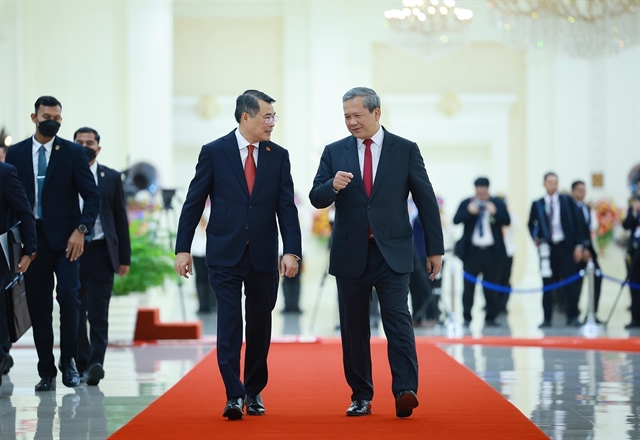
Vietnamese Prime Minister meets Cambodian National Assembly President
1.
 |
| Party General Secretary Tô Lâm and delegates vote to adopt the Resolution of the second plenum of the 14th Party Central Committee. VNA/VNS Photo Thống Nhất |
HÀ NỘI — Party General Secretary Tô Lâm has called for the early formulation of a resolution on a new national development model powered by science, technology, innovation and digital transformation, describing it as a “driving force of driving forces” to achieve double-digit economic growth.
He was speaking at the closing session of the second plenum of the 14th Party Central Committee on Wednesday afternoon, after three days of intensive deliberations.
Addressing the event, the Party chief said the Party Central Committee had reached a high level of consensus on major and strategic issues concerning the Party and the nation, particularly in organisational and personnel work as well as the Party’s foundational regulations.
He said that Party building in political and ideological terms must continue to be strengthened in the new period, laying a solid foundation to enhance the Party’s mettle, vanguard role, combative spirit and leadership capacity.
Calling on Party members nationwide to thoroughly grasp and strictly implement core commitments in political and ideological work, he emphasised the need to steadfastly adhere to and creatively apply Marxism–Leninism and Hồ Chí Minh Thought; uphold the goal of national independence associated with socialism; continue the Đổi mới (Rrenewal) policy; and strictly observe the Party’s organisational principles and rules to safeguard the Socialist Republic of Việt Nam.
On economic development, General Secretary Lâm affirmed that pursuing double-digit growth is an objective requirement arising from the country’s development stage and its aspiration for advancement.
“Low growth is not an option,” he said, stressing the need for high, sustainable and substantive expansion.
He outlined four guiding principles: ensuring growth quality and sustainability; maintaining macroeconomic stability, controlling inflation and safeguarding major economic balances; efficiently mobilising and allocating resources – prioritising key projects and public-private partnerships to boost competitiveness; and ensuring that growth translates into improved living standards and greater social equity.
Achieving these targets, he said, requires consistent, synchronised and determined implementation under the leadership of the Party Central Committee, with close coordination across ministries, sectors, localities and the entire political system.
To underpin this effort, the Party Central Committee will soon draft a resolution on a new development model grounded in science, technology, innovation and digital transformation, to be submitted at its third plenum.
Highlighting governance reform, he said the two-tier local administration model represents not merely an organisational change but a shift in governance, aimed at streamlining intermediary layers, improving grassroots effectiveness, optimising resource allocation and leveraging technology and data to better serve people and businesses. He stressed that decentralisation must go hand in hand with resource allocation, capacity building and robust oversight.
On anti-corruption efforts, he underscored the need to align inspection, supervision and power control with the broader goal of rapid and sustainable development. These efforts, he said, are essential not only to ensure a clean apparatus but also to strengthen public trust, maintain socio-political stability and foster a healthy development environment.
Amid expanding investment, major projects and more open policies, he warned of rising risks of corruption and wastefulness in both scale and sophistication. Institutions, he said, must be strengthened to make corruption 'impossible', while oversight mechanisms must ensure officials 'do not dare' and 'do not want' to engage in wrongdoing. All violations must be handled strictly, with persistent and continuous enforcement.
At the same time, he called for mechanisms to protect proactive and innovative officials who act for the common good, stressing the need to distinguish between self-serving violations and mistakes made in the course of reform and experimentation.
On national defence, security, foreign affairs and international integration, General Secretary Lâm stressed that a country seeking rapid growth and deeper global integration must ensure strategic autonomy, strong risk management, sound institutions and social stability, alongside resilience to both traditional and non-traditional security challenges.
Safeguarding national security in the new context, he said, goes beyond protecting sovereignty over land, sea and airspace to include maintaining a peaceful environment, safeguarding institutions and public trust, protecting cyberspace and data and securing key economic lifelines and strategic interests.
He emphasised that defence, security and foreign affairs must be integrated across all development strategies and policies, ensuring that growth remains sustainable, sovereign and risk-resilient, while enabling the country to proactively address threats before they emerge.
This integrated approach, he noted, would help build comprehensive national strength in peacetime, combining military capability, security capacity, diplomatic influence, economic strength, scientific and technological advancement, and national unity into a cohesive and mutually reinforcing system.
He also highlighted the importance of strengthening the 'people’s support posture', building an all-people national defence in tandem with people-based security, particularly in strategic areas such as border regions, seas and islands, major urban centres, key economic zones, critical infrastructure and cyberspace.
“This is the convergence of position and strength of national defence and societal defence - safeguarding territorial sovereignty alongside the Party’s ideological foundation, and maintaining political stability and social order,” he said.
The Party leader underlined the need to further integrate national defence, security and foreign affairs with socio-economic development, ensuring a close linkage between protection and development, stability and innovation, so that these pillars become both a component of national competitiveness and a direct driver of growth in the new era. — VNS
Politics & Law
 Politics & Law
 Politics & Law
 Politics & Law
 Politics & Law
 Politics & Law
 Politics & Law
 Politics & Law
 Politics & Law
 Politics & Law
 Politics & Law
 Politics & Law
 Politics & Law
 Politics & Law
 Politics & Law