 Politics & Law

Vietnamese scientist wins ASEAN-US Science Prize for Women
1.
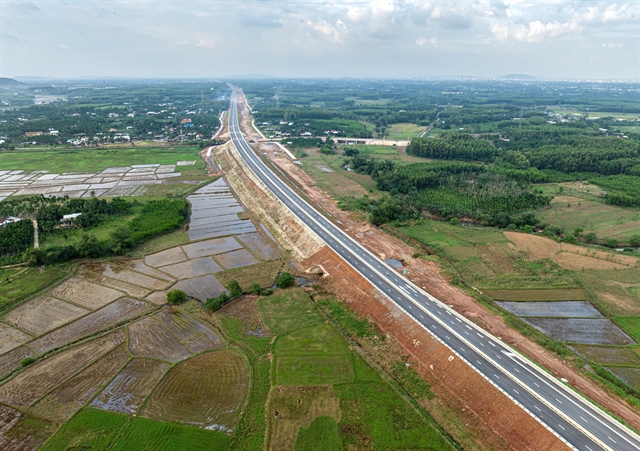 |
| An aerial view of the Quảng Ngãi–Hoài Nhơn Expressway, one of the major transport infrastructure projects inaugurated in 2025. — VNA/VNS Photo |
HÀ NỘI — Under the leadership of the Party and the Government, administrative reform has been steered towards more proactive, flexible, innovative and resolute governance, delivering institutional, regulatory and policy breakthroughs to support the country’s development.
In 2025, the Party and the State focused on further facilitating production and business, unlocking, mobilising and leveraging resources and generating breakthroughs across sectors.
Policy priorities have centred on promoting growth while safeguarding macroeconomic stability, controlling inflation and ensuring the major balances of the economy.
A key highlight over the past year has been institution-building and administrative reform to establish a two-tier local government system. The Government directed the drafting, coordination and submission of 10 breakthrough resolutions in key areas to the Politburo.
The new local government model has been rolled out with strong decentralisation and delegation of authority. Staffing in the state administrative sector has been reduced by 145,000 positions, while annual recurrent expenditure has fallen by VNĐ39 trillion (US$1.5 billion).
To date, the two-tier local government system has largely entered stable operation, marking a shift from an administrative mindset to one focused on serving the people and fostering development.
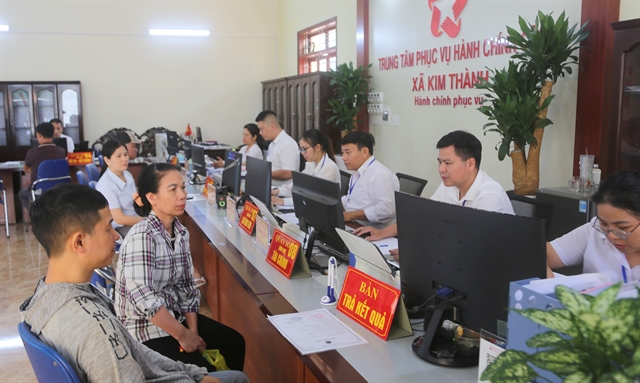 |
| People process administrative procedures at a local public service centre in Hải Phòng City, following the roll-out of the two-tier local government system in July 2025. — VNA/VNS Photo Minh Thu |
The timeliness and effectiveness of the Party’s guidelines and the Government’s administration in 2025 are reflected in the country’s growth figures. Việt Nam’s socio-economic performance maintained an upward trajectory, meeting and surpassing all 15 major targets set for the year with GDP growth of 8.02 per cent.
According to a newly released report by the UK-based Centre for Economics and Business Research, Việt Nam’s growth rate exceeded the global average and ranked among the highest in the Asia-Pacific region.
Specifically, the Organisation for Economic Co-operation and Development forecast global GDP growth at 3.2 per cent, while the International Monetary Fund and the European Union projected 3.2 per cent and 3.1 per cent respectively.
Within ASEAN, the Singapore government estimated its GDP growth in 2025 at 4.8 per cent, while Thailand and Indonesia recorded growth of 2 per cent and 4.9 per cent, respectively.
Việt Nam’s GDP growth is particularly notable as the country kept inflation under control at 3.31 per cent and maintained macroeconomic stability and major economic balances. The State budget deficit, public debt, government debt and national external debt all remained well below statutory limits.
In particular, Việt Nam’s GDP scale last year reached US$514 billion, rising to 32nd place globally, up five ranks from the previous year.
Meanwhile, GDP per capita reached $5,026, more than 1.4 times the 2020 level, moving Việt Nam into the group of upper-middle-income countries.
Prioritising growth
As a developing country, prioritising investment in infrastructure development is essential for Việt Nam, especially large-scale transport infrastructure, digital infrastructure for smart cities, and energy and logistics infrastructure aimed at sustainable development, national modernisation, new development space and stronger economic growth.
The resolution of the 13th National Party Congress identified the development of a synchronous, modern infrastructure system as one of three strategic breakthroughs. In particular, transport infrastructure plays a backbone role, laying the foundation for economic growth, regional connectivity and enhanced national competitiveness.
In a recent interview with Vietnam News Agency, Prime Minister Phạm Minh Chính said that large-scale, synchronous and modern infrastructure projects in transport, energy, logistics, services, health care, education, digital and urban infrastructure have been prioritised for construction and completion.
With strong connectivity and wide-ranging impacts, these projects are creating new development space, increasing the added value of land, enhancing competitiveness, attracting investment and laying a solid foundation for Việt Nam to become a regional and global connectivity hub.
The year 2025 was marked by three nationwide rounds of groundbreaking and inauguration ceremonies for 564 major infrastructure projects, with total investment exceeding VNĐ5.14 quadrillion ($195.5 billion), nearly 75 per cent of which came from the private sector, demonstrating the effectiveness of mobilising social resources for development investment.
By the end of 2025, Việt Nam had completed and put into operation about 3,345km of expressways and more than 1,711km of coastal roads, exceeding the targets set by the 13th National Party Congress.
At the same time, efforts were stepped up to advance science and technology, innovation and digital transformation, achieving important initial results. Implementing the Politburo’s Resolution 57, within one year the Government submitted to the National Assembly 10 draft laws regulating science, technology, innovation and digital transformation, along with the issuance of 19 guiding decrees.
Việt Nam now ranks second in ASEAN for artificial intelligence investment, sixth out of 40 countries in the WIN World AI Index and 44th out of 139 in the Global Innovation Index.
Breakthroughs in building a synchronous, modern infrastructure system play a foundational role in achieving the goal of double-digit GDP growth in 2026, the first year of implementing the upcoming 14th National Party Congress’s resolution and the first year of the five-year plan from 2026 to 2030.
Accordingly, the Government leader has urged authorities at all levels and sectors to ensure the progress of strategic infrastructure projects and to concentrate resources on breakthrough tasks and projects for socio-economic development. — VNS
Politics & Law
 Politics & Law
 Politics & Law
 Politics & Law
 Politics & Law
 Politics & Law
.jpg) Politics & Law
Politics & Law
 Politics & Law
 Politics & Law
 Politics & Law
 Politics & Law
 Politics & Law
 Politics & Law
 Politics & Law
 Politics & Law