 Politics & Law
Vietnamese scientist wins ASEAN-US Science Prize for Women
1.
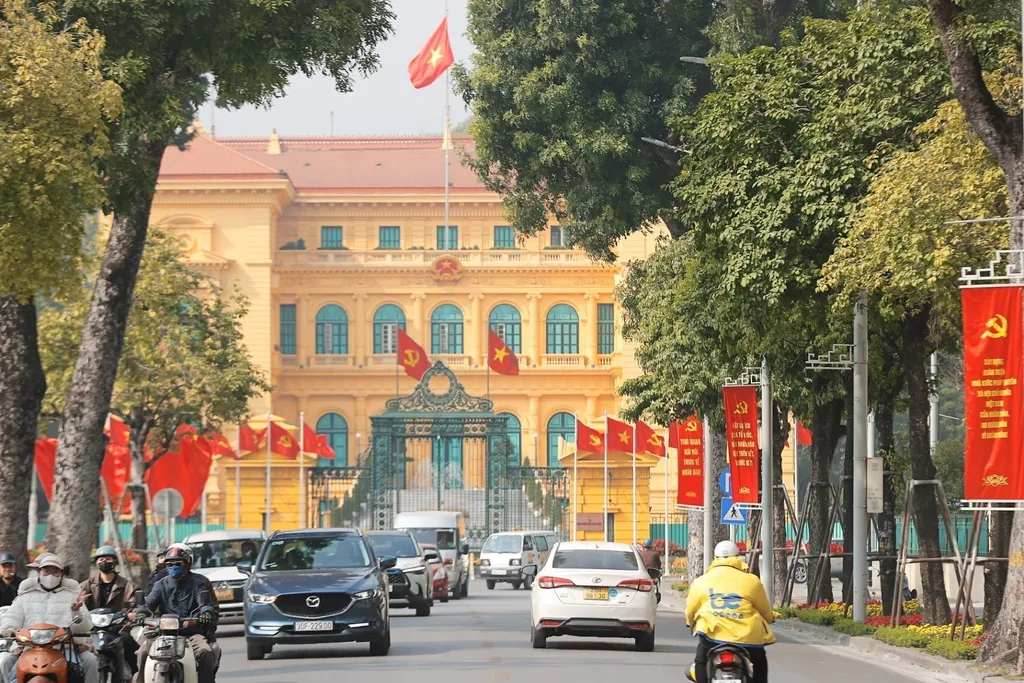 |
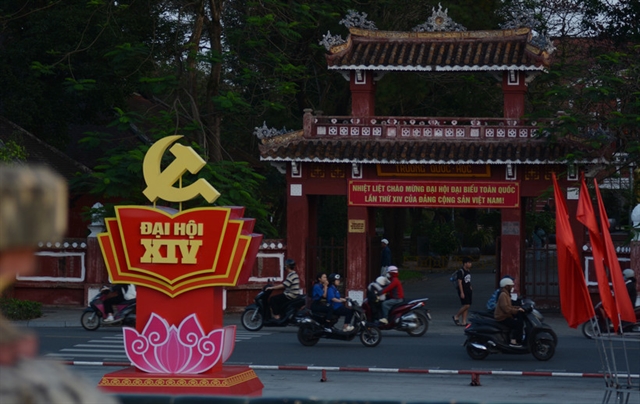
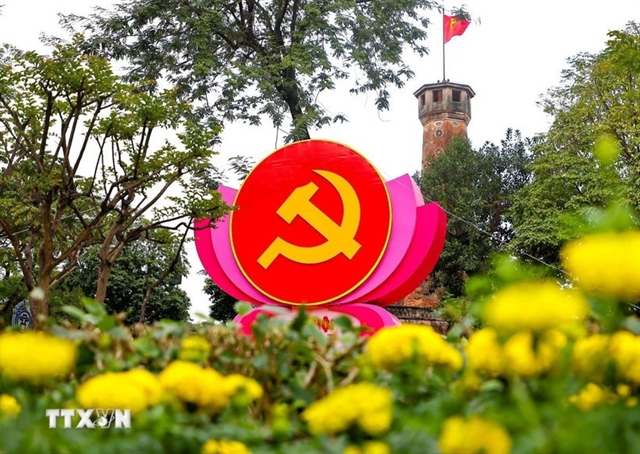
| Pano, posters and banners celebrating the 14th National Party Congress are displayed along city streets. VNA/VNS Photos |
The draft Political Report for the 14th National Congress of the Communist Party of Việt Nam, slated for January 19-25, introduces some of the most comprehensive and forward-looking reforms in recent decades, ranging from a unified strategic document and a detailed action programme to new approaches to growth, technology, institutional reform and human development.
In an interview with VietTimes e-Magazine, Professor Tạ Ngọc Tấn, permanent vice chairman of the Party’s Central Theory Council and permanent deputy head of the editorial team for the Congress documents, said that for the first time, the documents integrated three key reports: the Political Report, the Socio-economic Report and the Party-building Review, with the Political Report serving as the central document.
The integration of all reports into a single document ensures a coherent and unified presentation of the Party’s viewpoints, arguments and guiding line, making it easier for Party cadres and members, as well as the public, to understand, translate into concrete action and implement, according to Tấn.
Another highlight is the concrete translation of the Party’s guidelines into strategic decisions.
Prior to the Congress, the Politburo issued various important resolutions, turning the Party’s orientations for the Congress into specific strategic policies. This helps overcome the previous situation where resolutions were only issued after the Congress, and instead makes it possible to proactively review, amend, and remove issues, address limitations, and stay closely aligned with development goals, directions, and priority tasks for immediate implementation after the Congress.
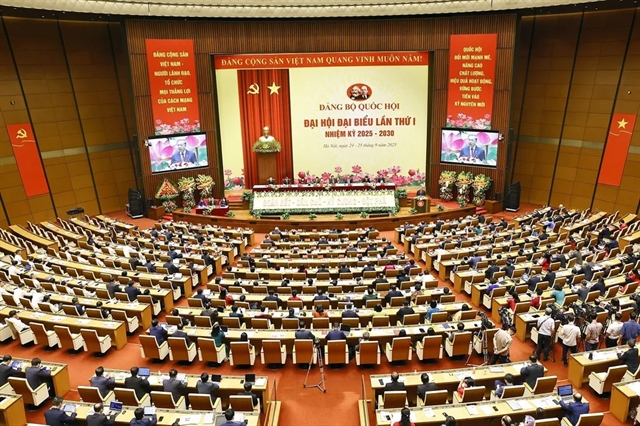 |
| The first Congress of the Party Organisation of the National Assembly for the 2025–2030 tenure convened in Hà Nội in September 2025. VNA/VNS Photo |
Notably, Tấn pointed out that for the first time, the Party Central Committee had adopted an action programme to implement the Resolution of the 14th Congress, which is included as an integral part of the Political Report.
The programme identifies in detail the projects, schemes and specific tasks to be carried out in the five-year tenure. It clearly assigns lead agencies, timelines, expected outcomes, resources and necessary conditions. This serves as a basis for all levels and sectors to implement the Resolution in line with their assigned functions, tasks and powers.
He stressed that the drafting process had been conducted in a meticulous, scientific and democratic manner and continuously updated. Since 2019, the documents had been continuously revised in light of new feedback. During just one month of public consultation, more than 4.5 million people contributed over 14 million specific comments.
Breakthrough elements
 |
| General Secretary Tô Lâm, together with incumbent and former leaders of the Party and the State, viewed an exhibition of Constitution publications displayed at the event. |
According to Tấn, the draft Political Report for the 14th Congress contains a number of important new features, the first being a systematic presentation of the theory of the renewal line.
Second, the draft also raises the requirement to build a compatible and modern institutional framework to achieve rapid and sustainable development, in which the political system is regarded as the decisive factor, the economic institution as the central pillar, and other institutions as playing important roles.
Third, it sets out a new growth model, economic restructuring and accelerated industrialisation and modernisation. The draft Political Report proposes policies to prioritise the development and gradual mastery of core, advanced and critical industrial production technologies.
The private sector is to be developed as one of the most important drivers of the national economy, while ensuring an appropriate and effective relationship between the State, the market and society.
 |
| Prime Minister Phạm Minh Chính performs the gong-striking ceremony to launch a new phase of development at the Vietnam Private Economic Forum (VPSF) 2025. |
According to the editorial team, identifying the private sector as one of the most important drivers of the economy reflects a strategic vision in the context of deepening international integration and increasingly intense global competition. This perspective underscores the growing role of private enterprises in technological innovation, job creation, productivity enhancement and contributions to the State budget, thereby strengthening the foundations of Việt Nam’s economic autonomy in a new phase of development.
The draft also places culture and people at the centre of development. Culture is regarded as the spiritual foundation, while people are seen as both a vital resource and an intrinsic driving force, as well as a regulating factor for sustainable development.
For the first time, the national value system, along with the value systems of Vietnamese culture, people and families, is clearly articulated in the document. Healthcare is identified as a pillar of social welfare, closely linked to equity and digital transformation in public health services.
 |
| The private sector is to be developed as one of the most important drivers of the national economy. |
In addition, scientific and technological breakthroughs, innovation, and education and training are identified as the central drivers of national development in the new era. The draft highlights the need to accelerate the green transition and economic restructuring, improve the quality of human resources, and foster new growth poles and key economic regions.
According to the editorial team, Việt Nam will prioritise strong investment in core and future technologies such as artificial intelligence, semiconductors, biotechnology, new materials, clean energy, space technology and the peaceful use of nuclear energy.
The document calls for policies to support research, development and application, the promotion of domestic technology enterprises, the development of a dynamic start-up and innovation ecosystem, the formation of a global innovation network of Vietnamese professionals, and the safeguarding of technological sovereignty.
Education is identified as a strategic pillar closely aligned with science and technology and the labour market. The draft sets out a vision for an open, modern and internationally integrated education system, emphasising practical and career-oriented learning and using international learning outcomes as a benchmark of quality.
Universities will be granted greater autonomy, shifting from administrative management to modern governance, and strengthening linkages with enterprises and research institutions to support sustained innovation and comprehensive human development.
 |
| On August 25, 2025, at the Hoà Lạc Hi-Tech Park, the Ministry of Finance assigned the National Innovation Centre to organise a ceremony announcing the establishment of three innovation networks in strategic technology sectors: quantum technology, cybersecurity, and aerospace and unmanned aerial vehicles. |
In addition, the draft underlines the need for a major breakthrough in the development of an autonomous, self-reliant and modern defence and security industry with dual use capability, in order to firmly safeguard the Motherland in all circumstances, especially in the context of high-tech warfare. External relations are to be advanced in a way that matches the country’s historical, cultural and strategic stature in the new era.
Development goals
Tấn said the 14th National Party Congress was assessed as having a particularly important position, opening a new era described as the era of national rise.
The Congress takes place at a time when the world is undergoing profound changes and rapid technological advances that are transforming politics, society and science and technology.
 |
| General Secretary Tô Lâm, Head of the Drafting Subcommittee for the 14th National Party Congress documents, delivers his remarks. |
“We are carrying out a revolutionary restructuring of the apparatus and building a new political model based on three pillars: the Party, the State and the People. The 14th Congress is being held in a spirit of confidence and democratisation,” he said.
The Political Report to be submitted to the 14th Congress assesses the context of the 13th tenure as especially difficult, complex, unexpected and hard to predict. Despite this, the country has achieved major and comprehensive gains in the economy, society, national defence, security and external relations, while implementing many transformative tasks that lay a solid foundation for Việt Nam to enter a new phase of development.
The draft documents set development targets for Việt Nam to become, by 2030, when the Party celebrates its centenary, a developing country with modern industry and upper-middle income. By 2045, when the country marks the 100th anniversary of the founding of the Democratic Republic of Việt Nam – the predecessor of the Socialist Republic of Việt Nam – Việt Nam aims to become a developed, high-income country.
 |
| By 2045, marking 100 years since the founding of the Democratic Republic of Việt Nam, the country aims to reach developed, high-income status. |
To achieve these goals, the draft proposes that GDP growth in the period 2026 to 2030 should reach about 10 per cent a year. GDP per capita is expected to reach around US$8,500 by 2030. The contribution of total factor productivity to growth is expected to rise to 55 per cent, while the Human Development Index is expected to reach 0.8.
Tấn outlined three grounds for believing that Việt Nam can achieve double-digit growth from 2026.
First, Việt Nam already experienced periods of high growth, approaching 10 per cent, especially in the late 1990s. That experience in macroeconomic management, mobilisation of resources and production promotion can be drawn upon in the current context.
Second, although the national growth rate has not yet reached double digits, some localities such as the former province of Bình Dương and Quảng Ninh have recorded very high growth rates. Many other provinces and cities are also setting targets of double-digit growth from next year, which shows that there is still considerable room and potential if domestic resources are tapped and used effectively.
Third, international experience shows that a number of economies have maintained double-digit growth for many years in order to move up into the ranks of developed economies, including South Korea, China and several East Asian economies and territories. VNS
Politics & Law
 Politics & Law
 Politics & Law
 Politics & Law
 Politics & Law
 Politics & Law
 Politics & Law
 Politics & Law
 Politics & Law
 Politics & Law
 Politics & Law
 Politics & Law
 Politics & Law
 Politics & Law