 Politics & Law

Solcis launches open compliance layer for AI agents on NVIDIA OpenShell
1.
|
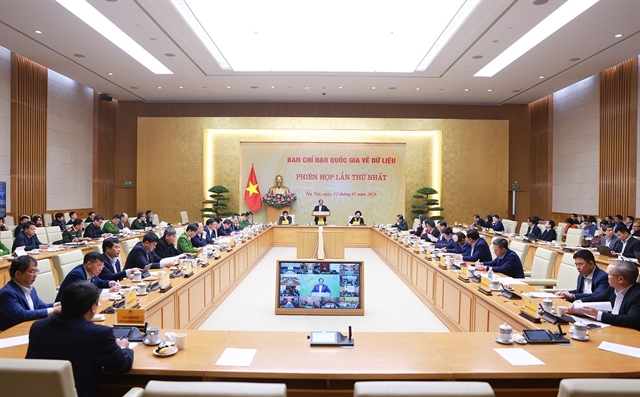
| At the meeting. VNA/VNS Photo |
HÀ NỘI — Prime Minister Phạm Minh Chính yesterday chaired the first meeting of the National Steering Committee on data.
The meeting was co-chaired online by Deputy Prime Ministers and Deputy Heads of the Steering Committee Nguyễn Chí Dũng and Phạm Thị Thanh Trà, with centrally governed provinces and cities connected.
Participants included General Lương Tam Quang, Politburo member, Minister of Public Security and Standing Deputy Head of the Steering Committee; Lê Hoài Trung, Party Central Committee Secretary and Minister of Foreign Affairs; as well as leaders of ministries, agencies, members of the Steering Committee and representatives of localities.
The National Steering Committee on Data is an inter-sectoral coordinating body tasked with conducting research, providing consultation and recommendations and assisting the Government, the Prime Minister and the Head of the Steering Committee in directing and coordinating the implementation of national guidelines, strategies, mechanisms, policies and large-scale solutions related to data.
Its responsibilities include overseeing the development and operation of national and sectoral databases, as well as the integration, synchronisation, storage, sharing, analysis, exploitation and coordination of data within the National Integrated Data Repository and addressing important inter-sectoral issues related to data.
In his opening remarks, Prime Minister Phạm Minh Chính, also Head of the Steering Committee, emphasised the vital role of data, noting that building databases is an important task of far-reaching significance.
The first meeting of the Steering Committee was aimed at unifying awareness, vision and concrete actions to build data that is accurate, sufficient, clean and dynamic, unified and shared. This, he said, would support the development of artificial intelligence and contribute to economic growth and sustainable development.
The Prime Minister said the meeting was convened with urgency to address the country’s pressing requirements. He noted that achieving economic growth of 10 per cent or higher in the coming period will require Việt Nam to move beyond traditional growth drivers and accelerate the development of new ones, particularly the digital economy, green economy, circular economy, data and artificial intelligence.
The Prime Minister noted that the Politburo has issued a number of core and strategic resolutions aimed at promoting rapid and sustainable development in the coming period. Among them, Resolution No.57-NQ/TW on breakthroughs in science and technology development, innovation and national digital transformation calls for maximising the potential of data, turning data into a primary means of production and accelerating the development of big data, the data industry and the data economy.
In recent times, the Government and the Prime Minister have directed ministries, sectors and localities to implement Resolution No.57 decisively, guided by the principle that the Party has directed, the Government has unified, the National Assembly has agreed and the people have supported, with a focus on action and a strong sense of urgency.
The Prime Minister said the world is witnessing unprecedented growth in data, with average annual growth exceeding 25 per cent, making data a highly valuable resource in the digital era. Việt Nam has achieved positive results in data development alongside progress in digital transformation and the rapid expansion of artificial intelligence (AI).
Economic experts have described this as an important opportunity for Việt Nam to make breakthroughs in the data sector. With effective data governance combined with artificial intelligence, the sector could generate revenues of up to US$80 billion by 2030, underscoring data’s role as a new growth driver.
At the same time, the Prime Minister pointed out that Việt Nam continues to face bottlenecks, including institutional constraints and legal frameworks that have yet to keep pace with reality, limited data connectivity and sharing among ministries, sectors and localities, low data quality and a lack of standardisation.
Data centre infrastructure also remains inadequate for the development of data and AI, while shortages of high-quality human resources and risks to cybersecurity and data safety pose additional challenges. These factors, he said, are major barriers to the formation of a data market and the development of sovereign national artificial intelligence capabilities.
To ensure effective outcomes, the Prime Minister urged delegates to focus on building high-quality, shared data from the source, breaking down data silos, balancing data openness with personal data protection and national security, developing a data market and appropriate pricing mechanisms, and designing data exchange models that support development while managing risks.
He also raised the need for strategies to develop sovereign AI with Vietnamese characteristics, mobilise Vietnamese-language data resources in areas such as culture, history and law, and strengthen computing and energy infrastructure for data centres.
In addition, the Prime Minister pointed to slow progress in several key national and sectoral databases and called for strong measures to end fragmented development based on differing technologies and standards.
The Prime Minister also asked delegates to share global data development trends and lessons applicable to Việt Nam, while identifying breakthrough tasks and solutions for the period ahead. — VNS
Politics & Law
 Politics & Law
 Politics & Law
 Politics & Law
 Politics & Law
 Politics & Law
 Politics & Law
 Politics & Law
 Politics & Law
 Politics & Law
 Politics & Law
 Politics & Law
 Politics & Law
 Politics & Law
 Politics & Law