 Politics & Law

Singaporeans Feeling the Pressure: Cost Concerns Rise as Household Optimism and Government Ratings Weaken - Blackbox Research Study
1.
|
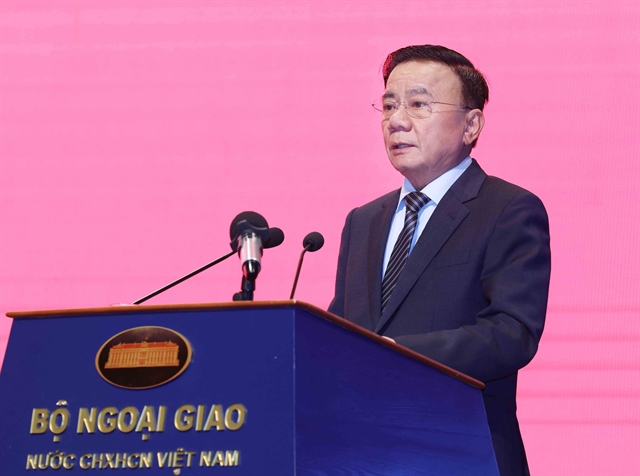
| Trần Cẩm Tú, Permanent Member of the Party Central Committee’s Secretariat delivers his speech at the conference on Tuesday morning in Hà Nội.— VNA/VNS Photos Phương Hoa |
HÀ NỘI — People-to-people diplomacy is not a supplementary activity but a strategic pillar of Việt Nam’s comprehensive and modern foreign policy.
People-to-people diplomacy plays a vital role in building broad social foundations, enhancing mutual understanding, strengthening trust and garnering international public support.
Trần Cẩm Tú, Permanent Member of the Party Central Committee’s Secretariat, made the remarks at a conference on Tuesday morning in Hà Nội reviewing people-to-people diplomatic work in 2025 and outlining tasks for 2026.
The event was organised by the Ministry of Foreign Affairs.
Tú stressed the need to ensure the Party’s comprehensive and absolute leadership, alongside effective State management, over people-to-people diplomacy.
He called for a thorough grasp of the Party’s foreign policy line and a profound shift in awareness across the political system regarding the position, role and importance of the field.
All Party committees, authorities, the Việt Nam Fatherland Front and mass organisations at all levels must regard people-to-people diplomacy as a regular political task, closely linked to the responsibility of heads of agencies, units and localities, he said.
Its objectives, requirements and tasks in the new period must be fully internalised, as this work constitutes a key component of the strategy to safeguard and develop the country, operating proactively and continuously to create new opportunities and spaces for cooperation.
He also called for a stronger role by the Việt Nam Fatherland Front in leading, directing and guiding the implementation of people-to-people diplomatic activities, while promoting international integration and mobilising external resources in support of the country’s sustainable development goals.
Priority areas for expanded cooperation with international partners would include human resource training, innovation, digital transformation, green and sustainable development and responses to non-traditional security challenges, he said.
Tú further underscored the importance of investing in both financial and human resources for people-to-people diplomacy.
The Ministry of Foreign Affairs was tasked with coordinating with relevant agencies and local authorities to conduct a preliminary review of nearly five years of implementing the Secretariat’s Directive No.12 of the 13th Party Congress.
On that basis, it would advise on the development of a national strategy on people-to-people diplomacy with a vision to 2045, aimed at more systematic, creative and effective implementation in the new revolutionary period.
He expressed confidence that the nationwide contingent of people-to-people diplomacy officials would continue to demonstrate the intellect, mettle and character of Việt Nam’s diplomacy in the Hồ Chí Minh era, contributing to the building of a strong, modern and comprehensive foreign service and helping realise the goals set out in the Party’s 14th National Congress.

|
| Participants at the conference. |
Strengthening friendship with other nations
Under a report presented at the conference, people-to-people diplomacy in 2025 contributed significantly to deepening friendship and cooperation with peoples of other countries, creating a favourable and positive social foundation for Việt Nam’s external relations.
The work has become increasingly integrated with Party diplomacy and State diplomacy, serving shared foreign policy objectives.
As one of the three pillars of Việt Nam’s comprehensive and modern diplomacy, people-to-people exchanges continued to actively support Party and State diplomatic efforts, vividly reflecting the substance of Việt Nam’s relations with other countries.
A wide range of meaningful activities were organised in conjunction with high-level visits by Vietnamese Party and State leaders abroad and visits to Việt Nam by foreign leaders.
Notable events included the Việt Nam - China People’s Friendship Meeting, the launch of the Red Journey: Youth Research and Study Programme and the forum Việt Nam - China Youth: Steadfast in Ideals, attended by Party General Secretary Tô Lâm, President Lương Cường and Chinese Party General Secretary and President Xi Jinping.
Other highlights were meetings honouring Russian intellectuals and experts who supported Việt Nam, a programme bringing together Korean friends with the participation of Party General Secretary Tô Lâm and a gathering of Vietnamese and US veterans and long-standing American partners, attended by President Lương Cường.
Bilateral people-to-people diplomacy continued to be promoted by mass organisations, delivering important results and contributing to the overall development of Việt Nam’s relations with other countries.
Particularly noteworthy were activities marking the Việt Nam - Cuba Friendship Year, jointly organised by Vietnamese localities and mass organisations with Cuban partners.
A nationwide fundraising campaign in support of the Cuban people, launched by the Việt Nam Fatherland Front and the Việt Nam Red Cross Society, attracted broad public support, raising a total of VNĐ656.7 billion (US$25 million), ten times the initial target.
Multilateral people-to-people diplomacy was also strengthened and elevated, with Vietnamese organisations assuming greater responsibilities and proposing new initiatives.
Through these activities, people-to-people diplomacy has helped mobilise diverse international resources in support of strategic resolutions of the Politburo, contributing to economic development and addressing social, environmental and climate change challenges.
Việt Nam’s image has become increasingly familiar to international friends and partners, while understanding of the country and its people has deepened.
Work related to overseas Vietnamese communities also made meaningful contributions to the policy of national great unity, with initiatives such as the Great National Unity Day in Fukuoka, Japan and the Vietnamese Language Ambassador programme.
The report, however, also pointed to shortcomings in 2025, including a tendency to focus on addressing immediate issues rather than developing long-term strategic proposals and a lack of breakthrough initiatives through people-to-people diplomatic channels.
Addressing the conference, Lê Hoài Trung, Minister of Foreign Affairs, called on Party committees, ministries, sectors, local authorities, socio-political organisations, mass associations and Vietnamese representative missions abroad to thoroughly implement the Party’s guidelines and the directives of the Permanent Secretariat. He reaffirmed the central role of people-to-people diplomacy within Việt Nam’s comprehensive and modern foreign policy, particularly in the new era. — VNS
Politics & Law
 Politics & Law
 Politics & Law
 Politics & Law
 Politics & Law
 Politics & Law
 Politics & Law
 Politics & Law
 Politics & Law
 Politics & Law
 Politics & Law
 Politics & Law
 Politics & Law
 Politics & Law
 Politics & Law