 Politics & Law

Việt Nam-EU, Belgium ties poised for new heights
1.

|
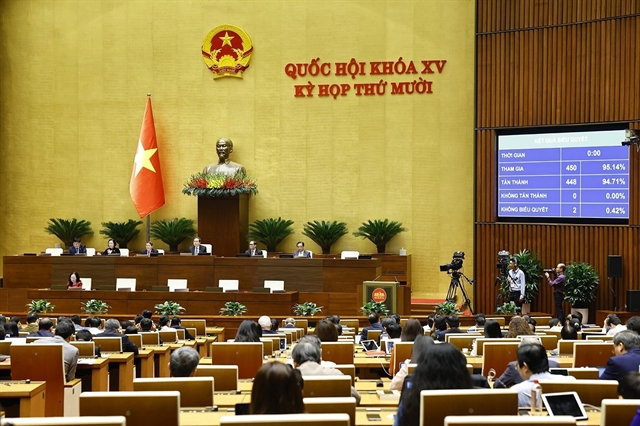
| The National Assembly convenes on Wednesday to vote on new and updated laws and resolutions. — VNA/VNS Photo Doãn Tấn |
HÀ NỘI — The National Assembly on Wednesday voted to pass and amend multiple laws related to defence and security, including the Law on Cybersecurity and the Law on Protection of State Secrets.
The Law on Cybersecurity, taking effect on July 1, 2026, was developed by merging the 2018 Cybersecurity Law and the 2015 Law on Cyberinformation Security. It aims to provide a robust legal framework to enhance national sovereignty in cyberspace and promote sustainable digital economic development.
Accordingly, the Ministry of Public Security is responsible for state management of cybersecurity, while the Ministry of National Defence is responsible for military information systems. The Government Cypher Committee manages cryptographic and cypher information systems, ensuring unified command and coordination amid international cyber threats.
The law provides specific regulations to safeguard vulnerable groups in cyberspace, with the scope of protection expanded to include children, the elderly, and individuals with cognitive difficulties.
The law also incorporates international commitments and strengthens international cybersecurity cooperation, particularly the UN Convention against Cybercrime (Hanoi Convention), which was open for signature in Hà Nội in October 2025.
To ensure adequate resources for enforcement, the law requires agencies and organisations using the state budget to allocate at least 15 per cent of their total budget for digital transformation and IT projects to cybersecurity, an increase from the previous proposal of 10 per cent.
In addition to clear definitions of data security, the law categorises information systems into five levels based on potential harm to national security and public order in case of incidents, ensuring targeted and proportionate protection measures.
State secret protection
The amended Law on Protection of State Secrets introduces significant updates regarding scope, technology, and administrative reform.
A notable new provision is the prohibition of using artificial intelligence (AI) or new technologies to infringe upon state secrets. Agencies and organisations deploying AI or emerging technologies must ensure compliance with state secret protection regulations.
The law also revises and narrows the scope of state secrets across fields such as legislation, oversight, finance, budget, agriculture and the environment, ensuring alignment with socio-economic development needs, access to information and international integration.
The document promotes decentralisation and administrative streamlining by removing authorisation procedures for determining state secrets. Accordingly, heads and deputy heads of agencies and organisations directly determine state secret classification.
Authority to duplicate or destroy secret documents is delegated to each agency’s management when retention is unnecessary, with clear regulations on destruction councils.
The law also specifies prohibited acts related to the unlawful collection, exchange, provision or transfer of state secrets to third parties without confidentiality agreements.
On the same day, the National Assembly also voted to amend 10 laws related to safety and order, including the Law on Entry, Exit, Transit and Residence of Foreigners. Accordingly, highly skilled foreigners serving Việt Nam’s socio-economic development can enjoy limited-duration visa exemptions. — VNS
Politics & Law
 Politics & Law
 Politics & Law
 Politics & Law
 Politics & Law
 Politics & Law
 Politics & Law
 Politics & Law
 Politics & Law
 Politics & Law
 Politics & Law
 Politics & Law
 Politics & Law
 Politics & Law
 Politics & Law