 Opinion

Lotte, Phát Đạt combine strengths in Thu Thiem project
1.
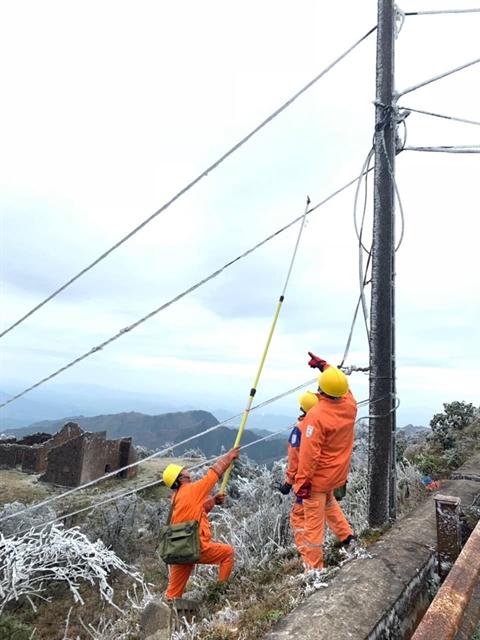 |
| Power engineers work to ensure electricity supply amid the harsh weather conditions in the northern region. — VNA/VNS Photo |
Văn Giáp
HÀ NỘI — Bringing electricity to remote areas and eliminating power blind spots has become a strategic task closely tied to the Party’s directions on poverty reduction, socio-economic development and the safeguarding of national defence and security.
The political report of the 13th Party Central Committee submitted to the 14th National Party Congress notes that social security has been increasingly strengthened, social welfare has steadily improved and policies for sustainable poverty reduction have been implemented in a coordinated and effective manner, guided by the principle of leaving no one behind.
By the final quarter of 2025, all 129 remote hamlets and villages nationwide previously classified as power and signal blind spots had been supplied with electricity, improving living conditions, reinforcing social welfare and supporting socio-economic development in disadvantaged areas.
A key driver of this progress has been the state utility Việt Nam Electricity (EVN), working with the Northern Power Corporation (EVNNPC) and the Central Power Corporation (EVNCPC). Their efforts have gone beyond stringing transmission lines and erecting power poles, helping to bring light and opportunity to some of the country’s most isolated communities.
Their work in the northern province of Lai Châu stands out as a clear example of this sustained commitment.
Hoàng Văn Thái, head of the Than Uyên regional power management team under Lai Châu Power Company, recalled the joy and excitement of residents in Nậm Manh Hamlet, Khoen On Commune, when electricity was switched on for the first time.
In 2021, when Lai Châu launched efforts to eliminate power blind spots, Thái and his colleagues crossed rugged terrain carrying coils of cable and heavy power poles on their shoulders, undeterred by torrential forest rains, slippery mud and freezing steel wires.
When the first transformer station came into operation and electricity lit up the village, elderly residents clasped the engineers’ hands in tearful gratitude amid children’s cheerful voices, an unforgettable reward for the power workers, Thái said.
Previously, only about 43 per cent of households in Lai Châu were connected to the national grid, while remote villages such as Sì Lở Lầu and Tủa Sín Chải remained in darkness.
As a subsidiary of EVNNPC, Lai Châu Power Company identified village electrification as a core mission linked to social welfare, poverty reduction, national defence and sustainable development.
Between 2020 and 2025, despite disruptions caused by COVID-19 and harsh natural conditions, the company completed multiple projects extending hundreds of kilometres of medium- and low-voltage lines to remote villages.
As a result, more than 7,900 households gained access to electricity through village electrification projects and the Government’s Programme 30a.
Giàng Thị Chơ, a resident of Háng Gàng Hamlet in Phong Thổ Commune, said her family once relied on candles and oil lamps, but now gathered under electric light in the evenings to follow the news and enjoy music, making daily life far more comfortable.
Electricity has not only lit homes but also opened opportunities for small businesses, agricultural processing, community-based tourism and higher incomes.
In border communes such as Mù Cả, Pa Ủ and Thu Lũm, power poles have been installed along border patrol roads, expanding electricity access while also supporting border management and sovereignty protection.
At the same time, power workers have guided residents in using digital services, including smartphone-based bill payments, e-invoices and online utilities. As a result, digital electricity services have become a bridge helping remote communities access information and services and integrate more easily into the national digital economy.
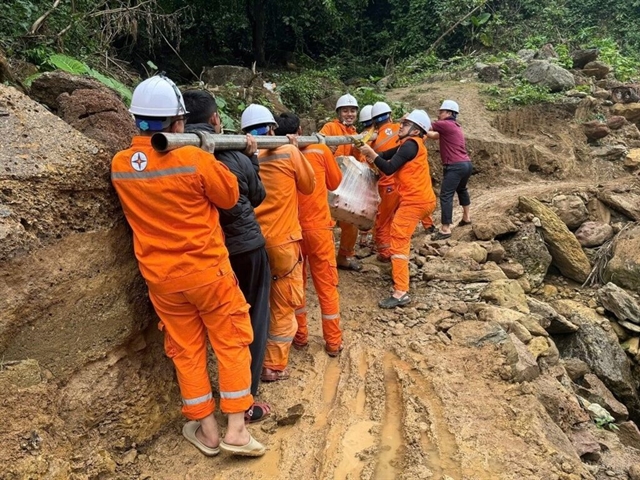 |
| Power workers transport equipment while navigating treacherous mountain cliffs to bring electricity to remote areas. — Photo courtesy of Việt Nam Electricity |
Following the Government’s Notice No.593/TB-VPCP dated October 31, 2025 on ensuring electricity access in remote areas, a determined campaign was launched across the energy sector.
Under the campaign, EVN acted as overall coordinator, mobilising maximum resources and assigning specific tasks to EVNNPC and EVNCPC, while closely monitoring progress to ensure efficiency.
In the northern region, EVNNPC took direct responsibility for electrifying 110 of the 129 previously non-electrified villages. EVNCPC handled the remaining villages in the central region, working closely with telecommunications companies and pressing ahead despite harsh storm-season weather.
EVNNPC general director Nguyễn Đức Thiện said the effort was not merely a technical task of extending power lines, but a journey of profound political and social significance that opened opportunities for education, employment and socio-economic development.
By December 15, 2025, EVN units had completed electrification in all 129 hamlets and villages that previously lacked power, achieving full coverage. By year’s end, all communes nationwide had electricity, with 99.85 per cent of households and 99.77 per cent of rural households connected to the grid. — VNS
Opinion
 Opinion
.jpg) Opinion
Opinion
 Opinion
 Opinion
 Opinion
 Opinion
 Opinion
 Opinion
 Opinion
 Opinion
 Opinion
 Opinion
 Opinion
 Opinion