.jpeg) Opinion
Opinion

Ping An Digital Bank Completes HKMA’s Second GenA.I. Sandbox Cohort
1.
To mark the establishment of diplomatic ties between Việt Nam and Norway (25/11/1971-25/11/2025) and also the beginning of the UN's 16 days of activism against gender based violence, Ambassador of Norway H.E. Hilde Solbakken wrote an article for Việt Nam News highlighting one of cooperation priorities between the two countries.
The advantages of gender equality are evident: fairer societies, faster economic growth and more solid and lasting peace. But one key question remains: are women equally represented where decisions are made?
Norway’s experience shows that when women are empowered to lead, societies become just, stronger and more sustainable. From peacebuilding, anti-corruption efforts and digital innovation, women’s leadership is helping to build more equitable and resilient communities.
Norway and Việt Nam are both committed to the Sustainable Development Goals, including SDG 5 on gender equality, thus share a growing cooperation that highlights how empowering women benefits not just women but entire communities.
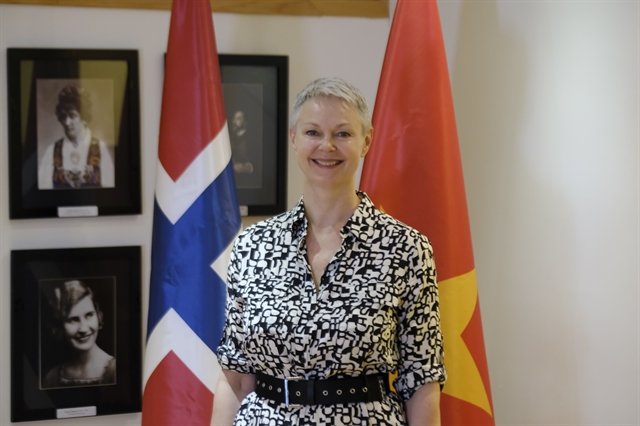 |
| Ambassador of Norway to Việt Nam Hilde Solbakken. Photo courtesy of the embassy |
Women’s leadership builds a more inclusive future
Gender equality has long been a cornerstone of Norway’s domestic and foreign policy. Today, nearly 45 per cent of Members of the Norwegian Parliament (the Storting) are women - the result of decades of commitment to equal access and representation in decision-making. Political parties, the private sector and civil society have all played a role in making gender balance an integral part of national governance.
Norway’s journey to one of the most equal societies today was built on education, participation and progressive social policies. Childcare support, parental leave and equal pay laws gave both women and men real choices, enabling everyone to contribute fully to national development.
For a small country like Norway, empowering all citizens is essential. Neglecting women’s potential would mean weakening the nation’s overall performance.
Women’s leadership strengthens trust and democracy
Diverse voices in leadership bring a wider range of perspectives, shape more inclusive policies, and deepen public trust. Norway’s political landscape reflects this inclusivity. Women have served as Prime Minister, Foreign Minister, Finance Minister and President of the Storting. Norway was also the first country to appoint a Gender Equality Ombud and consolidate equality laws under a dedicated Gender Equality Act.
As more women assumed leadership, the tone and substance of political debates evolved, giving more weight to family policy, education, healthcare and equality and creating a political discourse that reflects the realities of all citizens rather than only a portion of them.
Women’s leadership drives business and innovation
Norway pioneered mandatory gender quotas for corporate boards in 2004, initially applying them to public and state-owned limited liability companies. In 2023, the Storting expanded these rules to include private firms with over NOK 50 million in revenue or more than 30 employees, to ensure broader gender representation.
Empowering women is a catalyst for growth and equality. The OECD estimates that closing the gender gaps in employment could boost GDP per capita by 15-30 per cent by 2040, while historically, 10-20 per cent of Nordic GDP growth over the past 50 years is directly linked to women entering the workforce. In fact, Norway’s government has stated that the economic impact of women joining the labour market has been greater than the revenue from oil - a striking reminder that human capital is our most valuable resource.
Women in new frontiers
Last month the global community came together to sign the Hanoi Convention against Cybercrime. A cybersecurity, data governance, AI and digital transformation are new frontiers that will shape how societies function, it follows that the digital world needs diverse leadership. Ensuring more women enter STEM fields and take part in governing cyberspace is not only a matter of equality - it is essential for building a secure and inclusive digital future. When women participate fully, the digital sector becomes more innovative, more ethical, and better able to respond to the needs of all citizens.
Beyond representation
Progress must be continuously nurtured. In Norway, we continue working to close gaps in pay and representation that persist in certain sectors. Equality requires constant commitment and collaboration across government, business and society.
Việt Nam, too, has many prominent women leaders who inspire others and pave the way for future generations - including its first-ever female Deputy Prime Minister. Empowering women and girls is not a 'women’s issue' but a societal imperative. Every time a man supports equal pay, shares family responsibilities, or challenges bias, he contributes to a fairer and stronger society.
When women lead alongside men, our world would be not only more equal, but more peaceful, innovative and sustainable. VNS
Opinion
 Opinion
 Opinion
 Opinion
 Opinion
 Opinion
 Opinion
 Opinion
 Opinion
 Opinion
 Opinion
 Opinion
 Opinion
 Opinion
 Opinion