 Expat Corner
Việt Nam, Denmark issue joint statement on establishment of Comprehensive Strategic Partnership
1.
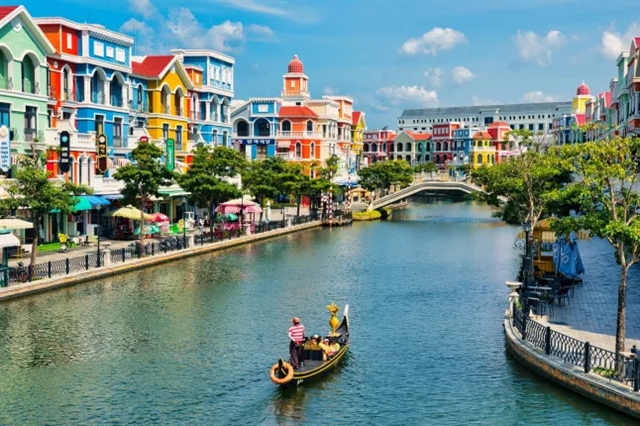 |
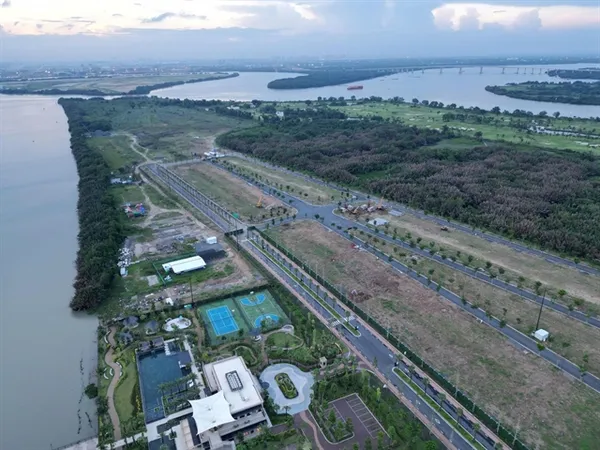
| Ocean Park 2 has taken the Europification of housing developments to new levels. — Photo courtesy of Ocean Park 2 |
AF Reeves - @afreeves23
The algorithm, for all its evils, is often a source of inspiration when it comes to these pieces. One caption: ‘what if Asians romanticised America the way y’all romanticise Asia’, a post by the increasingly popular @misseatinggood. Laid over footage of Costco queues, fast food chains, petrol pumps, and a bloke asleep on the pavement. The joke works because romanticising anywhere means choosing what to leave out of frame.
Despite the malls and the highways, the urban landscape of North America isn’t too prevalent here, thankfully. Though a different kind of borrowing is, and, unlike an easily removable reel, it is being poured in concrete. There is an architectural movement in Việt Nam romanticising a very particular Western moment: borrowed facades, columns and arches and pediments, statuary of no fixed period, piazzas that have never seen a market and, at its most garish, a contrived canal with an attempt at gondolas on it. You know where I’m talking about.
Another talking head, @namtueanhtran, puts it better than I can. She describes these developments as ‘a hollow pastiche of a European town where nobody actually lives’, and calls the process the ‘Disneyfication of space’. She goes after existing eyesores too, commenting on the hodge-podge of styles bolted together into what she labels ‘the McMansion’, and reads it as occidentalism. Copies of copies. Nobody here is attempting Venetian urbanism or the logic of a Georgian terrace. What is going up is an idea of Europe pieced together from films, brochures and wedding photography. It’s an analysis I fight but can’t help but concur with.
I am simply an observer and always will be. Nobody has asked me what Hà Nội should look like, now or ever, and nobody should. But I have been here long enough to care about the answer, and I am not the only foreigner chewing on it over a beer as the roads thin and the dust mounts.
Much of my summer in Europe was spent standing in front of old buildings, appreciating them. British terraces, Greek stone, squares that took centuries to settle into shape and are heavily protected. I compared it to Hội An and the Old Quarter here, and lamented my impending return to the forces of progress.
This is not the lazy argument that outside influence is contamination. The French built here, and the neoclassical villa is woven into this country’s architecture now, absorbed, adapted, made to work in the heat. A century of history. A lion atop a column, or god forbid a gondola, is a corporate mood-board concept to draw in the nouveau riche.
Imagine Japan without its eaves, its timber, its lanterns. Something missing that you could not name but would notice at once. Japan modernised hard and rebuilt in concrete, yet never decided somewhere else looked better. Singapore did, knocking down many of its old shophouses through the sixties and seventies, then spending decades since conserving what survived. The survivors are now among the city’s most coveted addresses.
Aspirational tastes are fickle. Concrete is not. So the question is not whether this is to my liking, but how the Vietnamese of 2060 will look at what went up in 2026. In a world flattening into homogeneity, a city with the confidence to look like itself is worth more, not less. — VNS
Expat Corner
 Expat Corner
 Expat Corner
.jpg) Expat Corner
Expat Corner
 Expat Corner
 Expat Corner
 Expat Corner
 Expat Corner
 Expat Corner
 Expat Corner
 Expat Corner
 Expat Corner
 Expat Corner
 Expat Corner
 Expat Corner